Plot summary
The small, belligerent country of Borogravia is a highly conservative nation, whose people live according to the increasingly strange decrees of its deity, Nuggan. The main feature of his religion is the Abominations; a long, often-updated list of banned things. These things include garlic, cats, the smell of beets, people with ginger hair, shirts with six buttons, anyone shorter than three feet (namely dwarves, children and babies), sneezing, jigsaw puzzles, chocolate (which was once Borogravia's staple export, plunging the country into increasing poverty), crop rotation (which degraded Borogravia's soil and reduced already scarce food supplies), and the colour blue.
Borogravia is in the midst of a war against an alliance of neighbouring countries, caused by a border dispute with the country of Zlobenia. Prince Heinrich of Zlobenia claims to be heir to the Borogravian throne through his aunt, the long-unseen Duchess. Ankh-Morpork has become involved following the destruction of its Clacks (optical telegraph) towers by Borogravia. Borogravia's leadership denies rumours that the war is going poorly for them.
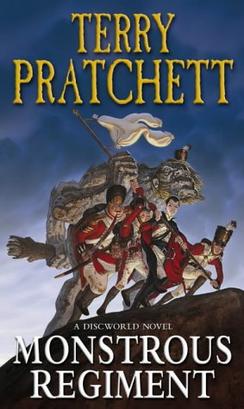
Polly Perks's autistic brother Paul, a gentle young man who loves birds and art, is missing in action after being conscripted. Polly is unable to take over the family business (a tavern known as "The Duchess"), as Nugganitic law does not permit women to own property. If Paul does not return the pub will be lost to their drunken cousin when their father dies. Partly to ensure her own future but mainly to ascertain whether Paul is alive, Polly sets off to join the army in order to find him. Women joining the army are regarded as an Abomination Unto Nuggan, so Polly dresses up as a man and enlists as Private Oliver Perks (taking her name from the folk song "Sweet Polly Oliver").
Polly is recruited into a squad led by the gruff but kind, long-serving Sergeant Jackrum and the repulsive political officer Corporal Strappi. Her fellow recruits include humans "Tonker" Halter, "Shufti" Manickle, "Wazzer" Goom, and "Lofty" Tewt, but due to the shortage of humans, also a vampire named Maladict, a troll named Carborundum, and an Igor named Igor.
That night whilst answering a call of nature, Polly meets an unseen supporter who assures her that although they know that Polly is a girl, they won't give her away. They give her some hints on how to pass as a boy more convincingly. Over the next few days, Polly discovers Lofty is also a girl. Since Lofty and Tonker are always together, Polly assumes that Lofty joined the army to follow her man. Later, she finds out that Shufti is also a girl, and pregnant; she joined the army to find the boy who impregnated her. Gradually, Polly discovers not only that most soldiers in the regiment are female, but also receives confirmation of Borogravia's bleak situation. Most of her country's forces are captured or on the run, and food supplies are limited.
The regiment meets its officer, the inexperienced Lieutenant Blouse, and makes its way toward the border Keep which the Zlobenians and their allies have captured. Thanks to a chance encounter where the regiment subdue and humiliate an elite Zlobenian detachment, including an undercover Prince Heinrich, their exploits become known to the outside world through William de Worde and his newspaper, The Ankh-Morpork Times . Their progress particularly piques the interest of Commander Vimes, who is stationed as a special envoy with the alliance at the Keep. Vimes has his officers keep track of the regiment, occasionally secretly providing aid.
Polly and most of the regiment are able to infiltrate the Keep, disguised as washerwomen. Once inside they release the Borogravian prisoners of war. Borogravia is able to retake much of the Keep, but when Polly admits her regiment are women, their own forces arrest them and bring them in front of a council of senior officers. With the council about to discharge them and force them to return home, Jackrum barges in and intervenes, revealing that more than a third of the military's top officers (including Chief of the General Staff General Froc) are women as well.
In the midst of this revelation, the Duchess, who has become an actual deity by the Borogravians' faith, briefly possesses Wazzer, her most passionate believer. The Duchess urges all of the generals to quit the war and return home to repair their country, ending their obligation to her. It is revealed that Nuggan is now dead, being reduced to a whisper, with the new Abominations (the last being rocks, ears and accordion players) being produced by the collective anxiety of his 'worshippers'.
A truce is successfully negotiated, and military rules are changed so that women are allowed to serve openly. In a private moment with Jackrum, Polly reveals to the Sergeant that she knows he is also a woman and persuades Jackrum to retire and find his grown son William, reuniting with him as his long-lost "father". Maladict admits that her real name is Maladicta, confirming that the entire regiment except Strappi had been women all along.
Shufti finds her baby's father but rejects him after realising he only wanted to marry her for money. The Morporkians release Polly's brother Paul alive and well and they return home to The Duchess tavern, accompanied by Shufti. The other members of the regiment go on to live lives that they would not have been able to consider before their emancipation.
Some time later, despite the peace they had desperately fought for, conflict breaks out again. Polly, having received correspondence from Sgt Jackrum, leaves the tavern to seek new ways to fight a war using the influence she gained. On the way to the front, she reunites with Maladicta, and identifies two new enlistees as girls impersonating boys and takes them under her leadership.