| Myja hyotan | |
|---|---|
| Osezaki, Japan | |
| Scientific classification | |
| Kingdom: | Animalia |
| Phylum: | Mollusca |
| Class: | Gastropoda |
| Subclass: | Heterobranchia |
| Infraclass: | Euthyneura |
| Order: | Nudibranchia |
| Infraorder: | Cladobranchia |
| Family: | Facelinidae |
| Genus: | Myja |
| Species: | M. hyotan |
| Binomial name | |
| Myja hyotan Martynov, Mehrotra, Chavanich, Nakano, Kashio, Lundin, Picton & Korshunova, 2019 [1] | |
Myja hyotan is a species of sea slug, an aeolid nudibranch, a marine gastropod mollusc in the family Facelinidae. [2]
In biology, a species is the basic unit of classification and a taxonomic rank of an organism, as well as a unit of biodiversity. A species is often defined as the largest group of organisms in which any two individuals of the appropriate sexes or mating types can produce fertile offspring, typically by sexual reproduction. Other ways of defining species include their karyotype, DNA sequence, morphology, behaviour or ecological niche. In addition, paleontologists use the concept of the chronospecies since fossil reproduction cannot be examined.
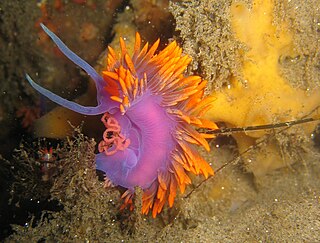
Sea slug is a common name for some marine invertebrates with varying levels of resemblance to terrestrial slugs. Most creatures known as sea slugs are actually gastropods, i.e. they are sea snails that over evolutionary time have either completely lost their shells, or have seemingly lost their shells due to having a greatly reduced or internal shell. The name "sea slug" is most often applied to nudibranchs, as well as to a paraphyletic set of other marine gastropods without obvious shells.
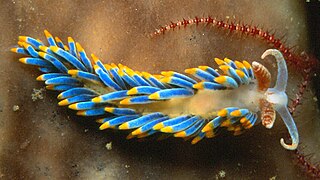
Nudibranchs are a group of soft-bodied, marine gastropod molluscs which shed their shells after their larval stage. They are noted for their often extraordinary colours and striking forms, and they have been given colourful nicknames to match, such as "clown", "marigold", "splendid", "dancer", and "dragon". Currently, about 3,000 valid species of nudibranchs are known.
This species was described from a depth of 7–15 m (23–49 ft) at Osezaki, Japan, 35°01′44″N138°47′23″E / 35.028980°N 138.789830°E . [1]
Japan is an island country in East Asia. Located in the Pacific Ocean, it lies off the eastern coast of the Asian continent and stretches from the Sea of Okhotsk in the north to the East China Sea and the Philippine Sea in the south.
Myja hyotan is a slender nudibranch with unusual elongate cerata which mimic the polyps of its hydroid prey, Pennaria . It is similar to Myja longicornis but differs in the shape of the cerata, which in this species have a long stalk, then a large swelling, a constriction and another swelling tapering to the tip. It grows to 20 mm (0.79 in) in length. [1]
Pennaria is a genus of hydrozoans. It is the only genus within the monotypic family Pennariidae.
Myja longicornis is a species of sea slug, an aeolid nudibranch, a marine gastropod mollusc in the family Tergipedidae. It was thought to be a close relative of Tergipes but molecular phylogeny reveals it to be a paedomorphic facelinid.
Ceras, plural Cerata, are anatomical structures found externally in nudibranch sea slugs, especially in aeolid nudibranchs, marine opisthobranch gastropod mollusks in the clade Aeolidida. The singular of cerata is ceras, which comes from the Greek word "κέρας", meaning "horn", a reference to the shape of these structures.
Aeolidioidea is a superfamily of sea slugs, the aeolid nudibranchs. They are marine gastropod molluscs in the suborder Cladobranchia.
Flabellinidae is a taxonomic family of brightly coloured sea slugs, specifically nudibranchs, marine gastropod mollusks. This family has no subfamilies.
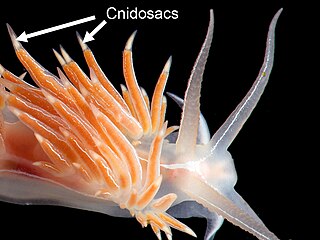
The Aeolidida is a taxonomic clade of sea slugs, specifically aeolid nudibranchs, marine gastropod molluscs in the clade Cladobranchia. They are distinguished from other nudibranchs by their possession of cerata containing cnidosacs.
Cuthonidae is a family of sea slugs, aeolid nudibranchs, marine gastropod molluscs in the superfamily Fionoidea.
Fjordia chriskaugei is a species of sea slug, an aeolid nudibranch, a marine heterobranch mollusc in the family Flabellinidae.
Apataidae is a taxonomic family of brightly coloured sea slugs, specifically nudibranchs, marine gastropod mollusks.
Flabellinopsidae is a taxonomic family of brightly coloured sea slugs, specifically nudibranchs, marine gastropod mollusks.
Samlidae is a taxonomic family of brightly coloured sea slugs, specifically nudibranchs, marine gastropod mollusks.
Paracoryphellidae is a taxonomic family of brightly coloured sea slugs, specifically nudibranchs, marine gastropod mollusks.
Borealea is a genus of sea slugs, specifically aeolid nudibranchs, marine gastropod molluscs in the family Flabellinidae.
Carronella is a genus of sea slugs, aeolid nudibranchs, marine gastropod mollusks in the family Flabellinidae.
Occidenthella is a genus of sea slugs, specifically aeolid nudibranchs, in the family Flabellinidae. The only described species is Occidenthella athadona, a combination named in 2017. It was originally described as Coryphella athadona in 1875. The genus name Occidenthella, from occidens, meaning "west" in Latin, refers to its distribution in the Western Pacific Ocean.
Gulenia is a genus of sea slugs, specifically aeolid nudibranchs, marine gastropod molluscs in the family Flabellinidae.
Gulenia monicae is a species of sea slug, an aeolid nudibranch, a marine heterobranch mollusc in the family Flabellinidae.
Gulenia orjani is a species of sea slug, an aeolid nudibranch, a marine heterobranch mollusc in the family Flabellinidae.
Ziminella is a genus of sea slugs, specifically aeolid nudibranchs, marine gastropod molluscs in the family Paracoryphellidae.
Samla takashigei is a species of sea slug, an aeolid nudibranch, a marine heterobranch mollusc in the family Samlidae.
Myja karin is a species of sea slug, an aeolid nudibranch, a marine gastropod mollusc in the family Facelinidae.