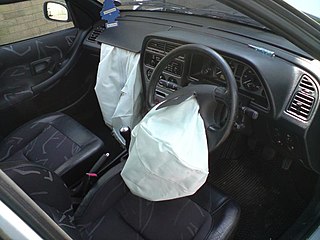
An airbag is a vehicle occupant-restraint system using a bag designed to inflate extremely quickly, then quickly deflate during a collision. It consists of the airbag cushion, a flexible fabric bag, an inflation module, and an impact sensor. The purpose of the airbag is to provide a vehicle occupant with a soft cushioning and restraint during a collision. It can reduce injuries between the flailing occupant and the interior of the vehicle.

Steering is a system of components, linkages, and many other parts that allows a vehicle to follow a desired course. An exception is the case of rail transport, by which rail tracks combined with railroad switches provide the steering function. The primary purpose of the steering system is to allow the driver to guide the vehicle.

Automotive safety is the study and practice of design, construction, equipment and regulation to minimize the occurrence and consequences of traffic collisions involving motor vehicles. Road traffic safety more broadly includes roadway design.
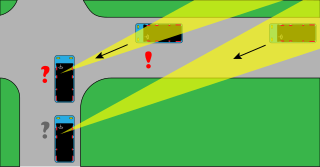
A blind spot in a vehicle is an area around the vehicle that cannot be directly seen by the driver while at the controls, under existing circumstances. In transport, driver visibility is the maximum distance at which the driver of a vehicle can see and identify prominent objects around the vehicle. Visibility is primarily determined by weather conditions and by a vehicle's design. The parts of a vehicle that influence visibility include the windshield, the dashboard and the pillars. Good driver visibility is essential to safe road traffic.
There are many types of car body styles. They vary depending on intended use, market position, location, and the era they were made in.

The Oldsmobile Silhouette is a minivan manufactured by General Motors for model years 1990–2004 over two generations.
In automotive engineering, a mid-engine layout describes the placement of an automobile engine in front of the rear-wheel axles, but behind the front axle.

An advanced driver-assistance system (ADAS) is any of a groups of electronic technologies that assist drivers in driving and parking functions. Through a safe human-machine interface, ADAS increase car and road safety. ADAS use automated technology, such as sensors and cameras, to detect nearby obstacles or driver errors, and respond accordingly. ADAS can enable various levels of autonomous driving, depending on the features installed in the car.
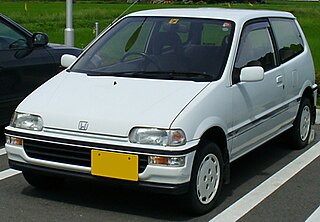
The Honda Today is a kei car produced by the Japanese automaker Honda beginning in 1985. It was replaced by the Honda Life in 1998. Honda's smallest car being produced at the time was the Honda City, which was a supermini and it had an engine larger than kei car legislation allowed. The Today represented a reentry into kei car production. Honda had abandoned kei passenger cars in 1975, choosing only to keep manufacturing the Honda Acty kei truck and the related Honda Street microvan in that segment. After 1975, Honda's smallest car was the Honda Civic, until the introduction of the smaller Honda City in 1981.

The Hyundai Grandeur is a front-wheel drive executive sedan manufactured and marketed by the South Korean manufacturer Hyundai since 1986. From 1986 to 1996, the Grandeur was the flagship for Hyundai's South Korean range before the Hyundai Dynasty was introduced. The Grandeur has evolved through five generations with intermediate restylings, and is marketed under various nameplates worldwide—prominently as the Hyundai Azera. As the Azera, it was the flagship of Hyundai's US and Canadian lineup until the arrival of the Genesis sedan. After the launch of the separate Genesis brand, the Grandeur/Azera resumed its place as the company's flagship.
A glossary of terms relating to automotive design.

A horse-drawn vehicle is a mechanized piece of equipment pulled by one horse or by a team of horses. These vehicles typically had two or four wheels and were used to carry passengers and/or a load. They were once common worldwide, but they have mostly been replaced by automobiles and other forms of self-propelled transport.

The Citroën Type C was a light car made by the French Citroën car company between 1922 and 1926 with almost 81,000 units being made. Known as Citroën 5HP or 5CV in France and 7.5HP in Britain, it was the second model of automobile designed and marketed by André Citroën, between 1922 and 1926. It followed the 10HP "Type A " (1919), then 10HP "B2" (1921); they were the first European mass-produced cars.

The drag coefficient is a common measure in automotive design as it pertains to aerodynamics. Drag is a force that acts parallel to and in the same direction as the airflow. The drag coefficient of an automobile measures the way the automobile passes through the surrounding air. When automobile companies design a new vehicle they take into consideration the automobile drag coefficient in addition to the other performance characteristics. Aerodynamic drag increases with the square of speed; therefore it becomes critically important at higher speeds. Reducing the drag coefficient in an automobile improves the performance of the vehicle as it pertains to speed and fuel efficiency. There are many different ways to reduce the drag of a vehicle. A common way to measure the drag of the vehicle is through the drag area.

The Polaris Slingshot is a three-wheeled motorcycle. The first edition of the model was introduced in 2014 as a 2015 model.

The third-generation Chrysler minivans are a series of passenger minivans that were marketed by the Chrysler Corporation from the 1996 to 2000 model years. Designated the NS platform by Chrysler, these minivans were sold by Chrysler, Dodge and Plymouth divisions in passenger configurations; minivans were exported under the Chrysler brand. While the second-generation AS platform was a revision of the original vans, the NS platform marked the first ground-up redesign of the Chrysler vans since their 1984 introduction, ending the use of components from K-Car derivatives.

The Renault Trezor is a two-seater electric concept car with autonomous capabilities built by Renault which was unveiled at the 2016 Paris Motor Show. The car secured the Festival Automobile International's Most Beautiful Concept car of the Year 2016 award. The car was expected to become a commercial product by 2020.

The NIO EP9 is a Chinese electric-powered, two-seat sports car manufactured by NIO, assisted by their Formula E racing division. The name EP9 stands for Electric Performance 9.

The Volkswagen Bora is a small family car, the fourth generation of the Volkswagen Jetta, and the successor to the Volkswagen Vento. Production of the car began in July 1999. Carrying on the wind nomenclature from previous generations, the car was known as the Volkswagen Bora in much of the world. Bora is a winter wind that blows intermittently over the coast of the Adriatic Sea, as well as in parts of Greece, Russia, Turkey, and the Sliven region of Bulgaria. In North America and South Africa, the Volkswagen Jetta moniker was again kept on due to the continued popularity of the car in those markets.


