
Natick is a town in Middlesex County, Massachusetts, United States. It is near the center of the MetroWest region of Massachusetts, with a population of 37,006 at the 2020 census. 10 miles (16 km) west of Boston, Natick is part of the Greater Boston area. Massachusetts's center of population was in Natick at the censuses of 2000–2020, most recently in the vicinity of Hunters Lane.
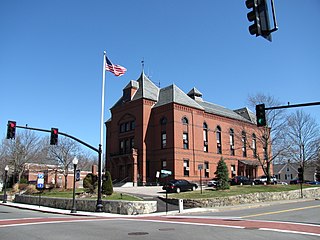
Canton is a town in Norfolk County, Massachusetts, United States. The population was 24,370 at the 2020 census. Canton is part of Greater Boston, about 15 miles southwest of Downtown Boston.

Framingham is a city in the Commonwealth of Massachusetts in the United States. Incorporated in 1700, it's located in Middlesex County and the MetroWest subregion of the Greater Boston metropolitan area. The city proper covers 25 square miles (65 km2) with a population of 72,362 in 2020, making it the 14th most populous municipality in Massachusetts. Residents voted in favor of adopting a charter to transition from a representative town meeting system to a mayor–council government in April 2017, and the municipality transitioned to city status on January 1, 2018. Before it transitioned, it had been the largest town by population in Massachusetts.
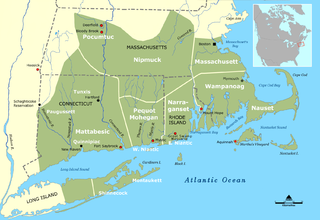
The Massachusett language is an Algonquian language of the Algic language family that was formerly spoken by several peoples of eastern coastal and southeastern Massachusetts. In its revived form, it is spoken in four communities of Wampanoag people. The language is also known as Natick or Wôpanâak (Wampanoag), and historically as Pokanoket, Indian or Nonantum.
The Massachusett were a Native American tribe from the region in and around present-day Greater Boston in the Commonwealth of Massachusetts. The name comes from the Massachusett language term for "At the Great Hill," referring to the Blue Hills overlooking Boston Harbor from the south.
Praying Indian is a 17th-century term referring to Native Americans of New England, New York, Ontario, and Quebec who converted to Christianity either voluntarily or involuntarily. Many groups are referred to by the term, but it is more commonly used for tribes that were organized into villages. The villages were known as praying towns and were established by missionaries such as the Puritan leader John Eliot and Jesuit missionaries who established the St. Regis and Kahnawake and the missions among the Huron in western Ontario.
USS Agawam may refer to the following ships of the United States Navy:
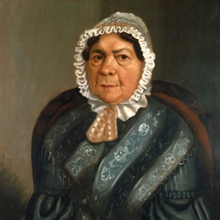
The Nipmuc or Nipmuck people are an Indigenous people of the Northeastern Woodlands, who historically spoke an Eastern Algonquian language. Their historic territory Nippenet, "the freshwater pond place," is in central Massachusetts and nearby parts of Connecticut and Rhode Island.

Praying towns were settlements established by English colonial governments in New England from 1646 to 1675 in an effort to convert local Native Americans to Christianity.

The Natick Mall is a shopping mall in Natick, Massachusetts. The original facility was the first enclosed shopping mall in Greater Boston upon opening in 1966; it was demolished and replaced by a larger building in 1994 and expanded in 2007. The mall, with the adjacent Shopper's World power center in Framingham, are components of the Golden Triangle shopping district in the center of MetroWest, situated between Route 9 and Route 30. With 1,695,884 square feet (157,553 m2) of gross leasable area, it is the largest shopping complex in New England. It is owned and managed by Brookfield Properties, a subsidiary of Brookfield Asset Management.
The Pawtucket tribe were a confederation of Eastern Algonquian-speaking Native Americans in present-day northeastern Massachusetts and southeastern New Hampshire. They are mostly known in the historical record for their dealings with the early English colonists in the 17th century. Confusion exists about the proper endonym for this group who are variously referred to in European documents as Pawtucket, Naumkeag, Wamesit, or Mystic Indians, or by the name of their current sachem or sagamore.
USS Natick may refer to the following ships of the United States Navy:
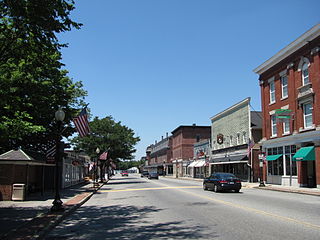
Ayer is a town in Middlesex County, Massachusetts, United States. Originally part of Groton, it was incorporated February 14, 1871, and became a major commercial railroad junction. The town was home to Camp Stevens, a training camp for Massachusetts volunteers during the American Civil War. Later, Fort Devens was established by the federal government to train New England soldiers for World War I. Fort Devens is a major influence on the area, although it is considerably smaller than when it was first closed in the mid-1990s. The town's population was 8,479 at the 2020 census.

Ponkapoag, also Punkapaug, Punkapoag, Ponkhapoag or Punkapog, is the name of a Native American "praying town" settled in the late 17th century western Blue Hills area of eastern Massachusetts by persons who had accepted Christianity. It was established in 1657, during the colonization of the Atlantic seaboard of the United States by settlers from Britain. This was the name given to the winter residence of the group of Massachusett who lived at the mouth of the Neponset River near Dorchester in the summer, in what colonists called Neponset Mill.
The Massachusett dialects, as well as all the Southern New England Algonquian (SNEA) languages, could be dialects of a common SNEA language just as Danish, Swedish and Norwegian are mutually intelligible languages that essentially exist in a dialect continuum and three national standards. With the exception of Massachusett, which was adopted as the lingua franca of Christian Indian proselytes and survives in hundreds of manuscripts written by native speakers as well as several extensive missionary works and translations, most of the other SNEA languages are only known from fragmentary evidence, such as place names. Quinnipiac (Quiripey) is only attested in a rough translation of the Lord's Prayer and a bilingual catechism by the English missionary Abraham Pierson in 1658. Coweset is only attested in a handful of lexical items that bear clear dialectal variation after thorough linguistic review of Roger Williams' A Key into the Language of America and place names, but most of the languages are only known from local place names and passing mention of the Native peoples in local historical documents.

Daniel Takawambait was likely the first ordained Native American Christian pastor in North America, and served the church in the praying town of Natick, Massachusetts from 1683 to 1716. Takawambait also advocated for indigenous land rights in colonial Massachusetts, and authored at least one publication.
The Praying Indians of Natick were a community of Indigenous Christian converts, known as Praying Indians, in the town of Natick, Massachusetts, one of many Praying Towns. They were also known as Natick Indians.
765 or 7.65 or 76.5, may refer to:
