
Low-alcohol beer is beer with little or no alcohol content and aims to reproduce the taste of beer without the inebriating effects of standard alcoholic brews. Most low-alcohol beers are lagers, but there are some low-alcohol ales. Low-alcohol beer is also known as light beer, non-alcoholic beer, small beer, small ale, or near-beer.

Tapioca is a starch extracted from the storage roots of the cassava plant. This species is native to the north region and central-west region of Brazil, but its use spread throughout South America. The plant was carried by Portuguese and Spanish explorers to most of the West Indies and Africa and Asia. It is a perennial shrub adapted to the hot conditions of tropical lowlands. Cassava copes better with poor soils than many other food plants.

Mulled wine, also known as spiced wine, is a beverage usually made with red wine along with various mulling spices and sometimes raisins. It is served hot or warm and is alcoholic, although there are non-alcoholic versions of it. It is a traditional drink during winter, especially around Christmas. It is served at Christmas markets in Europe.

Puerto Rican cuisine has its roots in the cooking traditions and practices of Europe, Africa and the native Taínos. Starting from the latter part of the 19th century. Puerto Rican cuisine can be found in several other countries.
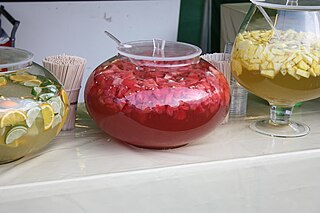
The term punch refers to a wide assortment of drinks, both non-alcoholic and alcoholic, generally containing fruit or fruit juice. The drink was introduced from India to the United Kingdom in the early seventeenth century, and from there its use spread to other countries. Punch is usually served at parties in large, wide bowls, known as punch bowls.
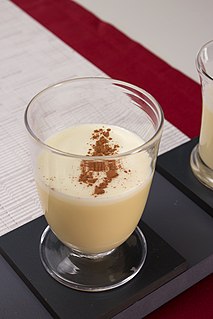
short description|Sweetened dairy-based beverage}}
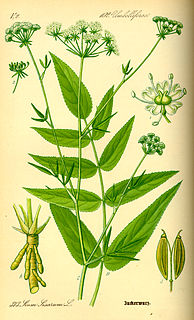
Sium sisarum, commonly known as skirret, is a perennial plant of the family Apiaceae sometimes grown as a root vegetable. The English name skirret is derived from the Middle English 'skirwhit' or 'skirwort', meaning 'white root'. In Scotland it is known as crummock. Its Danish name sukkerrod, Dutch name suikerwortel and German name "Zuckerwurzel" translate as 'sugar root'.

A hot toddy, also known as hot whiskey in Ireland, is typically a mixed drink made of liquor and water with honey, herbs and spices, and served hot. Hot toddy recipes vary and are traditionally drunk before retiring for the night, in wet or cold weather or to relieve the symptoms of the cold and flu. In How to Drink, Victoria Moore describes the drink as "the vitamin C for health, the honey to soothe, the alcohol to numb."
Peruvian cuisine reflects local practices and ingredients including influences from the indigenous population, including the Inca, and cuisines brought in with colonizers and immigrants from Europe, Asia and West Africa. Without the familiar ingredients from their home countries, immigrants modified their traditional cuisines by using ingredients available in Peru.

Sikhye is a traditional sweet Korean rice beverage, usually served as a dessert. In addition to its liquid ingredients, Sikhye contains grains of cooked rice and in some cases pine nuts.
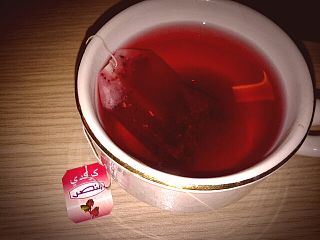
Hibiscus tea is a herbal tea made as an infusion from crimson or deep magenta-colored calyces (sepals) of the roselle flower. It is consumed both hot and cold. It has a tart, cranberry-like flavor.

A flaming drink is a cocktail or other mixed drink that contains flammable, high-proof alcohol, which is ignited prior to consumption. The alcohol may be an integral part of the drink, or it may be floated as a thin layer across the top of the drink. The flames are mostly for dramatic flair. However, in combination with certain ingredients, the flavor of the drink is altered. Some flavors are enhanced, and it may impart a toasted flavor to some drinks.
Drink mixers are the non-alcoholic ingredients in mixed drinks and cocktails. There are many reasons mixers are used. They change or enhance flavors or add new ones to a drink. Mixers dilute the drink, lowering the alcohol by volume in the drink. They may make the drink sweeter, more sour, or more savory. Some mixers change the texture or consistency of the drink, making it thicker or more watery. Drink mixers may also be used strictly for decorative purposes by changing the color or appearance of the drink. They also simply increase the volume of a drink, to make it last longer.

Chilean gastronomy stems mainly from the combination of traditional Spanish cuisine, Chilean Indigenous Mapuche culture and local ingredients, with later important influences from other European cuisines, particularly from Germany, Italy and France. The food tradition and recipes in Chile are notable for the variety of flavours and ingredients, with the country's diverse geography and climate hosting a wide range of agricultural produce, fruits and vegetables. The long coastline and the peoples' relationship with the Pacific Ocean add an immense array of seafood products to Chilean cuisine, with the country's waters home to unique species of fish, molluscs, crustaceans and algae, thanks to the oxygen-rich water carried in by the Humboldt Current. Chile is also one of the world's largest producers of wine and many Chilean recipes are enhanced and accompanied by local wines.

Ginger tea is an Asian herbal beverage that is made from ginger root. It has a long history as a traditional herbal medicine in East Asia, Indian subcontinent, Southeast Asia and the Middle East.

Smoking Bishop is a type of mulled wine, punch or wassail. It was especially popular in Victorian England at Christmas time and it appears in Dickens' story A Christmas Carol.
“A Merry Christmas, Bob!” said Scrooge with an earnestness that could not be mistaken, as he clapped him on the back. “A merrier Christmas, Bob, my good fellow, than I have given you for many a year! I’ll raise your salary, and endeavour to assist your struggling family, and we will discuss your affairs this very afternoon over a bowl of smoking bishop, Bob!”
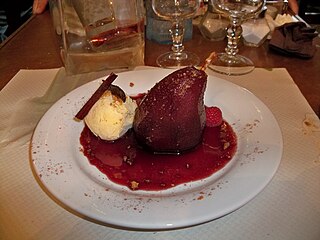
The Poire à la Beaujolaise or pear in wine is a traditional dessert of the wine-growing region of Beaujolais, and belonging to the cuisine of Burgundy and Lyon.

Mead is an alcoholic beverage that has been part of Polish culinary tradition for over a thousand years. It is made by alcoholic fermentation of a mixture of honey and water. It has a characteristic honey aroma and a flavour that may be enriched by the addition of fruit juices, herbs or spices. The colour ranges from golden to dark amber, depending on the type of honey used for production.

