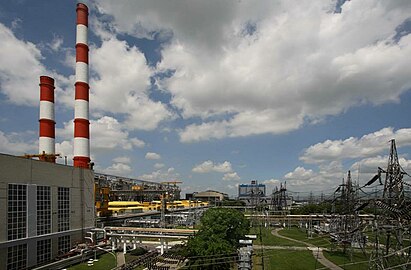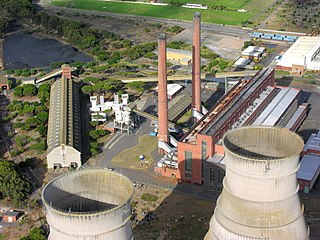
A power station, also referred to as a power plant and sometimes generating station or generating plant, is an industrial facility for the generation of electric power. Power stations are generally connected to an electrical grid.

A combined cycle power plant is an assembly of heat engines that work in tandem from the same source of heat, converting it into mechanical energy. On land, when used to make electricity the most common type is called a combined cycle gas turbine (CCGT) plant. The same principle is also used for marine propulsion, where it is called a combined gas and steam (COGAS) plant. Combining two or more thermodynamic cycles improves overall efficiency, which reduces fuel costs.
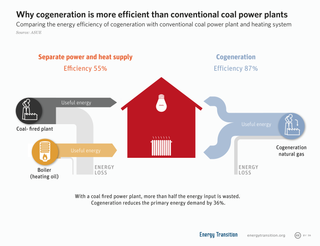
Cogeneration or combined heat and power (CHP) is the use of a heat engine or power station to generate electricity and useful heat at the same time.

A thermal power station is a type of power station in which heat energy is converted to electrical energy. In a steam-generating cycle heat is used to boil water in a large pressure vessel to produce high-pressure steam, which drives a steam turbine connected to an electrical generator. The low-pressure exhaust from the turbine enters a steam condenser where it is cooled to produce hot condensate which is recycled to the heating process to generate more high pressure steam. This is known as a Rankine cycle.

Konakovo Power Station is a thermal power plant located alongside the Ivankovo Reservoir in Konakovo Tver Oblast, Russia. It is a subsidiary of Enel Russia and one of the largest energy producers in Central Russia.

Peterhead Power Station is a multi-unit station owned and operated by SSE plc, with a capacity of 2,177 MW. It is located near Boddam and the A90, just south of Peterhead, in Aberdeenshire, in the northeast of Scotland. It stands next to Sandford Lodge, a circa-1800-built structure. Initially operating as an oil-fired power station and later transitioning to fossil gas, the plant has also served as a site for experimental hydrogen generation capacity.

Grain Power Station is a 1,275 megawatts (1,710,000 hp) operational CCGT power station in Kent, England, owned by Uniper. It was also the name of an oil-fired, now demolished, 1,320MW power station in operation from 1979 to 2012.

Peterborough Power Station is a 360MW gas-fired power station at Eastern Industry, Fengate in the city of Peterborough, Cambridgeshire in the United Kingdom. It employs around forty people.

Little Barford Power Station is a gas-fired power station just north of the village of Little Barford in Bedfordshire, England. It lies just south of the A428 St Neots bypass and east of the Wyboston Leisure Park. The River Great Ouse runs alongside. It was formerly the site of two coal-fired power stations, now demolished. The station is operated by RWE.

Shoreham Power Station is a 420MWe combined cycle gas-fired power station in Southwick, West Sussex. It was built on the site of the Brighton B Power Station.

Enel Russia is a Russian power generation company created by the reorganization of RAO UES, a former united power company of Russia. The company is registered in Yekaterinburg and its headquarters are in Moscow. The Italian Enel Group owns a majority stake of the company (56%).

The Wilton power station refers to a series of coal, oil, gas and biomass fired CHP power stations which provide electricity and heat for the Wilton International Complex, with excess electricity being sold to the National Grid. It is located on the Wilton site in Redcar and Cleveland, south of the town of Middlesbrough in North East England. The station has provided for the site since opening in 1952, when it was operated by ICI. The station is currently owned and operated by SembCorp Industries.
Nooter Eriksen, also known as Nooter/Eriksen or N/E, is a supplier of heat recovery steam generators, which are mostly found in combined cycle gas turbine power stations (CCGTs). These are also found in combined heat and power (CHP) systems, which tend to have a much smaller power output than CCGT stations. Nooter Eriksen is a subsidiary of CIC Group, also owning Nooter Construction, the Wyatt Group.

Neyveli Thermal Power Station is a set of power plant situated near lignite mines of Neyveli. It consists of three distinct units capable of producing 420 MW, 1,970 MW and 1000 MW respectively including their expansion units. It is operated by NLC. The total installed capacity of this station is 3390 MW as of April 2021.
Butibori Power Project is a coal-based thermal power plant located at Butibori near Nagpur in the Indian state of Maharashtra. The power plant is operated by the Reliance Power.

Reftinskaya GRES is the largest solid fuel thermal power plant in Russia. It is situated in Sverdlovsk Oblast, 100 km north-east of Yekaterinburg and 18 km from Asbest. Reftinskiy town, which is home to 18,000 people, is situated 2.5 km from the GRES, which produces 20,000 million KWh annually. It has a total installed capacity of 3,800 and heat power 350 GKh. Coal from Ekibastuz's coal field is used as the main fuel and the black oil is used as the starting fuel. GRES produces power with the bar «Outdoor switchgear -500 kV» on five power lines -500 kV and with the bar «Outdoor switchgear -220 kV» on five power lines -220 kV. The station supplies power to the industrial areas in Sverdlovsk, Tyumen, Perm and Chelyabinsk regions. The construction of the electric power station was started in 1963, the launching of the first power unit took place in 1970 and the last one in 1980.
Yerevan Thermal Power Plant, is a thermal power plant located about 10 kilometres (6.2 mi) from Yerevan, Armenia. An older, obsolete plant was fueled by natural gas and fuel oil, while the new combined-cycle plant is powered by natural gas and has a capacity of 242 megawatts. It produces a quarter of the country's electricity and is responsible for seasonal electricity swaps with Iran. The director general of the power plant is Hovakim Hovhannisyan.

Sredneuralskaya GRES is a power plant in Sredneuralsk, Sverdlovsk Oblast, Russia. It is a subsidiary of Enel Russia.
Blackburn power stations are a series of electricity generating stations that have provided electric power to the town of Blackburn and the wider area from 1895 to the present. The first station in Jubilee Street, Blackburn began operating in 1895. A new larger station known as Blackburn East or Whitebirk power station was commissioned in 1921 and was rebuilt in stages over the period 1942 to 1955. Whitebirk station closed in 1976. The 60 MW Blackburn Mill Combined Cycle Gas Turbine (CCGT) power station has generated electricity since 2002. The Blackburn energy from waste (EfW) plant is currently (2020) being planned.
The Thornhill power station generated and supplied electricity to the town of Dewsbury and the wider regional area from 1902 to 1982, and again from 1998. The first generating station on the site was owned and operated by the Yorkshire Electric Power Company. Following nationalisation of the British electricity supply industry in 1948 Thornhill power station was operated by a succession of state owned bodies. The power station was redeveloped with new plant in 1915, 1925, 1932–37 and 1950–54. The coal-fired steam station was decommissioned in 1982, and was subsequently demolished. A gas turbine power station on the site was commissioned in 1998.