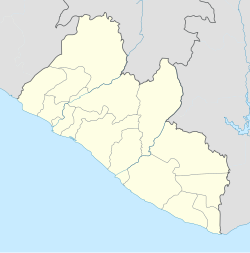
New Kru Town is a northwestern coastal suburb of Monrovia, located on the north end of Bushrod Island near the mouth of the Saint Paul River where it meets the Atlantic Ocean. It is the only borough in Liberia.[4]
The town grew as a planned "transplant" town of Old Kru Town after World War II when "Old Kru Town was evacuated for the development of a new breakwater for the new port with assistance from the Liberian government".[5] Being located where the Saint Paul River estuary meets the Atlantic Ocean, sea-fishing is an important source of income.[6]
A slum area, it has been subject to ethnic tensions.[7]Squatted houses are built in precarious zones and in 2013, 200 homes were washed away by a high tide.[8] In 2019 President George Weah appointed Tarpeh D. Carter as governor of New Kru Town, replacing Alice Weah.[9] New Kru Town constitutes the Montserrado-16 electoral district.[3] As of 2025, the governor is Robert B. Teah, who has overseen local security and community-policing initiatives in the borough.[10]
Landmarks
An "imposing" church was built in New Kru Town in about 1975 by American missionaries.[11] It also contains the Redemption Hospital and the multi-million dollar D. Tweh Memorial High School, "originally named in honor of Tolbert before the 1980 coup".[12] An avenue, Botoe Avenue, is named after Thomas Nimene Botoe.
In 2021, President George Weah launched a coastal defense and community resilience project in New Kru Town aimed at mitigating coastal erosion, flooding, and climate-related risks affecting residents. The initiative, supported by the United Nations Development Programme (UNDP), included shoreline protection measures, drainage improvements, and livelihood support for vulnerable households in the borough.[14]
United Nations officials have identified coastal communities such as New Kru Town as being among the most exposed to rising sea levels and extreme weather events in Liberia, underscoring the need for long-term urban planning and climate adaptation strategies.[15]
2022 church stampede
On January 19, 2022, a deadly stampede occurred during a religious revival service at a school soccer field in New Kru Town, killing at least 29 people, including 11 children. The incident happened as worshippers attempted to leave the event after reports that armed individuals were robbing attendees nearby, triggering panic and a rush toward a narrow exit gate.[16]
Liberian authorities launched an investigation into the incident, and President George Weah declared three days of national mourning following the tragedy. The event drew international attention to public safety concerns, youth unemployment, and the presence of criminal gangs in densely populated urban communities.[17]
Public safety and crime prevention
New Kru Town has experienced periodic increases in crime, prompting enhanced community-based security efforts. In 2025, the borough’s local administration partnered with Crime Watch Liberia and the Liberia National Police to strengthen night patrols and improve coordination between residents and law enforcement. The initiative was aimed at addressing armed robberies, drug-related activity, and nighttime break-ins, particularly in areas near Duala Market and surrounding neighborhoods.[18]
Community leaders and police officials have emphasized the role of volunteer patrols and community-police partnerships in improving public safety amid logistical and staffing constraints faced by national law enforcement agencies.[19]
↑United States. Foreign Broadcast Information Service (1982). Sub-Saharan Africa report. Foreign Broadcast Information Service. pp.59–60. Retrieved 28 April 2012.
This page is based on this Wikipedia article Text is available under the CC BY-SA 4.0 license; additional terms may apply. Images, videos and audio are available under their respective licenses.

 Liberia
