Related Research Articles

Utqiagvik, formerly known as Barrow, is the borough seat and largest city of the North Slope Borough in the U.S. state of Alaska. Located north of the Arctic Circle, it is one of the northernmost cities and towns in the world and the northernmost in the United States, with nearby Point Barrow which is the country's northernmost land.
The Thule or proto-Inuit were the ancestors of all modern Inuit. They developed in coastal Alaska by the year 1000 and expanded eastward across northern Canada, reaching Greenland by the 13th century. In the process, they replaced people of the earlier Dorset culture that had previously inhabited the region. The appellation "Thule" originates from the location of Thule in northwest Greenland, facing Canada, where the archaeological remains of the people were first found at Comer's Midden. The links between the Thule and the Inuit are biological, cultural, and linguistic.
The Paleo-Eskimo were the peoples who inhabited the Arctic region from Chukotka in present-day Russia across North America to Greenland prior to the arrival of the modern Inuit (Eskimo) and related cultures. The first known Paleo-Eskimo cultures developed by 2500 BCE, but were gradually displaced in most of the region, with the last one, the Dorset culture, disappearing around 1500 CE.

Vilhjalmur Stefansson was an Arctic explorer and ethnologist. He was born in Manitoba, Canada.
Point Barrow or Nuvuk is a headland on the Arctic coast in the U.S. state of Alaska, 9 miles (14 km) northeast of Utqiagvik. It is the northernmost point of all the territory of the United States, at 71°23′20″N156°28′45″W, 1,122 nautical miles south of the North Pole.

The Birnirk culture was a prehistoric Inuit culture of the north coast of Alaska, dating from the sixth century A.D. to the twelfth century A.D. The Birnirk culture first appeared on the American side of the Bering Strait, descending from the Old Bering Sea/Okvik culture and preceding the Thule culture; it is distinguished by its advanced harpoon and marine technology. A burial mound of the Birnirk culture was discovered in the town of Wales; 16 more have been found in Utqiagvik at the "Birnirk site," which is now a National Historic Landmark. An ancient Birnirk village has been found at present-day Ukpiaġvik.
The Big Eddy Site (23CE426) is an archaeological site located in Cedar County, Missouri, which was first excavated in 1997 and is now threatened due to erosion by the Sac River.
Point Franklin is a piece of land located on the Chukchi Sea side of North Slope, Alaska.
The Birnirk site is an archaeological site near Utqiagvik, Alaska. It includes sixteen prehistoric mounds which have yielded evidence of very early Birnirk and Thule culture. It is the type site of the Birnirk culture, and was designated a National Historic Landmark in 1962 for its archaeological importance in understanding prehistoric Arctic cultures.

Inuit are a group of culturally similar Indigenous peoples inhabiting the Arctic and subarctic regions of Greenland, Labrador, Quebec, Nunavut, the Northwest Territories, and Alaska. Inuit languages are part of the Eskimo–Aleut languages, also known as Inuit-Yupik-Unangan, and also as Eskaleut. Inuit Sign Language is a critically endangered language isolate used in Nunavut.
Comer's Midden was a 1916 archaeological excavation site near Thule, north of Mt. Dundas in North Star Bay in northern Greenland. It is the find after which the Thule culture was named. The site was first excavated in 1916 by whaling Captain George Comer, ice master of the Crocker Land Expedition's relief team, and of members of Knud Rasmussen's Second Danish Thule Expedition who were in the area charting the North Greenland coast.

The Wales Site, whose principal component is the Kurigitavik mound, is a well-documented archeological site on the Cape Prince of Wales, near Wales, Alaska. This site has artifacts from the Birnirk culture as well as the first discovery in Alaska of the later Thule culture. The site was designated a National Historic Landmark in 1962 for its archaeological significance.

Copper Inuit, also known as Inuinnait and Kitlinermiut, are a Canadian Inuit group who live north of the tree line, in what is now the Kitikmeot Region of Nunavut and in the Inuvialuit Settlement Region in the Inuvik Region of the Northwest Territories. Most of them historically lived in the area around Coronation Gulf, on Victoria Island, and southern Banks Island.

Capt. George Baker Leavitt Sr. was a Maine-born mariner who captained several whaling vessels out of New Bedford, Massachusetts. The steam whalers captained by Leavitt were active in the whaling fishery off the Alaska North Slope, where Leavitt met and married an Inupiaq woman. The mariner befriended many early Arctic explorers, whom he replenished with supplies and provided transportation to, as well as assisted in Arctic exploration. Leavitt Island in the Beaufort Sea's Harrison Bay is named for the early New England whaling captain.

HMS Blossom was an 18-gun Cormorant-class sloop-of-war. She was built in 1806 and is best known for the 1825–1828 expedition under Captain Beechey to the Pacific Ocean. She explored as far north as Point Barrow, Alaska, the furthest point into the Arctic any non-Inuit had been at the time. She was finally broken up in 1848.
Froelich Gladstone Rainey was an American anthropologist and Director of the University of Pennsylvania Museum of Anthropology and Archaeology from 1947 to 1977. Under his leadership, the Penn Museum announced the Pennsylvania Declaration, ending the purchase system of acquiring antiquities and artifacts that had, in practice, encouraged looting from historical sites.
James Louis Giddings Jr. was an American archaeologist who made significant contributions to Arctic archaeology. During three decades of his fieldwork in Northwest Alaska he established evidence of human occupation ranging as far back as 4,000 B.C.E.
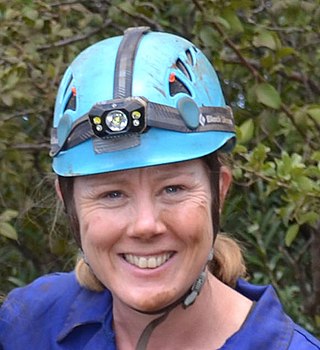
Marina Elliott is a Canadian biological anthropologist, who is known for being one of the six Underground Astronauts of the Rising Star Expedition.
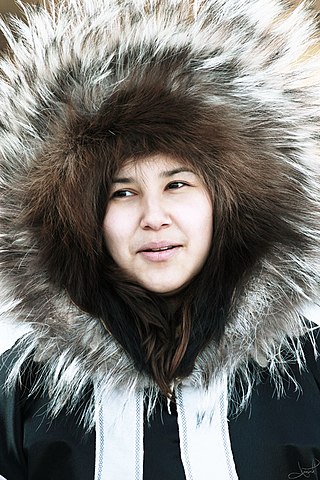
There is a long historical tradition of research on Inuit clothing across many fields. Since Europeans first made contact with the Inuit in the 16th century, documentation and research on Inuit clothing has included artistic depictions, academic writing, studies of effectiveness, and museum collections. Historically, European images of Inuit were sourced from the clothing worn by Inuit who travelled to Europe, clothing brought to museums by explorers, and from written accounts of travels to the Arctic.
References
- Beechey, Frederick William (1831). Narrative of a voyage to the Pacific and Beering's Strait, to co-operate with the polar expeditions performed in His Majesty's ship Blossom, under the command of Captain F.W. Beechey, R. N., F.R.S. &c. in the years 1825, 26, 27, 28. H. Colburn and R. Bentley. ISBN 0-665-47596-9. OCLC 1111847805.
- Bockstoce, John (2011). The Journal of Rochfort Maguire, 1852-1854 : Two Years at Point Barrow, Alaska, aboard HMS Plover in Search for Sir John Franklin, Volume II. Ashgate. ISBN 978-1-283-24750-4. OCLC 824104417.
- Murdoch, John (September 17, 2017). Ethnological Results of the Point Barrow Expedition. ISBN 978-3-337-32154-3. OCLC 1129760429.
- Ford, James A. (1959). Eskimo prehistory in the vicinity of Point Barrow, Alaska. Anthropological papers of the AMNH ; v. 47, pt. 1. New York. OCLC 705133484.
- Stefansson, Vilhjalmur (1978). Stefánsson-Anderson Arctic expedition of the American Museum : preliminary ethnological report. AMS Press. ISBN 0-404-11688-4. OCLC 319422626.
- Wissler, Clark (1916). "Harpoons and Darts in the Stefansson Collection". Anthropological Papers of the American Museum of Natural History. 14 (2).
- Jensen, Anne M. (January 2009). Nuvuk Point Barrow, Alaska : the Thule cemetery and Ipiutak occupation. OCLC 805946847.
- Krus, Anthony M; Jensen, Anne M; Hamilton, W Derek; Sayle, Kerry (April 23, 2019). "A Context-Appropriate Approach to Marine 14C Calibration: Δr and Bayesian Framework for the Nuvuk Cemetery, Point Barrow, Alaska" (PDF). Radiocarbon. 61 (3). doi:10.1017/rdc.2019.20. ISSN 0033-8222. S2CID 146297693.
- Tackney, Justin; Jensen, Anne M.; Kisielinski, Caroline; O'Rourke, Dennis H. (January 9, 2019). "Molecular analysis of an ancient Thule population at Nuvuk, Point Barrow, Alaska". American Journal of Physical Anthropology. 168 (2). doi: 10.1002/ajpa.23746 . ISSN 0002-9483. PMID 30628076.
- Raff, Jennifer A.; Rzhetskaya, Margarita; Tackney, Justin; Hayes, M. Geoffrey (April 17, 2015). "Mitochondrial diversity of Iñupiat people from the Alaskan North Slope provides evidence for the origins of the Paleo- and Neo-Eskimo peoples". American Journal of Physical Anthropology. 157 (4). doi:10.1002/ajpa.22750. ISSN 0002-9483. PMID 25884279.
- Raghavan, Maanasa; DeGiorgio, Michael; Albrechtsen, Anders; et al. (August 29, 2014). "The genetic prehistory of the New World Arctic". Science . 345 (6200). doi: 10.1126/science.1255832 . PMID 25170159. S2CID 353853.