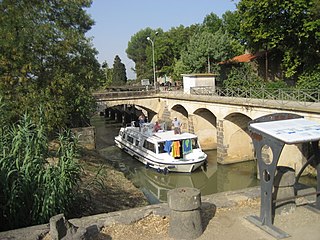
Canals or artificial waterways are waterways or engineered channels built for drainage management or for conveyancing water transport vehicles. They carry free, calm surface flow under atmospheric pressure, and can be thought of as artificial rivers.

The Canal du Midi is a 240 km (150 mi) long canal in Southern France. Originally named the Canal Royal en Languedoc and renamed by French revolutionaries to Canal du Midi in 1789, the canal is considered one of the greatest construction works of the 17th century.

The Briare Canal is one of the oldest canals in France. Its construction started in 1604. It was the first summit level canal in Europe that was built using pound locks, connecting the Rhone-Saône and Seine valleys. It is 57 kilometres long and is part of the Bourbonnais route from Saint-Mammès on the Seine to Chalon-sur-Saône on the Saône.

Navigable aqueducts are bridge structures that carry navigable waterway canals over other rivers, valleys, railways or roads. They are primarily distinguished by their size, carrying a larger cross-section of water than most water-supply aqueducts. Roman aqueducts were used to transport water and were created in Ancient Rome. The 662-metre (2,172 ft) long steel Briare aqueduct carrying the Canal latéral à la Loire over the River Loire was built in 1896. It was ranked as the longest navigable aqueduct in the world for more than a century, until the Magdeburg Water Bridge in Germany took the title in the early 21st century.

The Canal de Garonne, formerly known as Canal latéral à la Garonne, is a French canal dating from the mid-19th century that connects Toulouse to Castets-en-Dorthe. The remainder of the route to Bordeaux uses the river Garonne. It is the continuation of the Canal du Midi which connects the Mediterranean with Toulouse.

A summit-level canal is an artificial waterway connecting two separate river valleys. The term refers to a canal that rises to cross a summit then falls down the other side. The summit pound is a level stretch of water at the highest part of the canal, contained by two locks that prevent the water from flowing downstream in both directions. Since water flows out when locks open to admit boats, the summit pound must have a water supply.

The Canal latéral à la Loire was constructed between 1827 and 1838 to connect the Canal de Briare at Briare and the Canal du Centre at Digoin, a distance of 196 kilometres (122 mi). It replaced the use of the river Loire, which was unreliable during winter floods and summer droughts. Aqueducts were used to cross the Allier at Le Guétin and the Loire at Digoin. However, because of the extreme length required, an aqueduct was not built to cross the Loire at Briare until 1896, when the Briare aqueduct was constructed.

There are 91 working locks on the Canal du Midi along its 240-kilometre (150 mi) course from the Bassin du Thau on the Mediterranean coast to the junction with the Canal lateral a la Garonne in Toulouse. There are a further 13 locks on the 37-kilometre (23 mi) La Nouvelle branch which runs through Narbonne to the Mediterranean at Port-la-Nouvelle. The locks are all under the management of the French navigation authority, Voies navigables de France.

Ognon Lock is a double chamber lock on the Canal du Midi in the Aude region of Languedoc, France. The adjacent locks are Pechlaurier Lock 2726 metres to the east and Homps Lock 689 metres to the west.
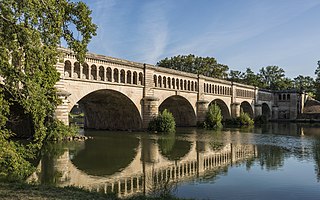
The Orb Aqueduct is a bridge which carries the Canal du Midi over the Orb in the city of Béziers in Languedoc, France. The aqueduct is 28 metres (92 ft) wide, 12 metres (39 ft) tall and at 240 metres (790 ft) is the longest on the Canal du Midi.

Cesse Aqueduct is one of several aqueducts, or water bridge, created for the Canal du Midi. Originally, the canal crossed the Cesse on the level. Pierre-Paul Riquet, the original architect of the canal, had placed a curved dam 205 metres (673 ft) long and 9.10 metres (29.9 ft) high across the Cesse in order to collect water to make the crossing possible; the aqueduct replaced this dam.
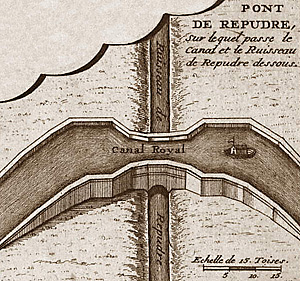
The Répudre Aqueduct is the first aqueduct built on the Canal du Midi. Pierre-Paul Riquet designed it to cross the Répudre River. It was built by Emmanuel d'Estan. It was designed in 1675 and completed in 1676, but was severely damaged that winter and had to be rebuilt. It is one of three original aqueducts created by Pierre-Paul Riquet during the building of the canal from 1667 to 1681.
The Hers Aqueduct is one of several aqueducts, or water bridges, created for the Canal du Midi. It crosses the river Hers-Mort near the village of Renneville, south of Villefranche-de-Lauragais. The structure was first built in 1688–1690, but the present structure is the result of modifications by Jean-Polycarpe Maguès in 1806, chief engineer on the Canal du Midi. It has been listed since 1998 as a monument historique by the French Ministry of Culture.
The Orbiel Aqueduct is one of several aqueducts on the Canal du Midi. Until its building, the canal crossed the River Orbiel on the level. A dam on the Orbiel was demolished and replaced with the Aqueduct. It was built in 1686-87 by Antoine Niquet and designed by Marshal Sebastien Vauban, It is found in the city of Trèbes.
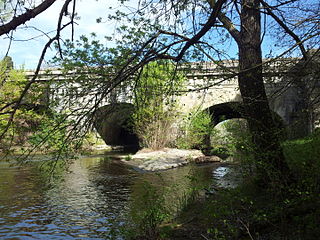
The Fresquel Aqueduct is one of several aqueducts on the Canal du Midi. Until its building, the canal crossed the River Fresquel on the level. Built in 1802–1810, the structure is near Carcassonne. It was built when the canal was rerouted to pass through Carcassonne.
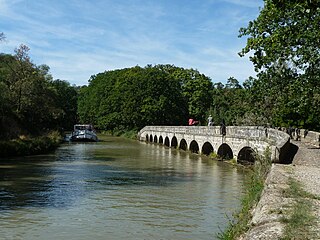
The Argent-Double Aqueduct is one of several aqueducts on the Canal du Midi. The Argent-Double stream is culverted under the canal at La Redorte.
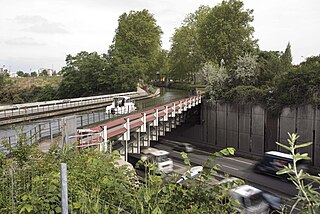
The Herbettes Aqueduct is one of several aqueducts on the Canal du Midi. In Toulouse France, it carries the canal over a four-lane highway in a metal trough. The trough has been colorfully painted underneath. The aqueduct is about 2 km (1.2 mi) from the Port Saint-Sauveur.

Aqueducts on the Canal du Midi allow the canal to intersect and cross over natural streams. There are two exceptions, the first is the Herbettes Aqueduct where it crosses a four-lane highway in Toulouse. Another exception is where it intersections with the Libron river and the crossing is accomplished via the Ouvrages du Libron.
The balancing of incoming and outgoing water allows the Canal du Midi to operate as it does. Each time a lock operates, large quantities of water are either required to fill it or dump from it into the lower level pound. There must be a constant source of water in order to fill and the excess water dumped must have a place to exit the canal without it overflowing. Being able to provide this water source was one of the most important problems to be solved by Pierre Paul Riquet, its creator.