Open evangelical

Last updated

An open evangelical attempts to uphold evangelical doctrines, morality, and spirituality, while also being inclusive of others. It is a term which is commonly used in the United Kingdom in reference to both individuals and institutions. [1]

Evangelicalism, evangelical Christianity, or evangelical Protestantism, is a worldwide, trans-denominational movement within Protestant Christianity which maintains the belief that the essence of the Gospel consists of the doctrine of salvation by grace through faith in Jesus's atonement. Evangelicals believe in the centrality of the conversion or "born again" experience in receiving salvation, in the authority of the Bible as God's revelation to humanity, and in spreading the Christian message. The movement has had a long presence in the Anglosphere before spreading further afield in the 19th, 20th and early 21st centuries.

Contents

Uses

Open evangelicals describe their position as combining a traditional evangelical emphasis on the nature of scriptural authority, the teaching of the ecumenical creeds and other traditional doctrinal teachings, with an approach towards culture and other theological points of view which tends to be more inclusive than that taken by other evangelicals. In the Church of England, Graham Kings contrasts open evangelicals from "conservative evangelicals" and "charismatic evangelicals." [1] Another Anglican, Martin Percy, contends that such a position is quite tenuous and, on divisive issues, either stands firm to a form of uncritical conservatism or risks being attacked as theological liberalism. [2]

Bible Collection of religious texts in Judaism and Christianity

The Bible is a collection of sacred texts or scriptures. Varying parts of the Bible are considered to be a product of divine inspiration and a record of the relationship between God and humans by Christians, Jews, Samaritans, and Rastafarians.

Authority is the right to exercise power, which can be formalized by a state and exercised by way of judges, appointed executives of government, or the ecclesiastical or priestly appointed representatives of a God or other deities. Authority, in the sense of "authorization", can also mean the right to complete an action or execute an order.

Ecumenical creeds umbrella term used in the Western Church to refer to the Nicene Creed, the Apostles Creed and, less commonly, the Athanasian Creed

Ecumenical creeds is an umbrella term used in Lutheran tradition to refer to three creeds: the Nicene Creed, the Apostles' Creed and the Athanasian Creed. These creeds are also known as the catholic or universal creeds.

The think tank Fulcrum and the periodical Anvil were established as fora for open evangelicals within the Church of England. [3] Prominent advocates of the open evangelical position include N.T. Wright, Graham Kings, Steven Croft, and Justin Welby. Among Anglican theological colleges, open evangelicalism is particularly strong within Ridley Hall, Cambridge, [4] Cranmer Hall, Durham, and Wycliffe Hall, Oxford. Prominent open evangelical churches include St Mary's Church, Islington (Diocese of London) [5] and St Nicholas' Church, Durham.

Fulcrum is an evangelical Anglican think tank representing the evangelical centre of the Church of England. Formed in 2002, Fulcrum aims to renew the moderate centre of the evangelical tradition in the Church of England. Fulcrum is normally viewed as representative of the open evangelical tradition within the Church of England.

Graham Kings Mission Theologian in the Anglican Communion; Bishop of Sherborne; British Anglican bishop

Graham Kings is a British Church of England bishop. On 17 September 2017 he was installed as priest-in-charge of St Matthew's at the Elephant, London. From 15 July 2015, he was the Mission Theologian in the Anglican Communion. He was previously consecrated as the Anglican Bishop of Sherborne on 24 June 2009 at a service in Westminster Abbey; he had been the final area bishop under the 1981–2009 area scheme.

Steven Croft (bishop) Bishop of Oxford; Bishop of Sheffield; British Anglican bishop and mission theologian

Steven John Lindsey Croft is a Church of England bishop and theologian specialising in mission. He is the Bishop of Oxford since the confirmation of his election on 6 July 2016. He was the Bishop of Sheffield from 2008 until 2016; previously he was Archbishops’ Missioner and Team Leader of Fresh Expressions, a joint Church of England and Methodist initiative. He falls within the open evangelical tradition of Anglicanism.

See also

Ecumenism Cooperation between Christian denominations

The term "ecumenism" refers to efforts by Christians of different Church traditions to develop closer relationships and better understandings. The term is also often used to refer to efforts towards the visible and organic unity of different Christian denominations in some form.

Inclusivism, one of several approaches to understanding the relationship between religions, asserts that while one set of beliefs is absolutely true, other sets of beliefs are at least partially true. It stands in contrast to exclusivism, which asserts that only one way is true and all others are in error. It is a particular form of religious pluralism, though that term may also assert that all beliefs are equally valid within a believer's particular context.

Paleo-orthodoxy is a Protestant Christian theological movement in the United States which emerged in the late 20th and early 21st centuries and which focuses on the consensual understanding of the faith among the Ecumenical councils and Church Fathers. While it understands this consensus of the church fathers as Orthodoxy proper, it calls itself paleo-orthodoxy to distinguish itself from neo-orthodoxy, a movement that was influential among Protestant churches in the mid-20th century.

Related Research Articles

Wycliffe Hall, Oxford church of England theological college of the University of Oxford

Wycliffe Hall is a Church of England theological college and a Permanent Private Hall of the University of Oxford in the United Kingdom. The college is named after John Wycliffe, who was master of Balliol College, Oxford in the 14th century.

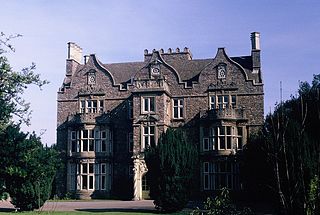
Ridley Hall, Cambridge

Ridley Hall is a theological college located in Sidgwick Avenue in Cambridge in the United Kingdom, which trains men and women intending to take Holy Orders, as deacon or priest of the Church of England, and members of the laity working with children and young people, as lay pioneers and within a pastoral capacity such as lay chaplaincy. It was founded in 1881 and named in memory of Nicholas Ridley, a leading Anglican theologian and martyr of the sixteenth century. The college's first principal was the theologian Handley Moule, later Bishop of Durham.

Low church Christian denominations without much ritual

"Low church" Christian denominations are those who give relatively little emphasis to ritual, sacraments and the authority of clergy. The term is most often used in a liturgical context.

Trinity College, Bristol

Trinity College, Bristol is an evangelical Anglican theological college located in Stoke Bishop, Bristol, England. It offers a range of full-time and part-time taught undergraduate and postgraduate courses which are validated by the University of Durham through the Common Awards Scheme, though the college sets its own curriculum. Many of its students are training for ordination in the Church of England; and hence there is a strong vocational aspect to the courses it provides. It also has students of other Christian denominations, as well as students who are intending to serve within various forms of lay ministry. The college also has a significant number of students studying for research degrees at masters and doctoral levels. All of Trinity's postgraduate research courses are validated by the University of Aberdeen.

Ridley College (Melbourne)

Ridley College, formerly known as Ridley Melbourne, is a Christian theological college in the parklands of central Melbourne. Established in 1910, it has an evangelical foundation and outlook and is affiliated with the Australian College of Theology and the Anglican Church of Australia. The college offers on-campus and distance learning and provides training for various Christian ministries in a range of contexts.

David Wenham is a British theologian and Anglican clergyman, who is the author of several books on the New Testament.

Richard Duncan Turnbull is a Church of England clergyman. He was the Principal of Wycliffe Hall, Oxford, an Evangelical Anglican theological college which is part of the University of Oxford. He stepped down in June 2012 following a long-running dispute.

Maurice Arthur Ponsonby Wood, was an Anglican bishop in the Evangelical tradition. He was a Royal Navy commando chaplain in World War II and later the Bishop of Norwich.

Conservative evangelicalism is a term used in the United Kingdom to describe a theological movement found within evangelical Protestant Christianity, and is sometimes simply synonymous with evangelical within the United Kingdom. The term is used more often in the first sense, but conservative evangelicals themselves tend to use it in the second.

Martyn Percy British Anglican priest and theologian

Martyn William Percy is a Church of England priest and academic. He has been the Dean of Christ Church, Oxford, since October 2014 and was previously Principal of Ripon College Cuddesdon, Oxford.

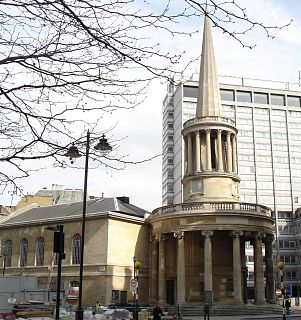
St Marys Church, Islington Church in London

The Church of St Mary the Virgin is the historic parish church of Islington, in the Church of England Diocese of London. The present parish is a compact area centered on Upper Street between Angel and Highbury Corner, bounded to the west by Liverpool Road, and to the east by Essex Road/Canonbury Road. The church is a Grade II listed building.

Julian Tudor Henderson is a British Anglican bishop. Since 2013, he has been the Bishop of Blackburn, the diocesan bishop of the Diocese of Blackburn in the Church of England. From 2005 to 2013, he was the Archdeacon of Dorking in the Diocese of Guildford.

Evangelical Anglicanism

Evangelical Anglicanism or evangelical Episcopalianism is a tradition or church party within Anglicanism that shares affinity with broader evangelicalism. Evangelical Anglicans share with other evangelicals the attributes of "conversionism, activism, biblicism and crucicentrism" identified by historian David Bebbington as central to evangelical identity. The emergence of evangelical churchmanship can be traced back to the First Great Awakening in America and the Evangelical Revival in Britain in the 18th century. In the 20th century, prominent figures have included John Stott and J. I. Packer.

Ian Jagger is a retired British Anglican Priest. From 2006 until retirement, he served as the Archdeacon of Durham, a senior priest in the Diocese of Durham, Church of England. After parish ministry in the Diocese of London, the Diocese of Oxford, and the Diocese of Portsmouth, he was Archdeacon of Auckland from 2001 to 2006.

Mark Simon Austin Tanner is a British Anglican bishop and academic. Since 2016, he has been the Bishop of Berwick, a suffragan bishop in the Diocese of Newcastle From August 2011 until his consecration, he was the Warden of Cranmer Hall, Durham, a Church of England theological college. In September 2016, he was announced as the next Bishop of Berwick, and was consecrated a bishop on 18 October 2016 during a service at York Minster.

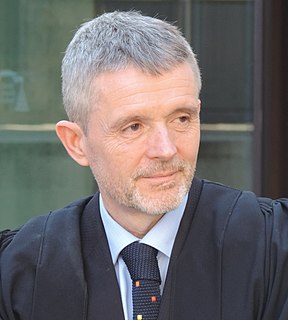
Michael John Volland is a British Anglican priest and academic, specialising in mission and practical theology. Since 2017, he has been Principal of Ridley Hall, Cambridge, an Anglican theological college in the Open Evangelical tradition. He was previously Director of Mission at Cranmer Hall, Durham, and Director of Context-based Training at Ridley Hall.

Anne Catherine Dyer is a British Anglican bishop and academic administrator. She has served as Bishop of Aberdeen and Orkney in the Scottish Episcopal Church since 2018. Previously, from 2005 to 2011, she was the Warden of Cranmer Hall, Durham, a theological college of the Church of England. Then, she was Rector of Holy Trinity Church, Haddington, East Lothian in the Diocese of Edinburgh between 2011 and 2018.

George John Charles Marchant was a British Anglican priest. From 1974 to 1983, he was Archdeacon of Auckland in the Diocese of Durham. He had previously been Vicar of St Nicholas' Church, Durham, and before that ministered in the Diocese of London, the Diocese of Ely, and the Diocese of Lincoln.

References

  1. 1 2 Kings, Graham (September 2003). "Canal, River and Rapids: Contemporary Evangelicalism in the Church of England". Anvil. 20 (3) via Fulcrum Anglican.
  2. Percy, Martyn (1998). Power and the Church: Ecclesiology in an Age of Transition. Bloomsbury Academic. pp. 210–211. ISBN   9780304701056.
  3. Chapman, Mark (2006). Anglicanism: A Very Short Introduction. Oxford University Press. p. 72. ISBN   9780191578199.
  4. "The Ethos at Ridley". Archived from the original on 22 February 2018. Retrieved 9 October 2019.
  5. Hayes, Alan L. (2003). "A Model of "Open Evangelicalism": St. Mary, Islington, London, Easter Sunday 2003". Anglican and Episcopal History. 72 (4): 542–548. ISSN   0896-8039.