
Virgo is one of the constellations of the zodiac. Its name is Latin for maiden, and its old astronomical symbol is . Between Leo to the west and Libra to the east, it is the second-largest constellation in the sky and the largest constellation in the zodiac. The ecliptic intersects the celestial equator within this constellation and Pisces. Underlying these technical two definitions, the sun passes directly overhead of the equator, within this constellation, at the September equinox. Virgo can be easily found through its brightest star, Spica.

An elliptical galaxy is a type of galaxy with an approximately ellipsoidal shape and a smooth, nearly featureless image. They are one of the four main classes of galaxy described by Edwin Hubble in his Hubble sequence and 1936 work The Realm of the Nebulae, along with spiral and lenticular galaxies. Elliptical (E) galaxies are, together with lenticular galaxies (S0) with their large-scale disks, and ES galaxies with their intermediate scale disks, a subset of the "early-type" galaxy population.

Spiral galaxies form a class of galaxy originally described by Edwin Hubble in his 1936 work The Realm of the Nebulae and, as such, form part of the Hubble sequence. Most spiral galaxies consist of a flat, rotating disk containing stars, gas and dust, and a central concentration of stars known as the bulge. These are often surrounded by a much fainter halo of stars, many of which reside in globular clusters.

The Virgo Cluster is a large cluster of galaxies whose center is 53.8 ± 0.3 Mly away in the constellation Virgo. Comprising approximately 1,300 member galaxies, the cluster forms the heart of the larger Virgo Supercluster, of which the Local Group is a member. The Local Group actually experiences the mass of the Virgo Supercluster as the Virgocentric flow. It is estimated that the Virgo Cluster's mass is 1.2×10¹⁵M☉ out to 8 degrees of the cluster's center or a radius of about 2.2 Mpc.

A dwarf galaxy is a small galaxy composed of about 1000 up to several billion stars, as compared to the Milky Way's 200–400 billion stars. The Large Magellanic Cloud, which closely orbits the Milky Way and contains over 30 billion stars, is sometimes classified as a dwarf galaxy; others consider it a full-fledged galaxy. Dwarf galaxies' formation and activity are thought to be heavily influenced by interactions with larger galaxies. Astronomers identify numerous types of dwarf galaxies, based on their shape and composition.

Messier 90 is an intermediate spiral galaxy exhibiting a weak inner ring structure about 60 million light-years away[a] in the constellation Virgo. It was discovered by Charles Messier in 1781.
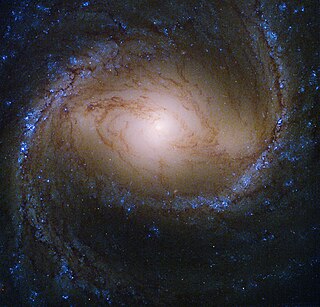
Messier 91 is a barred spiral galaxy that is found in the south of Coma Berenices. It is in the local supercluster and is part of the Virgo Cluster of galaxies. It is about 63 million light-years away from our galaxy. It was the last of a group of eight "nebulae" – the term 'galaxy' only coming into use for these objects once it was realized in the 20th century that they were extragalactic – discovered by Charles Messier in 1781. It is the faintest object in the Messier catalog, with an apparent magnitude of 10.2.
The Canis Major Overdensity or Canis Major Dwarf Galaxy is a disputed dwarf irregular galaxy in the Local Group, located in the same part of the sky as the constellation Canis Major.

The Spring Triangle is an astronomical asterism involving an imaginary triangle drawn upon the celestial sphere, with its defining vertices at Arcturus, Spica, and Regulus. This triangle connects the constellations of Boötes, Virgo, and Leo. It is visible in the evening rising in the southeastern sky of the Northern Hemisphere between March and May and setting until August, while at morning rising and setting from November to the end of February.

NGC 1569 is a dwarf irregular galaxy in Camelopardalis. The galaxy is relatively nearby and consequently, the Hubble Space Telescope can easily resolve the stars within the galaxy. The distance to the galaxy was previously believed to be only 2.4 Mpc. However, in 2008 scientists studying images from Hubble calculated the galaxy's distance at nearly 11 million light-years away, about 4 million light-years farther than previously thought, meaning it is a member of the IC 342 group of galaxies.

The Milky Way is the galaxy that includes the Solar System, with the name describing the galaxy's appearance from Earth: a hazy band of light seen in the night sky formed from stars that cannot be individually distinguished by the naked eye.

The Virgo Stellar Stream, also known as Virgo Overdensity, is the proposed name for a stellar stream in the constellation of Virgo which was discovered in 2005. The stream is thought to be the remains of a dwarf spheroidal galaxy that is in the process of merging with the Milky Way. It is the largest galaxy visible from the Earth, in terms of the area of the night sky covered.

The Shapley Supercluster or Shapley Concentration is the largest concentration of galaxies in our nearby universe that forms a gravitationally interacting unit, thereby pulling itself together instead of expanding with the universe. It appears as a striking overdensity in the distribution of galaxies in the constellation of Centaurus. It is 650 million light-years away (z=0.046).

Gamma-ray burst progenitors are the types of celestial objects that can emit gamma-ray bursts (GRBs). GRBs show an extraordinary degree of diversity. They can last anywhere from a fraction of a second to many minutes. Bursts could have a single profile or oscillate wildly up and down in intensity, and their spectra are highly variable unlike other objects in space. The near complete lack of observational constraint led to a profusion of theories, including evaporating black holes, magnetic flares on white dwarfs, accretion of matter onto neutron stars, antimatter accretion, supernovae, hypernovae, and rapid extraction of rotational energy from supermassive black holes, among others.
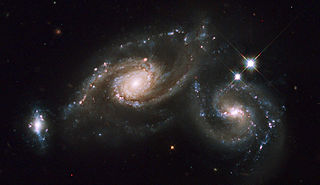
The NGC 5679 group, also known as Arp 274, is a triplet of galaxies, MCG+1-37-36, MCG+1-37-35 and MCG+1-37-34, spanning about 200000 light-years and at some 400 million light-years from Earth in the constellation Virgo. Arp 274 refers to the Atlas of Peculiar Galaxies, compiled by Halton Arp in 1966. Galaxies 269 through 274 in his catalogue are galaxies that appear to have connected arms.
A hypercompact stellar system (HCSS) is a dense cluster of stars around a supermassive black hole that has been ejected from the center of its host galaxy. Stars that are close to the black hole at the time of the ejection will remain bound to the black hole after it leaves the galaxy, forming the HCSS.

An intergalactic star, also known as an intracluster star or a rogue star, is a star not gravitationally bound to any galaxy. Although a source of much discussion in the scientific community during the late 1990s, intergalactic stars are now generally thought to have originated in galaxies, like other stars, before being expelled as the result of either galaxies colliding or of a multiple-star system traveling too close to a supermassive black hole, which are found at the center of many galaxies.

An anemic galaxy is a type of spiral galaxy characterized by a low contrast between its spiral arms and its disk.
SDSS J1229+1122 is a blue supergiant O-type star in the tail of dwarf irregular galaxy IC 3418. It illuminates a nebula clump of gas, and was discovered from the spectrum of the illumination source. The clump of gas resides in a tail caused by ram pressure stripping of gas from the galaxy by the galaxy cluster. It was determined to be a blue supergiant through analysis of its spectrum taken with the 8m Subaru telescope. The discovery was made by Youichi Ohyama and Ananda Hota, using the Subaru Telescope. This discovery was then followed up with the AstroSat to image it with finer angular resolution in the ultraviolet than that of GALEX. With addition of HST optical data the astronomers believe that the ram pressure stripped tail of IC3418 many have many such young star forming clumps and potentially single O-type stars.

NGC 4522 is an edge-on spiral galaxy located about 60 million light-years away within the Virgo Cluster in the constellation Virgo. NGC 4522 is losing its molecular gas though ram-pressure stripping as it plows though the cluster at a speed of more than 10 million kilometres per hour. The galaxy was discovered by astronomer John Herschel on January 18, 1828.

