
Dianetics is a set of ideas and practices, invented in 1950 by science fiction writer L. Ron Hubbard, regarding the human mind. Dianetics was originally conceived as a form of psychological treatment, but was rejected by the psychological and medical establishments as pseudoscientific. It was the precursor to Scientology and has since been incorporated into it. It involves a process referred to as "auditing", which utilizes an electrical resistance meter, ostensibly to remove emotional burdens and "cure" people from their troubles.
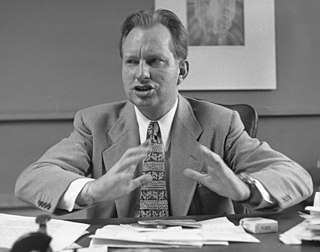
Lafayette Ronald Hubbard was an American author and the founder of Scientology. A prolific writer of pulp science fiction and fantasy novels in his early career, in 1950 he authored Dianetics: The Modern Science of Mental Health and established organizations to promote and practice Dianetics techniques. Hubbard created Scientology in 1952 after losing the intellectual rights to his literature on Dianetics in bankruptcy. He would lead the Church of Scientology – variously described as a cult, a new religious movement, or a business – until his death in 1986.
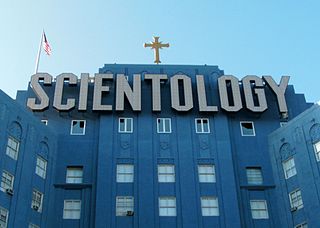
Followers of the Scientology movement maintain a wide variety of beliefs and practices. The core belief holds that a human is an immortal, spiritual being (thetan) that is resident in a physical body. The thetan has had innumerable past lives, some of which, preceding the thetan's arrival on Earth, were lived in extraterrestrial cultures. Based on case studies at advanced levels, it is predicted that any Scientologist undergoing auditing will eventually come across and recount a common series of past-life events.
In Scientology, the concept of the thetan is similar to the concept of self, or the spirit or soul as found in several belief systems. The term is derived from the Greek letter Θ, theta, which in Scientology beliefs represents "the source of life, or life itself." In Scientology it is believed that it is the thetan, not the central nervous system, which commands the body.

The E-Meter is an electronic device used in Scientology that allegedly "registers emotional reactions". After claims by L. Ron Hubbard that the procedures of auditing, which used the E-Meter, could help heal diseases, the E-Meter became the subject of litigation. Since then, the Church of Scientology publishes disclaimers declaring that the E-Meter "by itself does nothing", is incapable of improving health, and is used solely for spiritual purposes.

Dianetics: The Modern Science of Mental Health, sometimes abbreviated as DMSMH, is a book by L. Ron Hubbard about Dianetics, a pseudoscientific system that would later become part of Scientology. Hubbard claimed to have developed it from a combination of personal experience, basic principles of Eastern philosophy and the work of Sigmund Freud. The book is considered part of Scientology's canon. It is colloquially referred to by Scientologists as Book One. The book launched the movement, which later defined itself as a religion, in 1950. As of 2013, New Era Publications, the international publishing company of Hubbard's works, sells the book in English and in 50 other languages.
Scientology and its perspectives on sexual orientation are based on the writings of L. Ron Hubbard, the founder of the Church of Scientology. His statements about homosexuality have led critics to assert that Scientology promotes homophobia, though these allegations are disputed by some Scientologists.
Scientology founder L. Ron Hubbard routinely referred to "space opera" in his teachings, drawing from science-fiction and weaving it into his origins of human history. In his writings, wherein thetans were reincarnated periodically over quadrillions of years, retaining memories of prior lives, to which Hubbard attributed complex narratives about life throughout the universe. The most controversial of these myths is the story of Xenu, to whom Hubbard attributed responsibility for many of the world's problems.
In Dianetics and Scientology, Clear is a status afforded to followers by the Scientology organization, or by other Scientologists, after they complete certain activities. It is one of the major ostensible "states" practitioners strive to reach on their way up what the Scientologists call the Bridge to Total Freedom. Scientology followers are given the status of Clear when a person is deemed to be free of the influence of engrams – supposed unwanted emotions or painful traumas which Scientology claims are not readily available to the conscious mind. Scientologists believe that human beings accumulate anxieties, psychosomatic illnesses, and aberration due to receiving engrams throughout their current or past lives, and that by applying Dianetics, every single person can obtain the status of Clear.
Since the founding of the Church of Scientology in 1954 by L. Ron Hubbard, the relationship between Scientology and psychiatry has been dominated by strong opposition by the organization against the medical specialty of psychiatry and of psychology with themes relating to this opposition occurring repeatedly throughout Scientology literature and doctrine. According to the Church of Scientology, psychiatry has a long history of improper and abusive care. The group's views have been disputed, criticized, and condemned by experts in the medical and scientific community and have been a source of public controversy.
MEST is an acronym for matter, energy, space and time, and means the physical universe. It was coined in 1950 by Scientology founder L. Ron Hubbard, and is spoken as a word rather than spelling out the letters.
History of Dianetics and Scientology begins around 1950. During the late 1940s, L. Ron Hubbard began developing a mental therapy system which he called Dianetics. Hubbard had tried to interest the medical profession in his techniques, including the Gerontological Society, the Journal of the American Medical Association, and the American Journal of Psychiatry, but his work was rejected for not containing sufficient evidence of efficacy to be acceptable.

Scientology: A History of Man is a book by L. Ron Hubbard, first published in 1952 under the title What to Audit by the Scientific Press of Phoenix. According to the author, it provides "a coldblooded and factual account of your last sixty trillion years." It has gone through many editions since its first publication and is a key text of the Church of Scientology. The book has been ridiculed by critics of Scientology for its unusual writing style and pseudoscientific claims; it has been described as "a slim pretense at scientific method ... blended with a strange amalgam of psychotherapy, mysticism and pure science fiction; mainly the latter."
This bibliography of Scientology includes Scientology and Dianetics-related books, periodicals and other issues authored by L. Ron Hubbard and those produced by the Church of Scientology and its related organizations. Books bearing L. Ron Hubbard's name are considered texts of Scientology's canon.
The amount of material on Dianetics and Scientology is extensive, to say the least. This material is composed of books by L. Ron Hubbard ; compilations of his works; taped lectures; auditor training materials ; course packages; booklets; a large number of magazines and annuals; and video recordings of the major annual events.

Scientology: The Now Religion is a book on Scientology, written by George Malko. The book was published in 1970 in Hardcover format by Delacorte Press, and then in a paperback edition in 1971, by Dell Publishing. The book was the first full-length analysis of the history surrounding the founding of the Church of Scientology, and L. Ron Hubbard. Malko conducted interviews with members, and provides analysis about certain practices.
An incident in Scientology beliefs is something that happened to a person that continues to have a grip on their mind or spirit, and is negatively affecting them. It could be an accident or traumatic event that includes pain and subconscious commands, whether from this life or in past lives. Scientology auditing procedures are used to locate incidents in the mind, and relieve them.
The relationship between Scientology and religious groups is very complex. There are significant contradictions between Scientology and most religions, especially the major monotheistic religions. Scientology texts written by its inventor, L. Ron Hubbard, claim that it is fully compatible with all existing major world religions, and that it does not conflict with them or their religious practices. Members are not allowed to engage in other similar mental therapies or procedures, religious or otherwise.
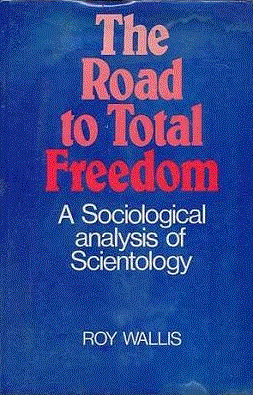
The Road to Total Freedom: A Sociological Analysis of Scientology is a non-fiction book about Scientology by sociologist Roy Wallis. Originally published in 1976 by Heinemann, it was republished in 1977 by Columbia University Press. The original manuscript was the product of Wallis's doctoral research at Oxford under the tutelage of Bryan Wilson. Wallis, after a review of the original manuscript by Scientology leaders, made edits to about 100 passages before publication.

Scientology is in part derived from, and shares elements with, a number of esoteric or occult systems. The extent of the influence of specific occult belief systems on Scientology is a subject of debate amongst scholars.
From 1950 to 1953, Hubbard led the Dianetics Movement which published, promoted and provided an alternative talk therapy called "auditing".


