Monywa is the largest city in Sagaing Region, Myanmar, located 136 km north-west of Mandalay on the eastern bank of the River Chindwin. Monywa is one of the largest economic cities in Myanmar.
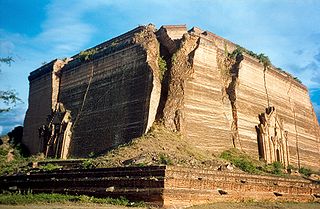
Mingun is a town in Sagaing Township of Sagaing Region, north-west Myanmar (Burma), located 11 km up the Ayeyarwady River on the west bank from Mandalay. Its main attraction is the ruined Mingun Pahtodawgyi.

The Shwedagon Pagoda, officially named Shwedagon Zedi Daw and also known as the Great Dagon Pagoda and the Golden Pagoda, is a gilded stupa located in Yangon, Myanmar.
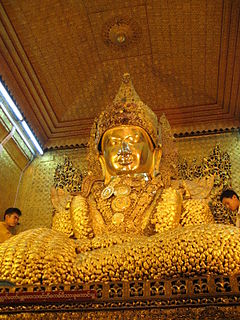
The Mahamuni Buddha Temple is a Buddhist temple and major pilgrimage site, located southwest of Mandalay, Myanmar (Burma) (Myanmar). The Mahamuni Buddha image is deified in this temple, and originally came from Arakan. It is highly venerated in Burma and central to many people's lives, as it is seen as an expression of representing the Buddha's life.

The chinthe is a highly stylized leogryph commonly depicted in Burmese iconography and Myanmar architecture, especially as a pair of guardians flanking the entrances of Buddhist pagodas and kyaung. The chinthe is featured prominently on most paper denominations of the Burmese kyat. A related creature, the manussiha, is also commonly depicted in Myanmar. In Burmese, chinthe is synonymous with the Burmese word for "lion."

Bupaya Pagoda is a notable pagoda located in Bagan, in Myanmar, at a bend on the right bank of the Ayeyarwady River. The small pagoda, which has a bulbous shaped dome, is widely believed to have been built by the third King of Pagan, Pyusawhti who ruled from 168 to 243 AD. It is one of the most notable shrines among the thousands of new or ruined Pagodas in Pagan, which is located about 90 miles (140 km) south of Mandalay.

The Mahabodhi Temple is a Buddhist temple located in Bagan, Myanmar. It was built during the reign of King Htilominlo, and is modelled after the Mahabodhi Temple of Bihar, India. The temple is built in an architectural style typical during the Gupta period, and contains a large pyramidal tower with many niches containing over 450 images of Buddha. The temple survived the 1975 Bagan earthquake, and was repaired in following years.

The Shwesandaw Pagoda, or Shwesandaw Paya is a Buddhist pagoda in the center of Pyay, Burma. It is one of the more important Buddhist pilgrimage locations in Burma. It is said to contain a couple of the Buddha's hairs, as its name means Golden Hair Relic.

Kyaikpun Pagoda, is a pagoda in Bago, Myanmar. Most notably, Kyaik Pun Pagoda is the home to the Four Seated Buddha shrine, a 27 m (89 ft) statue depicting the four Buddhas namely Kakusandha, Konagamana, Kassapa, and Gautama seated in four positions, sitting back to back to four directions. According to tradition, the Four Seated Buddha was built by King Migadippa of Bago the 7th Century AD. It was renovated by King Dhammazedi in the late 15th century.

The Shwemawdaw Pagoda is a stupa located in Bago, Myanmar. It is often referred to as the Golden God Temple. At 114 metres (374 ft) in height, the Shwemadaw holds the record for the tallest pagoda in the country although the Shwedagon Pagoda in Yangon is usually credited as the tallest pagoda in Myanmar. Shwemadaw, along with the Shwedagon and Kyaiktiyo, are famous Mon pagodas. The pagoda's annual festival is a 10-day affair that takes place during the Burmese month of Tagu.
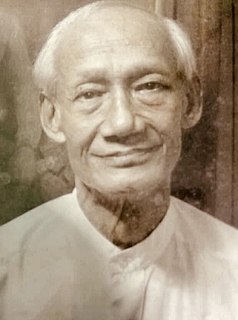
Prince Taw Phaya Galay Aung Zay was a Burmese prince, businessman and politician. He was one of the senior members of the Royal House of Konbaung and the grandson of King Thibaw and Queen Supayalat.

Kyaikmaraw is a town in the Mon State of south-east Myanmar, 4 kilometres (2.5 mi) southeast of Mawlamyine.

The Mingun Pahtodawgyi is an incomplete monument stupa in Mingun, approximately 10 kilometres (6.2 mi) northwest of Mandalay in Sagaing Region in central Myanmar. The ruins are the remains of a massive construction project begun by King Bodawpaya in 1790 which was intentionally left unfinished. The pahtodawgyi is seen as the physical manifestations of the well known eccentricities of Bodawpaya. He set up an observation post on an island off Mingun to personally supervise the construction of the temple.

Kyauktawgyi Buddha Temple is a well-known Buddhist temple located near the southern entry to Mandalay Hill, Myanmar, opposite the northeastern corner of the Mandalay moat. The image of the Buddha is officially known as Maha Thetkya Mayazein.

The Shwesandaw Pagoda, or Shwesandaw Paya, is a Buddhist Stupa in Twante Township, south of Yangon region, Myanmar. It is one of the popular tourist destination and also pilgrimage site for Buddhists as it is said to contain a couple of the Buddha's hairs and its name means Golden Hair Relic.

Paya(Burmese: ဖာယာ; [pʰàjà]) is a village in Kyain Seikgyi Township, Kawkareik District, in the Kayin State of Myanmar. It is the home of Paya Taung.

The Man Buddha Temple is a Buddhist temple in Sale, Magway Region, Myanmar that houses the Shinbin Maha Laba Man Buddha.
Aung Zabu Forest Monastery, commonly known as Japan Paya is a Buddhist monastery (kyaung) in Yegya village, Hmawbi Township, Yangon Region, Myanmar (Burma).
Burmese-Siamese War (1802-1805) was the military conflict between the Kingdom of Burma under the Konbaung dynasty and Kingdom of Siam under the Chakri dynasty over the Lanna city-states. It is composed of two parts: the Burmese Invasion of Chiangmai in 1802 and the Siamese Invasion of Chiang Saen in 1804. The Burmese King Bodawpaya attempted to reclaim the lost dominions in the Lanna east of Salween River. The Lanna, under leadership of Prince Kawila of Chiangmai with Siamese support, successfully repelled the Burmese invasion. The Siamese under King Rama I then dispatched troops, in retaliation, to attack Burmese Chiang Saen in 1805. The town of Chiang Saen surrendered and came under Siamese rule. The wars resulted in the Burmese influence being totally eliminated from Lanna, permanently.
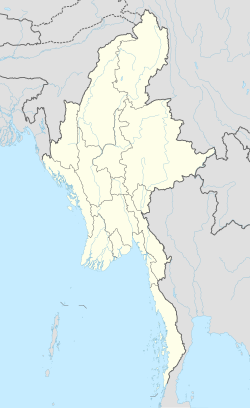

 Myanmar