
Physical therapy (PT), also known as physiotherapy, is a healthcare profession, as well as the care provided by physical therapists who promote, maintain, or restore health through patient education, physical intervention, disease prevention, and health promotion. Physical therapist is the term used for such professionals in the United States, and physiotherapist is the term used in many other countries.
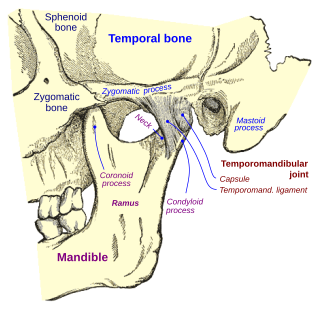
Temporomandibular joint dysfunction is an umbrella term covering pain and dysfunction of the muscles of mastication and the temporomandibular joints. The most important feature is pain, followed by restricted mandibular movement, and noises from the temporomandibular joints (TMJ) during jaw movement. Although TMD is not life-threatening, it can be detrimental to quality of life; this is because the symptoms can become chronic and difficult to manage.

Bruxism is excessive teeth grinding or jaw clenching. It is an oral parafunctional activity; i.e., it is unrelated to normal function such as eating or talking. Bruxism is a common behavior; the global prevalence of bruxism is 22.22%. Several symptoms are commonly associated with bruxism, including aching jaw muscles, headaches, hypersensitive teeth, tooth wear, and damage to dental restorations. Symptoms may be minimal, without patient awareness of the condition. If nothing is done, after a while many teeth start wearing down until the whole tooth is gone.
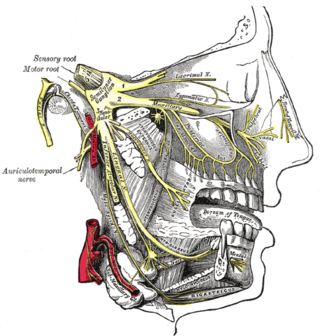
Trigeminal neuralgia, also called Fothergill disease, tic douloureux, trifacial neuralgia, or suicide disease, is a long-term pain disorder that affects the trigeminal nerve, the nerve responsible for sensation in the face and motor functions such as biting and chewing. It is a form of neuropathic pain. There are two main types: typical and atypical trigeminal neuralgia.

Cyclobenzaprine, sold under several brand names including, historically, Flexeril, is a muscle relaxer used for muscle spasms from musculoskeletal conditions of sudden onset. It is not useful in cerebral palsy. It is taken by mouth.
Manual therapy, or manipulative therapy, is a part of Physiotherapy, it is a physical treatment primarily used by physical therapists, occupational therapists to treat musculoskeletal pain and disability; it mostly includes kneading and manipulation of muscles, joint mobilization and joint manipulation. It is also used by Rolfers, massage therapists, athletic trainers, osteopaths, and physicians.
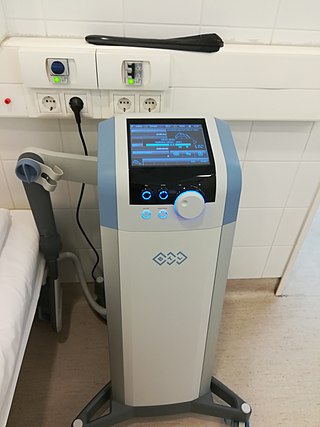
Electrotherapy is the use of electrical energy as a medical treatment. In medicine, the term electrotherapy can apply to a variety of treatments, including the use of electrical devices such as deep brain stimulators for neurological disease. The term has also been applied specifically to the use of electric current to speed wound healing. The use of EMS is also very wide for managing muscular pain. Additionally, the term "electrotherapy" or "electromagnetic therapy" has also been applied to a range of alternative medical devices and treatments. Evidence supporting the effectiveness of electrotherapy is limited.

Myofascial trigger points (MTrPs), also known as trigger points, are described as hyperirritable spots in the skeletal muscle. They are associated with palpable nodules in taut bands of muscle fibers. They are a topic of ongoing controversy, as there is limited data to inform a scientific understanding of the phenomenon. Accordingly, a formal acceptance of myofascial "knots" as an identifiable source of pain is more common among bodyworkers, physical therapists, chiropractors, and osteopathic practitioners. Nonetheless, the concept of trigger points provides a framework which may be used to help address certain musculoskeletal pain.
An oral medicine or stomatology doctor/dentist has received additional specialized training and experience in the diagnosis and management of oral mucosal abnormalities including oral cancer, salivary gland disorders, temporomandibular disorders and facial pain, taste and smell disorders; and recognition of the oral manifestations of systemic and infectious diseases. It lies at the interface between medicine and dentistry. An oral medicine doctor is trained to diagnose and manage patients with disorders of the orofacial region.
Dry needling, also known as trigger point dry needling and intramuscular stimulation, is a treatment technique used by various healthcare practitioners, including physical therapists, physicians, and chiropractors, among others. Acupuncturists usually maintain that dry needling is adapted from acupuncture, but others consider dry needling as a variation of trigger point injections. It involves the use of either solid filiform needles or hollow-core hypodermic needles for therapy of muscle pain, including pain related to myofascial pain syndrome. Dry needling is mainly used to treat myofascial trigger points, but it is also used to target connective tissue, neural ailments, and muscular ailments. The American Physical Therapy Association defines dry needling as a technique used to treat dysfunction of skeletal muscle and connective tissue, minimize pain, and improve or regulate structural or functional damage.
The Nigeria Society of Physiotherapy (NSP) is the national professional association representing Nigerian-trained physiotherapists as well as foreign-trained physiotherapists practicing in Nigeria. The society was inaugurated on 29 August 1959 at a meeting held the Physiotherapy Department of the University College Hospital, Ibadan by a group of Nigerian and British Physiotherapists.

Physical therapy education varies greatly from country to country. Worldwide, physical therapy training ranges from basic work site education in hospitals and outpatient clinics to professional doctoral degree and masters programs.
World Physiotherapy is the international organisation for physiotherapy, representing more than 600,000 physiotherapists worldwide through its 128 member organisations. World Physiotherapy is the operating name of World Confederation for Physical Therapy (WCPT).
Sarah Elizabeth Lamb is the Pro-Vice-Chancellor and Executive Dean of the Faculty of Health and Life Sciences at the University of Exeter, and the Mireille Gillings Professor for Health Innovation. She is also an Honorary Departmental Professor at the Nuffield Department of Medicine, University of Oxford and was the Foundation Director of the Oxford Clinical Trials Research Unit.

Rachelle Buchbinder is an Australian rheumatologist and clinical epidemiologist. Her clinical practice is in conjunction with research involving multidisciplinary projects relating to arthritis and musculoskeletal conditions. She promotes improvement of communication with patients and health literacy in the community.

Kusal Goonewardena is an Australian physical therapist and health lecturer known for being founder and Head of Sports Medicine at Elite Akademy, University of Melbourne. He has authored several books and is a fitness expert on ABC Radio National's Life Matters program.
Alison Hazel McGregor is a British physiotherapist and biomedical engineer who is a professor at Imperial College London. Her research is focused on the musculoskeletal system and the mechanisms/impacts of injury. She has previously served as the President and Secretary of the Society for Back Pain Research.
Lynette (Lyn) March AM is an Australian rheumatologist and clinical epidemiologist. She is Liggins Professor of Rheumatology and Musculoskeletal Epidemiology in the Faculty of Medicine and Health at the University of Sydney, Australia.

