
Louis Henry Sullivan was an American architect, and has been called a "father of skyscrapers" and "father of modernism." He was an influential architect of the Chicago School, a mentor to Frank Lloyd Wright, and an inspiration to the Chicago group of architects who have come to be known as the Prairie School. Along with Wright and Henry Hobson Richardson, Sullivan is one of "the recognized trinity of American architecture." The phrase "form follows function" is attributed to him, although the idea was theorised by Viollet le Duc who considered that structure and function in architecture should be the sole determinants of form. In 1944, Sullivan was the second architect to posthumously receive the AIA Gold Medal.

The Wrigley Building is a skyscraper located at 400–410 North Michigan Avenue on Chicago's Near North Side. It is located on the Magnificent Mile directly across Michigan Avenue from the Tribune Tower. Its two towers in an elaborate style were built between 1920 and 1924 to house the corporate headquarters of the Wrigley Company. Its bright white facade is covered in terra cotta.
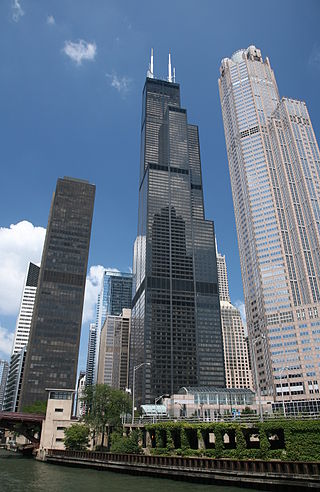
The buildings and architecture of Chicago reflect the city's history and multicultural heritage, featuring prominent buildings in a variety of styles. Most structures downtown were destroyed by the Great Chicago Fire in 1871.
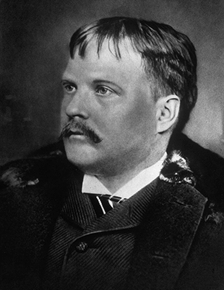
John Wellborn Root was an American architect who was based in Chicago with Daniel Burnham. He was one of the founders of the Chicago School style. Two of his buildings have been designated National Historic Landmarks ; others have been designated Chicago landmarks and listed on the National Register of Historic Places. In 1958, he was posthumously awarded the AIA Gold Medal.
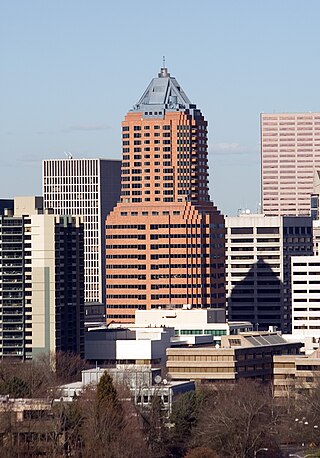
Portland architecture includes a number of notable buildings, a wide range of styles, and a few notable pioneering architects.

Francis Hatch Kimball was an American architect practicing in New York City, best known for his work on skyscrapers in lower Manhattan and terra-cotta ornamentation. He was an associate with the firm Kimball & Thompson. His work includes the Empire Building, Manhattan Life Insurance Building, and Casino Theatre. All but one of Kimball's works were in the United States.

Glazed architectural terra cotta is a ceramic masonry building material used as a decorative skin. It featured widely in the 'terracotta revival' from the 1880s until the 1930s.

The Pui Tak Center, formerly known as the On Leong Merchants Association Building, is a building located in Chicago's Chinatown. Designed by architects Christian S. Michaelsen and Sigurd A. Rognstad, the building was built for the On Leong Merchants Association and opened in 1928. The Association used it as an immigrant assistance center, and the building was informally referred to as Chinatown's "city hall". In 1988, the FBI and Chicago Police raided the building as part of a racketeering investigation. The US federal government seized the building that same year.
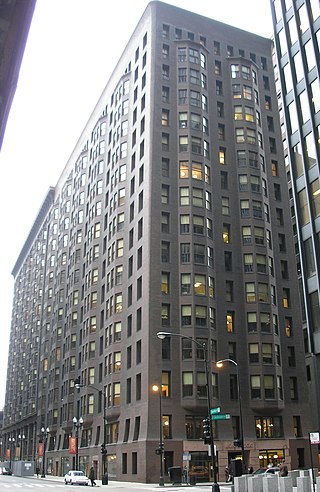
The Monadnock Building is a 16-story skyscraper located at 53 West Jackson Boulevard in the south Loop area of Chicago. The north half of the building was designed by the firm of Burnham & Root and built starting in 1891. At 215 feet, it is the tallest load-bearing brick building ever constructed. It employed the first portal system of wind bracing in the United States. Its decorative staircases represent the first structural use of aluminum in building construction. The later south half, constructed in 1893, was designed by Holabird & Roche and is similar in color and profile to the original, but the design is more traditionally ornate. When completed, it was the largest office building in the world. The success of the building was the catalyst for an important new business center at the southern end of the Loop.

The Carbide & Carbon Building is a 37-story, 503 feet (153 m) landmark Art Deco high rise built in 1929, located on Michigan Avenue in Chicago. It is clad in black granite, green and gold terra cotta, with gold leaf and bronze trim. It was converted to a hotel in 2004.

The Reliance Building is a skyscraper located at 1 W. Washington Street in the Loop community area of Chicago, Illinois. The first floor and basement were designed by John Root of the Burnham and Root architectural firm in 1890, with the rest of the building completed by Charles B. Atwood in 1895. It is the first skyscraper to have large plate glass windows make up the majority of its surface area, foreshadowing a design feature that would become dominant in the 20th century.

The Guaranty Building, formerly called the Prudential Building, is an early skyscraper in Buffalo, New York. It was designed by Louis Sullivan and Dankmar Adler and completed in 1896. The building has been declared a National Historic Landmark and is located within the Joseph Ellicott Historic District.
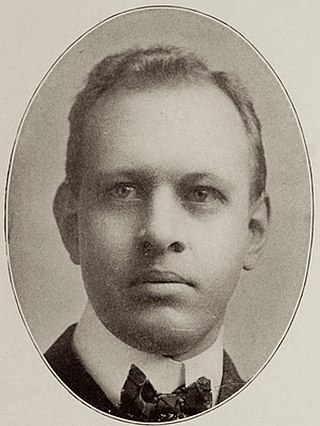
William James Dodd (1862–1930) was an American architect and designer who worked mainly in Louisville, Kentucky from 1886 through the end of 1912 and in Los Angeles, California from early 1913 until his death. Dodd rose from the so-called First Chicago School of architecture, though of greater influence for his mature designs was the classical aesthetic of the Beaux-Arts style ascendant after the Chicago World's Columbian Exposition of 1893. His design work also included functional and decorative architectural glass and ceramics, furniture, home appliances, and literary illustration.

Graham, Anderson, Probst & White (GAP&W) was a Chicago architectural firm that was founded in 1912 as Graham, Burnham & Co. This firm was the successor to D. H. Burnham & Co. through Daniel Burnham's surviving partner, Ernest R. Graham, and Burnham's sons, Hubert Burnham and Daniel Burnham Jr. In 1917, the Burnhams left to form their own practice, which eventually became Burnham Brothers, and Graham and the remaining members of Graham, Burnham & Co. – Graham, (William) Peirce Anderson, Edward Mathias Probst, and Howard Judson White – formed the resulting practice. The firm also employed Victor Andre Matteson.

Burnham and Root was one of Chicago's most famous architectural companies of the nineteenth century. It was established by Daniel Hudson Burnham and John Wellborn Root.

Architectural terracotta refers to a fired mixture of clay and water that can be used in a non-structural, semi-structural, or structural capacity on the exterior or interior of a building. Terracotta is an ancient building material that translates from Latin as "baked earth". Some architectural terracotta is stronger than stoneware. It can be unglazed, painted, slip glazed, or glazed.
Sidney Lovell was an American architect best known for designing mausoleums, and to a lesser extent theaters and opera houses. His first cemetery commission, the mausoleum at Rosehill Cemetery in Chicago, Illinois, is considered his best work. He obtained a patent on an improved mausoleum ventilation system in 1917. Two of his works are listed on the National Register of Historic Places.

The Detroit Financial District is a United States historic district in downtown Detroit, Michigan. The district was listed on the U.S. National Register of Historic Places on December 14, 2009, and was announced as the featured listing in the National Park Service's weekly list of December 24, 2009.
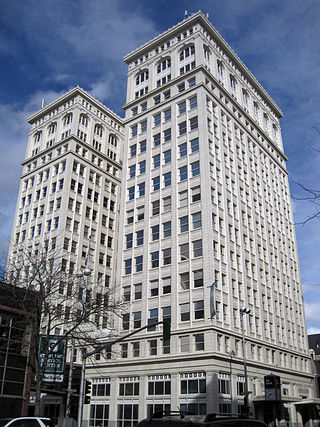
The U.S. Bank Building, previously the Old National Bank Building, is a high-rise in Spokane, Washington, United States. Having been completed in 1910, it was the first skyscraper in the Inland Northwest. At 219 ft (67 m) tall, the building was the tallest in the state of Washington from 1910 to 1911, when it was surpassed by the Key Bank Center in Tacoma—which itself was far surpassed by Seattle's Smith Tower in 1914. It remained the tallest building in Spokane, until the 1929 completion of the Paulsen Medical and Dental Building, located across the street.
The New York Architectural Terra-Cotta Company was a manufacturer of architectural terracotta based in Queens, New York, U.S.


