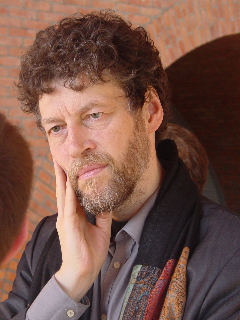
Philip Denwood is a British Tibetologist noted for his work on traditional Tibetan arts and handicrafts, Himalayan architecture and Tibetan linguistics.
He was born on 29 August 1941 in Workington, Cumberland where he also grew up. In 1962 he gained his BA in Geography and History at University College London (UCL), and later in 1964 an MA in Architecture and Town Planning from Liverpool University. He became a research Fellow in Tibetan at SOAS in 1965 and became Lecturer in Tibetan in 1973.
Denwood describes his interest in Himalayan cultures as purely accidental. Having completed his study at Liverpool and based in England, Denwood was living next door to a friend of his from college David Snellgrove. Snellgrove had not long returned from a trip to the Himalayas and had brought five Tibetan refugees back with him around the time of the first wave of exiles post 1959. Denwood's intrigue about the situation with his friend's house guests, coupled with his interest in oriental architecture inspired him to join Snellgrove on an overland trip to India he had been planning. They drove a Land Rover to Nepal together, (which they later sold to a Bhutanese army officer,) and Denwood stayed there learning Tibetan while Snellgrove went ahead to South India. When Snellgrove returned to Nepal, Denwood joined him once again and they drove to Bhutan. The trip lasted a year in total and learning the Tibetan language had prompted Denwood's interest in linguistics.
When he returned to England, Denwood landed the training post of Research Fellow of Tibetan at the School of Oriental and African Studies, University of London (SOAS), where he was eventually appointed as a lecturer.[1]
During his time learning Tibetan in Nepal, Denwood had observed the lack of material available for learning the language, and found the native approach to teaching too unscientific. His budding interest in linguistics brought about his own analysis of the language, learning also from Richard Keith Sprigg who at the time was teaching in the SOAS Linguistics department. This study culminated in the writing of his own book of Tibetan grammar, titled; 'Tibetan'.
Denwood's interest in Tibetan handicrafts he again describes as accidental. The SOAS library had sent him to Delhi, India on a placement for 6 months. He traveled with his wife and two young children. Having been introduced to the Tibetan community there he became familiar with the carpet trade. It was his wife who decided to learn how to weave a carpet, whilst Denwood wrote a book about the process.
Denwood retired from teaching at SOAS in 2006.
Works
Denwood, Philip (1971). "Bhutanese architecture." Journal of the Royal Central Asian Society 58.1: 24–33.
Denwood, Philip (1973). "A Greek Bowl from Tibet." Iran XI: 121–128.
Denwood, Philip (1974). The Tibetan Carpet. Aris & Phillips, Warminster.
Denwood, Philip (1977). Le Tapis Tibétain. Le Courrier du Livre, Paris 1977.
Denwood, Philip (1978). Arts of the Eurasian Steppelands (edited), (Percival David Foundation Colloquy 7), SOAS.
Denwood, Philip (1978) "Stupas of the Tibetan Bonpos." in The Stupa, ed. by A.Dallapiccola, Heidelberg 1978.
Denwood, Philip (1980). "Temple and Rock Inscriptions at Alchi." in D.L.Snellgrove & T.Skorupski, The Cultural Heritage of Ladakh vol 2, Aris & Phillips, Warminster. 117–163.
Denwood, Philip (1981). "Metal and other objects in some of the Istanbul Album paintings." (with G.Fehervari) in Islamic Art 1, The Islamic Art Foundation, New York.
Buddhist Studies, Ancient and Modern (edited with A.Piatigorsky), SOAS, Centre of South Asian Studies 1983.
"Notes on some Tibetan Bonpo Rituals." in Buddhist Studies, Ancient and Modern (see above), 12–19.
Denwood, Philip (). "The Tibetan noun-final -s." Linguistics of the Tibeto-Burman Area 9/1, 97–101.
Denwood, Philip (1990). "Inscriptions at Balukhar and Char Zampa and archaeological observations on the fort of Balukhar and its environs" (with N.F.Howard), T. Skorupski, (ed.),
Indo-Tibetan Studies. Papers in honour and appreciation of Professor David L.Snellgrove's contribution to Indo-Tibetan studies (= Buddhica Britannica vol.2). Tring (1990), The Institute of Buddhist Studies, 75–80. [10]
Denwood, Philip (1991). "Some rare words in Tibetan documents of the early period", E.Steinkellner (ed.), Tibetan history and language. Studies dedicated to Uray Geza on his seventieth birthday (= Wiener Studien zur Tibetologie und Buddhismuskunde 26). Vienna (1991), Arbeitskreis für tibetische und buddhistische Studien Universität Wien, 129–136. [10]
Denwood, Philip (1990). "Uses of Indian technical literature in Tibetan architecture", South Asian Studies 6 (1990), 95–104. [2, 10]
Denwood, Philip (1990). "Some remarks on the status and dating of the sBa-bzhed ", The Tibet Journal XV,6 (1990), 135–148. [2]
"Some formative influences on Mahayana Buddhist art," The Buddhist Forum 2, London (1991), SOAS.
"Sources of mandala design in India and Tibet", R.Whitfield (ed.), The Rise of Esoteric Buddhist Art, Percival David Foundation Colloquy No. 13, London (1992), SOAS .
"Tibetan", Encyclopaedia of Language and Linguistics, Pergamon Press & University of Aberdeen Press, Oxford & Aberdeen (1993)
Recent Research on Ladakh 4 & 5: proceedings of the Fourth and Fifth International Colloquia on Ladakh. (edited with H.Osmaston) SOAS/Motilal Banarsidas 1996.
“William Moorcroft: an Assessment.” in Proceedings of the Fifth International Conference on Ladakh in Recent Research on Ladakh 4 & 5, 39–54.
“The Tibetanisation of Ladakh: the Linguistic Evidence.” in Proceedings of the Fifth International Conference on Ladakh in Recent Research on Ladakh 4 & 5, 281–289.
“The artist’s treatise of sMan-bla Don-grub”, The Tibet Journal XXI/2, Summer 1996, 24–30.
“Tibetan sl- and zl-”, The Tibet Journal XXI/3, Autumn 1996.
Tibetan Art: Towards a definition of Style (edited, with J.Casey Singer) Calmann & Kng, London 1997.
“Architectural style at Shalu.” in Tibetan Art: Towards a definition of Style edited by J.Casey Singer & Philip Denwood, Calmann & Kng, London 1997, 220–229.
Tibetan, Benjamins, Amsterdam 1999.
“Early connections between Ladakh/Baltistan and Amdo/Kham.” in Ladakhi Histories: Local and Regional perspectives, edited by John Bray, Brill, Leiden & Boston, 2006, 31–40.
“The Tibetans in the Western Himalayas and Karakoram, Seventh-Eleventh Centuries: Rock art and inscriptions.” Journal of Inner Asian Art & Archaeology 2, 2007, 49–58.
“The Tibetans in the West.” Part 1: Journal of Inner Asian Art & Archaeology 3, 2008, 7-21.
Bon or Bön, also known as Yungdrung Bon, is the indigenous Tibetan religion which shares many similarities and influences with Tibetan Buddhism. It initially developed in the tenth and eleventh centuries but retains elements from earlier Tibetan religious traditions. Bon is a significant minority religion in Tibet, especially in the east, as well as in the surrounding Himalayan regions.
The Tibetic languages form a well-defined group of languages descending from Old Tibetan. According to Nicolas Tournadre, there are 50 Tibetic languages, which branch into more than 200 dialects, which could be grouped into eight dialect continua. These Tibetic languages are spoken in Tibet, the greater Tibetan Plateau, and in the Himalayas in Gilgit-Baltistan, Ladakh, Aksai Chin, Nepal, and in India at Himachal Pradesh, and Uttarakhand. Classical Tibetan is the major literary language, particularly for its use in Tibetan Buddhist scriptures and literature.
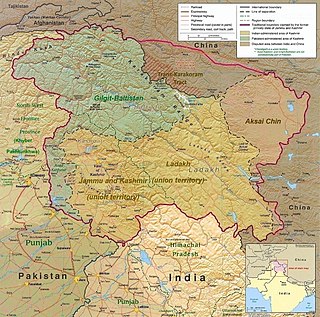
Ladakh is a region administered by India as a union territory and constitutes an eastern portion of the larger Kashmir region that has been the subject of a dispute between India and Pakistan since 1947 and India and China since 1959. Ladakh is bordered by the Tibet Autonomous Region to the east, the Indian state of Himachal Pradesh to the south, both the Indian-administered union territory of Jammu and Kashmir and the Pakistan-administered Gilgit-Baltistan to the west, and the southwest corner of Xinjiang across the Karakoram Pass in the far north. It extends from the Siachen Glacier in the Karakoram range to the north to the main Great Himalayas to the south. The eastern end, consisting of the uninhabited Aksai Chin plains, is claimed by the Indian Government as part of Ladakh, but has been under Chinese control.
Zhangzhung or Shangshung was an ancient kingdom in western and northwestern Tibet, pre-dating Tibetan Buddhism. Zhangzhung culture is associated with the Bon religion, which has influenced the philosophies and practices of Tibetan Buddhism. Zhangzhung people are mentioned frequently in ancient Tibetan texts as the original rulers of today's western Tibet. Only in the last two decades have archaeologists been given access to do field work in the areas once ruled by the Zhangzhung.
Ladakh has a long history with evidence of human settlement from as back as 9000 b.c. It has been a crossroad of high Asia for thousands of years and has seen many cultures, empires and technologies born in its neighbours. As a result of these developments Ladakh has imported many traditions and culture from its neighbours and combining them all gave rise to a unique tradition and culture of its own.
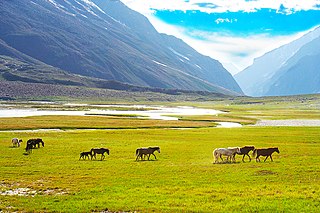
The Suru Valley is a valley in the Kargil District in the Union Territory of Ladakh, India. It is drained by the Suru River, a tributary of the Indus River. The valley's most significant town is Sankoo.
Tibetology refers to the study of things related to Tibet, including its history, religion, language, culture, politics and the collection of Tibetan articles of historical, cultural and religious significance. The last may mean a collection of Tibetan statues, shrines, Buddhist icons and holy scripts, Thangka embroideries, paintings and tapestries, jewellery, masks and other objects of fine Tibetan art and craftsmanship.
Zhangzhung is an extinct Sino-Tibetan language that was spoken in Zhangzhung in what is now western Tibet. It is attested in a bilingual text called A Cavern of Treasures and several shorter texts.
Lopön Tenzin Namdak is a Tibetan religious leader and the most senior teacher of Bon, in particular of Dzogchen and the Mother Tantras.
Per Kværne is a Norwegian tibetologist and historian of religion.
H.W.A. (Henk) Blezer is a Dutch Tibetologist, Indologist, and scholar of Buddhist studies.
Samten Gyeltsen Karmay (1936-) is a writer and researcher in the field of Tibetan Studies. His work is focused on the study of Tibetan myths, beliefs, the Bon religion and religious history.
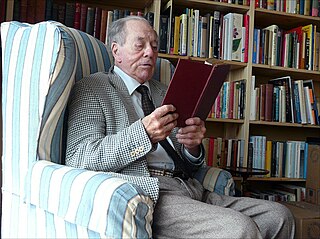
David Llewellyn Snellgrove, FBA was a British Tibetologist noted for his pioneering work on Buddhism in Tibet as well as his many travelogues.
August Hermann Francke was a German Tibetologist. He worked in Ladakh and Lahul from 1896 to 1908 and published the Ladakh chronicles with an English translation. He served as the first professor of Tibetan at the Berlin University.
Purang-Guge kingdom was a small Western Himalayan kingdom which was founded and flourished in the 10th century in western Tibet.
Gyurme Dorje was a Scottish Tibetologist and writer.
Marianne Winder was a Czech-British specialist in Middle High German and a librarian at the Institute of Germanic Studies at the University of London. She later was associated for more than thirty years with the Wellcome Library of the Wellcome Institute for the History of Medicine where she was successively Assistant Librarian (1963–1970), Curator of Eastern Printed Manuscripts and Books (1970–1978) and finally, after having retired, a Tibetan medical consultant (1978–2001).
Lungtok Tenpai Nyima was the 33rd Menri Trizin, the abbot of the Menri Monastery and former leader of Bon.
Daba (Tibetan: མདའ་པ, Wylie: mda' pa; Chinese: 达巴乡; pinyin: Dábā Xiāng) or Danbab (Tibetan: མདའ་འབབ་ཤང, Wylie: mda' 'bab shang, ZYPY: Danbab Xang) is a township under the administration of Zanda County in the Tibet region of China, centred at the Daba village.
John Clarke (1954-2020) was a British specialist in Ladakhi and Tibetan metalwork. He was Curator of Himalayan and Southeast Asian Art at the Victoria and Albert Museum.
This page is based on this Wikipedia article Text is available under the CC BY-SA 4.0 license; additional terms may apply. Images, videos and audio are available under their respective licenses.