Related Research Articles

Bursa is a city in northwestern Turkey and the administrative center of Bursa Province. The fourth-most populous city in Turkey and second-most populous in the Marmara Region, Bursa is one of the industrial centers of the country. Most of Turkey's automotive production takes place in Bursa.

A hammam or Turkish bath is a type of steam bath or a place of public bathing associated with the Islamic world. It is a prominent feature in the culture of the Muslim world and was inherited from the model of the Roman thermae. Muslim bathhouses or hammams were historically found across the Middle East, North Africa, al-Andalus, Central Asia, the Indian subcontinent, and in Southeastern Europe under Ottoman rule. A variation on the Muslim bathhouse, the Victorian Turkish bath, became popular as a form of therapy, a method of cleansing, and a place for relaxation during the Victorian era, rapidly spreading through the British Empire, the United States, and Western Europe.
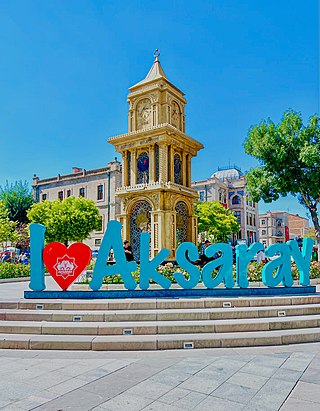
Aksaray is a city in the Central Anatolia region of Turkey. It is the seat of Aksaray Province and Aksaray District. Its population is 247,147 (2021). In 2021 the province had an estimated population of 429,069 distributed over about 7,659 km2 (2,957 sq mi). The average elevation is 980 m (3,215 ft), with the highest point being Mt. Hasan at 3,253 m (10,673 ft).

Fatih is a municipality and district of Istanbul Province, Turkey. Its area is 15 km2, and its population is 368,227 (2022). It is home to almost all of the provincial authorities but not the courthouse. It encompasses the peninsula coinciding with old Constantinople. In 2009, the district of Eminönü, which had been a separate municipality located at the tip of the peninsula, was once again remerged into Fatih because of its small population. Fatih is bordered by the Golden Horn to the north and the Sea of Marmara to the south, while the Western border is demarked by the Theodosian wall and the east by the Bosphorus Strait.
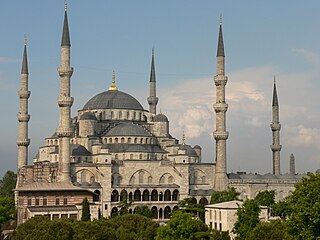
Ottoman architecture is an architectural style or tradition that developed under the Ottoman Empire over a long period, undergoing some significant changes during its history. It first emerged in northwestern Anatolia in the late 13th century and developed from earlier Seljuk Turkish architecture, with influences from Byzantine and Iranian architecture along with other architectural traditions in the Middle East. Early Ottoman architecture experimented with multiple building types over the course of the 13th to 15th centuries, progressively evolving into the classical Ottoman style of the 16th and 17th centuries. This style was a mixture of native Turkish tradition and influences from the Hagia Sophia, resulting in monumental mosque buildings focused around a high central dome with a varying number of semi-domes. The most important architect of the classical period is Mimar Sinan, whose major works include the Şehzade Mosque, Süleymaniye Mosque, and Selimiye Mosque. The second half of the 16th century also saw the apogee of certain decorative arts, most notably in the use of Iznik tiles.

The large Fatih Mosque is an Ottoman mosque off Fevzi Paşa Caddesi in the Fatih district of Istanbul, Turkey. The original mosque was constructed between 1463 and 1470 on the site of the Church of the Holy Apostles. Seriously damaged in the 1766 earthquake, it was rebuilt in 1771 to a different design. It is named after the Ottoman sultan Mehmed the Conqueror, known in Turkish as Fatih Sultan Mehmed, who conquered Constantinople in 1453.

The Green Mosque, also known as the Mosque of Mehmed I, is a part of a larger complex on the east side of Bursa, Turkey, the former capital of the Ottoman Turks before they captured Constantinople in 1453. The complex consists of a mosque, a mausoleum known as the Green Tomb, a madrasa, a public kitchen, and a bathhouse. The name Green Mosque comes from its green and blue interior tile decorations.

Turkish art refers to all works of visual art originating from the geographical area of what is present day Turkey since the arrival of the Turks in the Middle Ages. Turkey also was the home of much significant art produced by earlier cultures, including the Hittites, Ancient Greeks, and Byzantines. Ottoman art is therefore the dominant element of Turkish art before the 20th century, although the Seljuks and other earlier Turks also contributed. The 16th and 17th centuries are generally recognized as the finest period for art in the Ottoman Empire, much of it associated with the huge Imperial court. In particular the long reign of Suleiman the Magnificent from 1520 to 1566 brought a combination, rare in any ruling dynasty, of political and military success with strong encouragement of the arts.

İznik is a municipality and district of Bursa Province, Turkey. Its area is 753 km2, and its population is 44,236 (2022). The town is at the site of the ancient Greek city of Nicaea, from which the modern name derives. The town lies in a fertile basin at the eastern end of Lake İznik, with ranges of hills to the north and south. As the crow flies, the town is only 90 kilometres southeast of Istanbul but by road it is 200 km around the Gulf of İzmit. It is 80 km by road from Bursa.
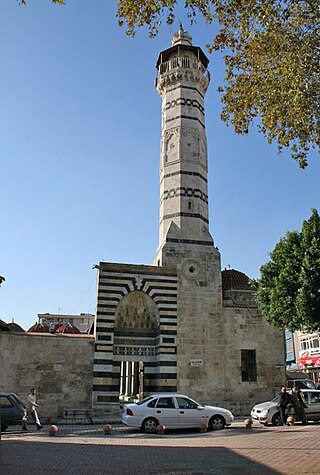
The Great Mosque of Adana, also known as the Ramazanoglu Mosque Turkish: Ramazanoğlu Camii), is a 16th-century mosque in Adana, Turkey. It forms part of a complex (külliye) that includes a madrasah and a mausoleum (türbe). The buildings are on Kızılay street, next to the Ramazanoğlu Hall.
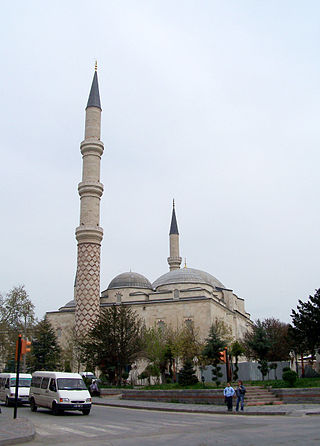
The Üç Şerefeli Mosque is a 15th-century Ottoman mosque in Edirne, Turkey.

Sultantepe is a neighbourhood in the municipality and district of Üsküdar, Istanbul Province, Turkey. Its population is 10,874 (2022). It is on the Asian side of Istanbul. The name Sultantepe means "sultan hill."
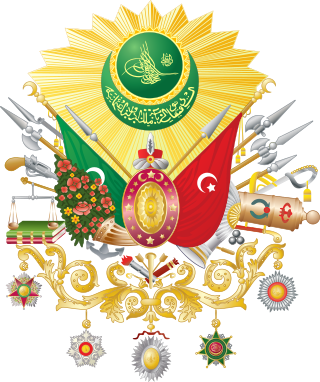
The following outline is provided as an overview of and topical guide to the Ottoman Empire:

The following is a timeline of the history of the city of Bursa, Turkey.
Beçin was a historical fort in Turkey.
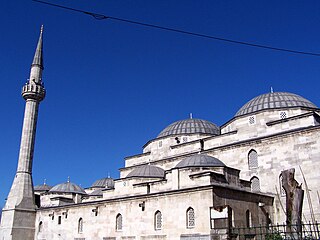
The Mahmut Pasha Mosque is a 15th-century Ottoman mosque near the Grand Bazaar in the Fatih district of Istanbul, Turkey.
Tacünnisa Hatice Halime Hatun, also known as Alime Hatun or Sultan Hatun, was a princess of the House of Candar as daughter of İsfendiyar Bey, ruler of the Beylik of Candar. She was a consort of Sultan Murad II of the Ottoman Empire.
List of historical tekkes, zawiyas, and dergahs in Istanbul, Turkey:

Classical Ottoman architecture is a period in Ottoman architecture generally including the 16th and 17th centuries. The period is most strongly associated with the works of Mimar Sinan, who was Chief Court Architect under three sultans between 1538 and 1588. The start of the period also coincided with the long reign of Suleiman the Magnificent, which is recognized as the apogee of Ottoman political and cultural development, with extensive patronage in art and architecture by the sultan, his family, and his high-ranking officials.
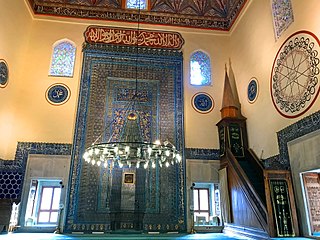
Early Ottoman architecture corresponds to the period of Ottoman architecture roughly up to the 15th century. This article covers the history of Ottoman architecture up to the end of Bayezid II's reign, prior to the advent of what is generally considered "classical" Ottoman architecture in the 16th century. Early Ottoman architecture was a continuation of earlier Seljuk and Beylik architecture while also incorporating local Byzantine influences. The new styles took shape in the capital cities of Bursa and Edirne as well as in other important early Ottoman cities such as Iznik. Three main types of structures predominated in this early period: single-domed mosques, "T-plan" buildings, and multi-domed buildings. Religious buildings were often part of larger charitable complexes (külliyes) that included other structures such as madrasas, hammams, tombs, and commercial establishments.