Historically, Bursa was known as Prusa or Prousa (Ancient Greek: Προῦσα), or Prusa near Olympus or Prusa under Olympus (Προῦσα ἐπὶ τῷ Ὀλύμπῳ, Προῦσα πρὸς τῷ Ὀλύμπῳ). The city became the capital of the Ottoman Empire (back then the Ottoman Beylik) from 1335 until the 1360s.
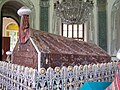
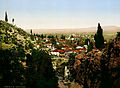
A more recent nickname is Yeşil Bursa ("Green Bursa") referring to the parks and gardens located across the city, as well as to the vast, varied forests of the surrounding region. Bursa has a rather orderly urban growth and borders a fertile plain. The mausoleums of the early Ottoman sultans are located in Bursa, and the city's main landmarks include numerous edifices built throughout the Ottoman period. Bursa also has thermal baths, old Ottoman mansions, palaces, and several museums. Mount Uludağ, known in classical antiquity as the Mysian Olympus or, alternatively, Bithynian Olympus, towers over the city and has a ski resort.
The shadow play characters Karagöz and Hacivat, according to some stories, are based on historic personalities who lived and died in Bursa in the 14th century.[5][6]
The earliest known human settlement near Bursa's current location was at the Ilıpınar Mound in c.6000 BC.[7] It was followed by the Bithynian city of Prusa, which was built by KingPrusias I of Bithynia.[8] The city was also referred to as Prusa ad Olympum after its location at the foot of the Bithynian Olympus (present day Uludağ Mountain).[9] One of the known characteristics of Prusa at that time was its hot springs that's dubbed as the "royal waters".[10] In 75/74 BC, Nicomedes IV, the last king of Bithynia, bequeated his entire kingdom to the Roman Republic in his last testament before he died.[11]
When I was looking about, Sir, for a place upon which to build the baths which you have graciously allowed to be erected at Prusa, I was pleased with a site on which there once stood, I am told, a beautiful mansion which is now in a ruinous and unsightly condition.
Encyclopædia Britannica suggests that, when Prusa was under Byzantine rule, The city prospered after the Byzantine EmperorJustinian I built a palace there.[14] the city then became a garrison city in 562, where imperial guards were stationed. Already by the mid-6th century, Prusa was known as a famous silk textile manufacturing centre.[15]
Bursa became the capital city of the early Ottoman Empire following its capture from the Byzantines in 1326. During the Ottoman rule, the city witnessed a considerable amount of urban growth, such as the building of hospitals, caravanserais (including the Koza Han), and madrasas.[15] The first official Ottoman mint was established in the city.[15] After conqueringAdrianople (now Edirne) in East Thrace, the Ottomans turned it into the new capital city in the 1360s.[b] No longer a capital city, Bursa still retained its spiritual and commercial importance in the Ottoman Empire.[17] In Bursa, the Ottoman SultanBayezid I built the Bayezid I Complex (which contains the Bayezid I Mosque) between 1390 and 1395 and the Grand Mosque of Bursa between 1396 and 1400.[18][19] After the defeat and capture of Bayezid in the Battle of Ankara by the forces of EmirTimur in 1402, the latter's grandson, Muhammad Sultan Mirza, had Bursa pillaged and burned.[20] Timur then assigned the administration of Bursa to his protégé, a son of Savcı Bey.[21] Bursa was later put under the control of Ottoman co-ruler and pretender Îsâ Çelebi during the Ottoman interregnum following the death of Bayezid in captivity.[c] On May 1403, Bursa was annexed by Mehmed Çelebi in the aftermath of the Battle of Ulubad.[21] According to a folio, Bursa is recorded to have a total of 174 quarters which was inhabitated by 6,457 tax-paying heads of households in 1487.[22]
Bursa was a hub of the Ottoman silk trade. The city housed a dockyard for many cargo ships and became a place of distribution of silk and other commodities from the East, particularly Ming China, to the rest of the Mediterranean world, which included the Italian city-states, particularly Genoa and Florence.[24][25] Bursa was a part of the land route of the Armenian trade networks.[26] Bursa also became a resort town since the Roman rule, with many springs centered in an area named Cekirge, such as the Ottoman hammams Eski and Yeni Kaplıcas.[15] Sometime during a Devshirme levy in 1603-4, the villagers of Eğerciler (currently called Eğerce), a Christian village in Bursa and provider of sheep to Istanbul, declared that the children of the village were very much needed as shepherds. They also asserted that even though they were not obliged to give any children to the army, the officers took some anyway. The Ottoman government responded by issuing a decree that commanded the return of the children.[27] In 1827, bursa was set as the capital of Hüdavendigâr Eyalet until, following the Vilayet Law, the Hüdavendigâr Vilayet from 1867 to the dissolution of the Ottoman Empire in 1922.
Modern Era
In July 1915, thousands of the Orthodox Christian populations took refugee in Bursa under the order of the Ottoman government under the political party Committee for Union and Progress (CUP) after being forced out of their coastal villages. This mass-migration worsened the conditions of the Greek population of Bursa, who have managed to survive the attacks and boycotts of 1914. Deportation orders later came to the Armenian population of Bursa after a series of deportations in Adapazari. Protestant population of Armenian descent in Bursa were initially spared from deportation. Killings even occurred in Çengiler, a village outside of Bursa, after some villagers tried to resist deportation. A year after the deportations, large numbers of Kurds, Circassians, and Syrians settled in the towns and villages of the region.[28] In the last days of the Greco-Turkish War in 1922, the Greek Army attempted to burn the center of Bursa however they were stopped by the allied commanders and were only able to burn the train station together with Turkish civilians in it.[29] The Cretan artilleryman Vasilios Moustakis describes the event with the following words: "The Infantry had come through and set fire to the station. We saw an English general on horseback, who ordered the fire to be put out because if Bursa were burned, it would be harming Greece".[30]
The city has traditionally been a pole of attraction, and was a major centre for refugees from various ethnic backgrounds who immigrated to Anatolia from the Balkans during the loss of the Ottoman territories in Europe between the late 19th and early 20th centuries. The most recent arrival of Balkan Turks took place between the 1940s and 1990s, when the People's Republic of Bulgaria expelled approximately 150,000 Bulgarian Turks to Turkey.[31] About one-third of these 150,000 Bulgarian Turkish refugees eventually settled in Bursa (especially in the Hürriyet neighbourhood). With the construction of new industrial zones in the period between 1980 and 2000, many people from the eastern provinces of Turkey came and settled in Bursa.
Bursa, initially home to a small Romaniote Jewish community, underwent a demographic shift with the arrival of Sephardic Jews who were expelled from the Iberian Peninsula in the late 15th century. The Sephardic majority quickly absorbed the Romaniotes, leading to a cultural and numerical dominance. Judaeo-Spanish became the daily language, and the community paid its poll tax through the representative, the kahya.[32]
Throughout the Ottoman period, most Jews resided in Kuruçeşme, Bursa's Jewish quarter, home to three synagogues. Etz Chaim (Eṣ Ḥayyim), the oldest, predated the Ottoman conquest, while the Gerush and Mayor synagogues were established by Sephardic newcomers. Despite the 1851 fire destroying Etz Chaim, the other two remain, along with the Berut synagogue. Bursa also had a Jewish cemetery until recently.[32]
Though never a major center, Bursa's Jewish population fluctuated. Dubious data suggests 683 families in 1571/72, dropping to 141 by 1696/97. By 1883, there were 2,179 Jews, with an influx of 400 from Akkerman in 1887. Pre-World War I, the population reached 3,500, but emigration reduced it to 140 by the early 21st century.[32]
Engaged in the local economy, Bursa's Jews were shop owners and involved in guilds. In the 16th and 17th centuries, they excelled in textile manufacturing, silk trade, goldsmithing, and finance. Despite economic struggles in the 18th and 19th centuries, a 1886 report highlighted poverty.[32]
Bursa faced blood libels in 1592 and 1865. Despite its size, the community produced renowned halakhic scholars across centuries. Modern schooling arrived in 1886 with Alliance Israélite Universelle, but it closed in 1923 during the secularization program. Jewish children then attended Turkish schools for a modern education.[32]
As of 2021, there are 60 Jews left in Bursa, one active synagogue and one Jewish cemetery.[33][34]
Geography
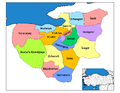
Köppen map of Bursa Province and surrounding regions:[36]
Bursa has a Mediterranean climate (Csa/Cs) under the Köppen and Trewartha classifications. The city has hot, dry summers that last from June until September. Winters are cool and damp, also containing the most rainfall. There can be snow on the ground which will last for a week or two. Air pollution is a chronic problem in Bursa.[38]
Climate data for Bursa (1991–2020, extremes 1928–2023)
Apart from its large automotive industry, Bursa also produces a substantial amount of dairy products (by Sütaş),[44] processed food (by Tat),[45] and beverages (by Uludağ).[46]
Traditionally, Bursa was famous for being the largest centre of silk trade in the Byzantine and later the Ottoman empires, during the period of the lucrative Silk Road. The city is still a major centre for textiles in Turkey and is home to the Bursa International Textiles and Trade Centre (Bursa Uluslararası Tekstil ve Ticaret Merkezi, or BUTTIM). Bursa was also known for its fertile soil and agricultural activities, which have decreased in the recent decades due to the heavy industrialization of the city.
Bursa is a major centre for tourism. One of the most popular skiing resorts in Turkey is located on Mount Uludağ, just next to the city proper. Bursa's thermal baths have been used for therapeutical purposes since Roman times. Apart from the baths that are operated by hotels, Uludağ University has a physical therapy centre which also makes use of thermal water.
Transportation
Tram type "Silkworm" is produced in Bursa by Turkish manufacturer Durmazlar.
Bursa has a metro (Bursaray), trams[47] and a bus system for inner-city public transport, while taxi cabs are also available. Bursa's Yenişehir Airport is 49km (30mi) away from the city centre. The citizens of Bursa also prefer Istanbul's airports such as Istanbul Airport and Sabiha Gökçen International Airport for flights to foreign countries, due to Istanbul's proximity to Bursa. There are numerous daily bus and ferry services between the two cities.
The 8.8km (5.5mi) long Bursa Uludağ Gondola (Turkish: Teleferik) connects Bursa with the ski resort areas 1,870m (6,140ft) high on the mountain Uludağ.[48]
The only railway station in Bursa is the Harmancık station on the Balıkesir-Kütahya railway, which was opened in 1930.
The average amount of time people spend commuting with public transit in Bursa, for example to and from work, on a weekday is 62 min. 12% of public transit riders ride for more than 2 hours every day. The average amount of time people wait at a stop or station for public transit is 18 min, while 31% of riders wait for over 20 minutes on average every day. The average distance people usually ride in a single trip on public transit is 8.1km (5.0mi), while 17% travel for over 12km (7.5mi) in a single direction.[49]
Education
Bursa Technical University campus
Bursa has two public universities and one private university. Uludağ University, founded in 1975, is the oldest institution of higher education in the city. Founded first as the Bursa University then renamed Uludağ University in 1982,[50] the university has a student body of 47,000, one of the largest in Turkey. Bursa Technical University[51] is the second public university of Bursa and was established in 2010, beginning education in the 2011–2012 academic year.
The first private university in Bursa was the Bursa Orhangazi University,[52] which started education in the 2012–2013 academic year. However, Orhangazi University was shut down by the Turkish government after the failed coup attempt of July 2016.
The city has one professional football club, Bursaspor, which formerly competed in the Süper Lig (Super League), the top-tier of Turkish football, until finishing 16th at the end of the 2018–19 Süper Lig season and being relegated to the TFF First League. A few years earlier, Bursaspor had managed to become the Turkish champions at the end of the 2009–10 Süper Lig season, thereby becoming the second Anatolian club to ever win the Süper Lig championship title after Trabzonspor. Henceforth, Bursaspor was often considered to be one of the five biggest football clubs in Turkey, along with Galatasaray, Fenerbahçe, Beşiktaş and Trabzonspor. The club's relegation to the TFF First League at the end of the 2018–19 season was a major shock for its fans and became a first in the history of Turkish football. Never had a club which had won the Süper Lig championship title been relegated.
Bursaspor plays its home games at the Timsah Arena (meaning "Crocodile Arena", crocodile being the mascot of the team), which has a seating capacity of 45,000.
The current mayor of the Bursa Metropolitan Municipality, Mustafa Bozbey[tr], is elected from the main opposition party, Republican People's Party (CHP), in March 2024.
Alinur Aktaş from the Justice and Development Party (AKP) was in office between 2019 and 2024, when the AKP coalition won 49.6% of the vote against the CHP coalition which got 47% of the vote.[56]
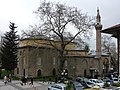
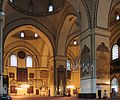
Ulu Cami is the largest mosque in Bursa and a landmark of early Ottoman architecture, which incorporated many elements from Seljuk architecture.
Ordered by Sultan Bayezid I, the mosque was designed and built by architect Ali Neccar in 1396–1400. It is a large and rectangular building, with a total of twenty domes that are arranged in four rows of five, and are supported by 12 columns. Supposedly the twenty domes were built instead of the twenty separate mosques which Sultan Bayezid I had promised for winning the Battle of Nicopolis in 1396. The mosque has two minarets.
Inside the mosque, there are 192 monumental wall inscriptions written by the famous calligraphers of that period. There is also a fountain (şadırvan) where worshipers can perform ritual ablutions before prayer; the dome over the şadırvan is capped by a skylight which creates a soft, serene light below; thus playing an important role in the illumination of the large building.
The horizontally spacious and dimly lit interior is designed to feel peaceful and contemplative. The subdivisions of space formed by multiple domes and pillars create a sense of privacy and even intimacy. This atmosphere contrasts with the later Ottoman mosques (see for example the works of Suleiman the Magnificent's chief architect, Mimar Sinan.) The mosques that were built after the conquest of Constantinople (Istanbul) by the Ottoman Turks in 1453, and influenced by the design of the 6th century Byzantine basilica of Hagia Sophia, had increasingly elevated and large central domes, which create a vertical emphasis that is intended to be more overwhelming; to convey the divine power of Allah, the majesty of the Ottoman Sultan, and the governmental authority of the Ottoman State.
Botanical Park of BursaThe village of Cumalıkızık, near Bursa, is a UNESCO World Heritage Site with Ottoman era historic houses.
↑Özek, Chengiz (2018). "500 years of Karagöz". Journal of Studies on Theater of Animated Forms. 1 (Móin Móin): 237. doi:10.5965/2595034701152016234. Retrieved 22 August 2025– via Academic.edu. According to one of these, Hacivat was a stonemason and Karagöz a blacksmith during the reign of Sultan Osman in the early 14th century. While the pair was working on the construction of a mosque in Bursa they distracted the other workers with their witty repartee, so that the work fell behind schedule and the sultan ordered their execution.
↑"Ottoman Capital Bursa". Official website of the Ministry of Culture and Tourism of the Republic of Turkey. Archived from the original on 14 January 2015. Retrieved 19 December 2014. ...in 1363 the Ottoman capital moved from Bursa to Edirne, although Bursa retained its spiritual and economic importance.
↑"BURSA (Nüfusun tarihsel gelişimi)"[BURSA (Population historical development)]. Bursa Gazeteciler Cemiyeti (in Turkish). Archived from the original on 13 April 2014. Retrieved 4 February 2025.
↑Mustafa Zahit Öner (2021). Anadolu'da Yunan Zulüm ve Vahşeti (in Turkish). İstanbul, Türkiye: DBY Yayınları. pp.265–267. ISBN978-625-7760-27-0. OCLC1236894121.
↑Moustakis, Vasilios (2000). Λόγια του κανονιέρη. 1079 μέρες συνοδοιπόροι με το θάνατο![Words of the gunner. 1079 days of companionship with death!] (in Greek). New York, USA. p.64. Στον σταθμό, είχαν περάσει τα Πεζικά και είχαν βάλει φωτιά. Είδαμε έναν έφιππο, Άγγλο στρατηγό, που διέταξε να σβήσουν τη φωτιά, γιατί αν καιγόταν η Προύσα, θα ήταν εις βάρος της Ελλάδος [At the station, the infantry had passed and set fire. We saw a mounted English general who ordered the fire to be put out, because if Bursa burned, it would be to the detriment of Greece]{{cite book}}: CS1 maint: location missing publisher (link)
↑Eminov, Ali, Turks and Other Muslim Minorities in Bulgaria, New York, Routledge, 1997, Höpken, W., "Modernisierung und Nationalismus: Sozialgeschichtliche Aspekte der bulgarischen Minderheitenpolitik gegenüber den Türken" in: SOE 7-8 (1986), Schönfeld, R., ed, Nationalitätenprobleme in Südosteuropa, Munich, Oldenbourg, 1997, p. 255-303, Erdinç, Didar, "Bulgaristan'daki Değişim Sürecinde Türk Azınlığın Ekonomik Durumu", Türkler, Ankara, 2002, s.394–400.
↑İslâm Ansiklopedisi: "It is disputed when the Ottomans conquered this place; various dates have been put forward in this regard, such as 1361, 1362, 1367 and 1369. Among these, the opinion that Edirne was captured in 1361 as a result of a systematic conquest policy by Murad and Lala Şahin, while Orhan Gazi was still alive, gains prominence. However, it has also been stated that the date of conquest may have occurred after 1366 (1369), based on an elegy showing that the city metropolitan Polykarpos was in Edirne in this capacity until 1366."[16]
↑Kastritsis: "It is not known exactly how Isa was able to take power from this son of Savcı, but the records of the Genoese colony of Pera make it clear that by January 1403, Isa was viewed as the dominant Ottoman ruler in Anatolia (dominans in Turchia)"[21]
This page is based on this Wikipedia article Text is available under the CC BY-SA 4.0 license; additional terms may apply. Images, videos and audio are available under their respective licenses.


 Turkey