Professores (Coronel Fabriciano)

Last updated
Professores
Neighborhood of Coronel Fabriciano
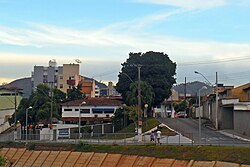
B. dos Professores visto da Av. Julita Pires Bretas, Coronel Fabriciano MG.JPG
View of the neighborhood from Julita Pires Bretas Avenue
Brazil Minas Gerais location map.svg
Red pog.svg
Professores
Location in Minas Gerais
Brazil location map.svg
Red pog.svg
Professores
Professores (Brazil)
Coordinates: 19°30′18″S42°37′30″W / 19.50500°S 42.62500°W / -19.50500; -42.62500
Country Flag of Brazil.svg  Brazil
State Minas Gerais
Municipality/City Coronel Fabriciano
ZoneSenador Melo Viana District
Area
  Total0.1 km2 (0.04 sq mi)
Population
  Total887
  Density7.094/km2 (18.37/sq mi)

Professores is a neighborhood in the Brazilian municipality of Coronel Fabriciano, in the interior of the state of Minas Gerais. It is located in the Senador Melo Viana district, in Sector 1. According to the Brazilian Institute of Geography and Statistics (IBGE), its population in 2010 was 887 inhabitants (0.9% of the municipality's total), distributed over an area of 0.1 km2. [1] [2]

Contents

The neighborhood was created by the Padres do Trabalho Association in 1973 in order to mitigate the impact of the establishment of Unileste. It was originally a housing complex for the university's professors and staff. It is located next to the center of Fabriciano and includes the Louis Ensch Stadium and the headquarters of the city's boy scouts. [3]

History

The population growth in the current Vale do Aço Metropolitan Region caused by the installation of large industries between the 1930s and 1950s, led to the creation of the Catholic University Center of Eastern Minas Gerais (Unileste), the first large educational complex in the region, at the end of the 1960s. A few years later, the Padres do Trabalho Association, responsible for founding Unileste, was also in charge of building the Universitário neighborhood, for the students, and the Professores neighborhood, for the institution's teachers and staff. [4] [3] [5]

The housing complexes were built in order to mitigate the impact of the establishment of Unileste. The Professores neighborhood was officially created in 1973 and the houses began to be completed in July of the same year, with the pavement already finished; the first inhabitant was Professor Ademir Castro. The original project had five blocks with 16 houses each. Most of the residences built were semi-detached, with two bedrooms, three bathrooms (one being a toilet), two living rooms, a kitchen, a garage and a backyard. The social part was restricted to the first floor, while the bedrooms were on the second floor. [3] [4] [5]

Over time, new streets emerged on the surrounding land and were incorporated into the neighborhood, such as Sanitária Avenue (now Julita Pires Bretas Avenue), on the banks of the Caladão Stream, which street was created by channeling a stretch of the creek in gabions to minimize flooding between the 1970s and 80s. Later, most of the houses in the complex underwent renovations, and by the end of the 1980s almost all of the facades had been modified. Due to its proximity to the center of Fabriciano and its access to urban services and leisure activities, Professores has become an upscale residential neighborhood. In 2016, Julita Pires Bretas Avenue was revitalized and its sidewalk refurbished. [4] [3] [5] [6] [7]

Geography and demography

Caladao Stream between the Professores and Bom Jesus neighborhoods. Ribeirao Caladao entre os B. dos Professores e Bom Jesus, Coronel Fabriciano MG2.JPG
Caladão Stream between the Professores and Bom Jesus neighborhoods.

The Professores neighborhood has a total area of 0.1 km2 and is bordered by Giovannini (to the north), Centro (to the west), Santa Helena (to the south) and Bom Jesus (to the east) neighborhoods. Julita Pires Bretas Avenue borders the Caladão Stream, which cuts through the city and receives dirt and pollution from homes and small industries, workshops or slaughterhouses on its banks. [8] [5]

In 2010, the Brazilian Institute of Geography and Statistics (IBGE) estimated that 887 inhabitants lived in the neighborhood, which is comparable to the two least populous cities in Brazil: Borá, in São Paulo, and Serra da Saudade, in Minas Gerais. Among the 63 neighborhoods in Fabriciano, Professores ranked 35th in terms of population, comprising 0.9% of the municipal population and 1.9% of the population of the Senador Melo Viana district, with a population density of 7,094.47 inhabitants per square kilometer. Of the total number of inhabitants, 419 were men (47.2% of the total) and 468 women (52.8%), with a sex ratio of 89.53, distributed in 340 households. Among the men, the predominant age group was people aged between 20 and 24, who accounted for 4.85% of the total. Among women, people aged between 50 and 54 predominated, also accounting for 4.85% of the total female population. [2] [1] [5]

The neighborhood is appreciated by the real estate sector, as homes are predominant and it is located next to the center of Fabriciano, one of the main commercial hubs in the region. It is covered by the Catholic pastoral work of the Community and Parish of Saint Sebastian, which represents the headquarters of the Diocese of Itabira-Fabriciano, and hosts some of the division's activities and events. [5] [9]

Infrastructure and leisure

Facade of the Boa Vista Municipal School. Fachada da Escola Municipal Boa Vista, Coronel Fabriciano MG.JPG
Facade of the Boa Vista Municipal School.
Aspect of the Professores neighborhood. Aspecto do B. dos Professores, Coronel Fabriciano MG.JPG
Aspect of the Professores neighborhood.

The neighborhood includes the building of the former Doutor Querubino State School, located on Ephrem Macedo Street. Initially established in the Nossa Senhora do Carmo neighborhood on February 15, 1968, the institution moved to its current building in 1983 after successive temporary relocations. However, the school was closed and its building became the headquarters of the Boa Vista Municipal School in 2020, which teaches elementary school classes. The water supply service is provided by Companhia de Saneamento de Minas Gerais (Copasa), while the electricity supply is the responsibility of Companhia Energética de Minas Gerais (Cemig), with 100% of the population having access to the electricity network. [10] [11] [12] [13] [14]

The Pastor Pimentel Interchange, which is the link between Magalhães Pinto and Tancredo Neves avenues, also divides the residential area and the center of Fabriciano from the Giovannini neighborhood and the Senador Melo Viana district. There are no public transport buses inside the neighborhood, except on Julita Pires Bretas Avenue. [15] [16]

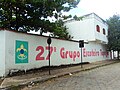
Inaugurated in 1950, the Louis Ensch Stadium, home of the Social Futebol Clube, is also located in the Professores neighborhood. It hosts important matches in local amateur leagues and official games in some categories of the Campeonato Mineiro. The Professores neighborhood also includes the headquarters of the Tapajós 27th Scouting Group, located on Amazonas Street, which operates since 1963 and offers children and young people various activities related to scouting. On Julita Pires Bretas Avenue, on the banks of the Caladão Stream, there is a sidewalk that is often used for leisure. [17] [18] [19]

The neighborhood is also popular for its leisure activities organized by the Parish of Saint Sebastian or the schools. Until the 1990s, the Corpus Christi Procession began at the Parish Church of Saint Sebastian, headed to Pedro Nolasco Street and returned to the temple. After the Cathedral of Saint Sebastian was completed, it was transferred to the streets of the Santa Helena and Professores neighborhoods. The scout group also holds some activities open to the population at its headquarters. [20]

See also

Related Research Articles

<span class="mw-page-title-main">Coronel Fabriciano</span> Municipality in Southeast, Brazil

Coronel Fabriciano is a municipality in the state of Minas Gerais in the Southeast region of Brazil. It is located in the region of Vale do Rio Doce and is situated 200 km from the state capital. The municipal population was estimated in 2020 by IBGE in 110,290 inhabitants. The area is 221.252 km2 (85.426 sq mi).

<span class="mw-page-title-main">Vale do Aço metropolitan area</span> Metropolitan Area of Brazil in Southeast

The Vale do Aço Metropolitan Region is a metropolitan area in Minas Gerais, Brazil, comprising only the four municipalities of Coronel Fabriciano, Ipatinga, Santana do Paraíso and Timóteo, but have an influence area of 22 other municipalities.

<span class="mw-page-title-main">Serra dos Cocais</span> Mountain chain in Brazil

The Serra dos Cocais is a mountain chain located in the Brazilian municipality of Coronel Fabriciano, in the interior of the state of Minas Gerais. It is part of the geologic province of the Espinhaço mountains and is composed of continuous blocks of granite over 600 million years old. Its altitude, which reaches a high point of 1200 meters above sea level, stands out from the surrounding terrain with average altitudes ranging between 500 and 800 meters. It contains an important remnant of the Atlantic Forest, in the middle of considerable reforestation with eucalyptus, and has been considered an area of environmental protection since 2002.

Rubem Siqueira Maia was a Brazilian physician and politician. After living in São João del-Rei during his childhood and graduating from the School of Medicine of Federal University of Minas Gerais (UFMG), he moved to Vale do Rio Doce to work on the construction of the Vitória-Minas Railway (EFVM) in the 1930s.

<span class="mw-page-title-main">Saint Sebastian Cathedral, Coronel Fabriciano</span> Catholic religious temple in Brazil

The Saint Sebastian Cathedral is a Catholic religious temple located in the Brazilian city of Coronel Fabriciano, in the interior of the state of Minas Gerais. It was inaugurated in 1993 and since then shares the title of seat of the Diocese of Itabira-Fabriciano with the Our Lady of the Rosary Cathedral, which also represents the Episcopal See, in Itabira.

<span class="mw-page-title-main">Saint Sebastian Parish, Coronel Fabriciano</span> Catholic Institution in Brazil

Saint Sebastian Parish is a division of the Catholic Church based in the Brazilian city of Coronel Fabriciano, in the interior of the state of Minas Gerais. The parish is part of the Diocese of Itabira-Fabriciano, and is located in Pastoral Region III. Its mother church is the Saint Sebastian Parish Church and its territory houses the co-cathedral of Saint Sebastian, which is one of the diocesan headquarters.

<span class="mw-page-title-main">Colégio Angélica</span> Private school in Brazil

Escola Normal Nossa Senhora do Carmo e Ginásio Angélica, also known as Colégio Angélica, is an educational institution in the Brazilian municipality of Coronel Fabriciano, in the interior of the state of Minas Gerais. It was created in 1950 under the administration the Congregation of the Carmelite Sisters of Divine Providence, which maintained the school until 2011. Since 2016, the Catholic Institute of Minas Gerais (ICMG) has been responsible for the institution, providing nursary, primary, elementary, and vocacional school.

<span class="mw-page-title-main">Doutor José Maria Morais Hospital</span> Brazilian Hospital

Doutor José Maria Morais Hospital is an institution located in the Brazilian city of Coronel Fabriciano, in the interior of the state of Minas Gerais. It was created by Belgo-Mineira in 1936, due to an epidemic of tropical diseases that the town was facing at the time.

<span class="mw-page-title-main">Catholic University Center of Eastern Minas Gerais</span> Brazilian higher education institution based in Minas Gerais.

The Catholic University Center of Eastern Minas Gerais (Unileste) is a Brazilian private higher education institution based in Coronel Fabriciano, in the interior of the state of Minas Gerais. It was created as part of the social works of the Padres do Trabalho Congregation in 1969, configuring itself as the first technical and higher education level school in the current Steel Valley Metropolitan Region (RMVA).

The Calado Station, also known as Coronel Fabriciano Station, was a railway station that operated as a passenger and loading and unloading terminal in the Brazilian municipality of Coronel Fabriciano, in the countryside of the state of Minas Gerais. It was inaugurated on June 9, 1924, being at the time one of the three largest stations of the Vitória-Minas Railway (EFVM). Around it was established the urban core that gave rise to the headquarters of the then-subordinated district to Antônio Dias, emancipated in 1948.

The history of Coronel Fabriciano, a Brazilian municipality in the interior of the state of Minas Gerais, began at the end of the 16th century. Expeditions followed the so-called Doce River Hinterlands in search of precious metals, however, the settlement of the region was forbidden at the beginning of the XVII century, to avoid smuggling of the gold extracted in the Diamantina region.

<span class="mw-page-title-main">Professor Pedro Calmon State School</span> Public school in Brazil

Professor Pedro Calmon State School is a public educational institution in the Brazilian municipality of Coronel Fabriciano, in the interior of the state of Minas Gerais. It offers both lower and upper secondary education, as well as adult education. It is the first school facility built in the city, and is located on one of the main streets in downtown Fabriciano, in a central position between the City Hall and the Saint Sebastian Parish Church.

<span class="mw-page-title-main">Caladão Stream</span> Brazilian watercourse

The Caladão Stream is a watercourse that rises and flows in the Brazilian municipality of Coronel Fabriciano, in the state of Minas Gerais. The source is located in Serra dos Cocais and runs for 10 kilometers to its mouth in the Piracicaba River. Its sub-basin covers 53 km2 and encompasses the Senador Melo Viana district, the most populous area of the city.

<span class="mw-page-title-main">Giovannini (Coronel Fabriciano)</span> Brazilian neighborhood

iovannini is a neighborhood in the Brazilian municipality of Coronel Fabriciano, in the state of Minas Gerais. It is located in the Senador Melo Viana district, in Sector 4. According to the Brazilian Institute of Geography and Statistics (IBGE), its population in 2010 was 3,020, distributed over an area of 0.5 km2.

<span class="mw-page-title-main">Júlia Kubitschek (Coronel Fabriciano)</span> Brazilian neighborhood

Júlia Kubitschek, popularly known as JK, is a neighborhood in the Brazilian municipality of Coronel Fabriciano, in the interior of the state of Minas Gerais. It is located in the Senador Melo Viana district, in Sector 4. According to the Brazilian Institute of Geography and Statistics (IBGE), its population in 2010 was 3,452 inhabitants, distributed over an area of 1.4 km2.

<span class="mw-page-title-main">Santa Terezinha (Coronel Fabriciano)</span> Brazilian neighborhood

Santa Terezinha or Santa Terezinha I is a neighborhood in the Brazilian municipality of Coronel Fabriciano, in the interior of the state of Minas Gerais. It is located in the Senador Melo Viana district, in Sector 1. According to the Brazilian Institute of Geography and Statistics (IBGE), its population in 2010 was 1 712 inhabitants, distributed over an area of 0.3 km2.

<span class="mw-page-title-main">Centro (Coronel Fabriciano)</span> Brazilian neighborhood

Centro is a neighborhood in the Brazilian municipality of Coronel Fabriciano, in the interior of the state of Minas Gerais. It is located in the headquarters district, in Sector 1. According to the Brazilian Institute of Geography and Statistics (IBGE), its population in 2010 was 2,799 inhabitants, distributed over an area of 0.6 km2.

<span class="mw-page-title-main">Santa Helena (Coronel Fabriciano)</span> Brazilian neighborhood

Santa Helena is a neighborhood in the Brazilian municipality of Coronel Fabriciano, in the interior of the state of Minas Gerais. It is located in the headquarters district, in Sector 1. According to the Brazilian Institute of Geography and Statistics (IBGE), its population in 2010 was 1 359 inhabitants, distributed over an area of 0.2 km2.

<span class="mw-page-title-main">Floresta (Coronel Fabriciano)</span> Brazilian neighborhood

Floresta is a neighborhood in the Brazilian municipality of Coronel Fabriciano, in the interior of the state of Minas Gerais. It is located in the Senador Melo Viana district, in Sector 6. According to the Brazilian Institute of Geography and Statistics (IBGE), its population in 2010 was 2,820 inhabitants, distributed over an area of 0.4 km2.

<span class="mw-page-title-main">Caladinho Stream</span> Brazilian watercourse

The Caladinho Stream is a watercourse that rises and flows in the Brazilian municipality of Coronel Fabriciano, in the state of Minas Gerais. The source is located near the Caladinho neighborhood and it runs for about 12 kilometers to its mouth in the Piracicaba River through the Industrial Novo Reno, Universitário, Aparecida do Norte, Morada do Vale, Aldeia do Lago and Santa Terezinha II neighborhoods. Its sub-basin covers 9 km2.

References

  1. 1 2 "Tabela 202 - População residente por sexo e situação do domicílio". IBGE. 2010-12-31.
  2. 1 2 "Sinopse por setores". IBGE. 2011-11-16.
  3. 1 2 3 4 "BAIRROS - PROFESSORES". Eu Amo Ipatinga. Retrieved 2023-12-27.
  4. 1 2 3 Gomes, Leonardo. "A origem dos nomes dos bairros de Coronel Fabriciano MG". Revista Nosso Vale. Archived from the original on 2014-03-22. Retrieved 2014-10-02.
  5. 1 2 3 4 5 6 Santos, Gabriel Novais (2015). "Um Bairro Quente: Experimentação narrativa entre meios" (PDF). UFV.
  6. "Imóveis registram 100% de valorização em 5 anos". Diário do Aço. 2011-10-12. Archived from the original on 2012-07-24. Retrieved 2014-10-02.
  7. "Parque Linear tem 48% de suas obras concluídas, segundo prefeitura". Diário do Aço. 2016-06-11. Retrieved 2023-12-27.
  8. "Expedição traça um retrato do Ribeirão Caladão". Coronel Fabriciano City Hall. 2009-10-19. Archived from the original on 2012-11-27. Retrieved 2012-02-08.
  9. "Imóveis registram 100% de valorização em 5 anos". Diário do Aço. 2011-10-12. Archived from the original on 2012-07-24. Retrieved 2014-10-02.
  10. "Quem Somos". CEMIG. Retrieved 2023-12-26.
  11. "HISTÓRICO". COPASA. Retrieved 2023-12-26.
  12. "Relação de Estabelecimentos de Ensino (ativos), segundo a SRE, o município, a dependência administrativa e a localização, por etapa, nível e modalidade de ensino". SEE. Archived from the original on 2013-08-10. Retrieved 2014-10-21.
  13. "Escola Boa Vista muda de endereço e adia o início das aulas". Coronel Fabriciano City Hall. 2020-02-04. Archived from the original on 2023-12-01. Retrieved 2023-11-30.
  14. Sá, Ivone Rosa (2013). "Projeto político pedagógico: uma ferramenta da gestão democrática". UFMG.
  15. "Defesa Civil interdita parte da avenida Julita Pires Bretas". Coronel Fabriciano City Hall. 2012-01-12. Archived from the original on 2014-10-06. Retrieved 2012-02-08.
  16. "Segunda fase do Parque Linear deve ser atacada em 6". Vale do Aço. 2013-01-11. Archived from the original on 2013-09-17. Retrieved 2013-09-17.
  17. Cunha Junior, Virgilio Amaral (2013). "Saci: A lenda que se fez história" (PDF). UFV. Archived from the original (PDF) on 2014-10-06.
  18. "Diversão máxima para os fabricianenses". Diário do Aço. 2013-01-20. Retrieved 2023-12-27.
  19. "Mais escoteiros, melhores cidadãos!". Vale do Aço. 2009-08-27. Archived from the original on 2012-12-31. Retrieved 2012-02-17.
  20. "NOSSA HISTÓRIA". Paróquia São Sebastião. Retrieved 2023-12-27.