| Rajasekhara | |
|---|---|
Depiction of "Cherman Perumal" Nayanar (Brihadisvara Temple, Thanjavur) | |
| Ruler of Kulasekhara/Kodungallur Chera Kingdom | |
| Reign | 9th century CE [1] |
| Successor | Sthanuravi |
| Died | Tiruvanchikkulam (Kodnguallur) |
| Religion | Hinduism (Shaiva) |
Rajashekhara (fl. 9th century CE [2] ) was a ruler of the Kodungallur Chera/Kulashekhara kingdom in medieval Kerala, southern India. It was during his reign - in 825 CE - the calendar known as the Kollam Era commenced. The calendar is also known as "Malayalam Era" [3] Rajashekhara is reputed to have issued the Vazhapalli Copper Plates — the earliest epigraphical record of a Chera king to be discovered from Kerala. [4] The Hindu saint Adi Shankara was a contemporary of Rajashekhara. Shivanandalahari, attributed to Sankara, indirectly mentions the Chera ruler as Rajashekhara. [3] Rajashekhara also figures in Vidyaranya's Shankaravijaya. [3] Rajashekhara was succeeded by king Sthanu Ravi. [3]
Kerala is a state on the southwestern, Malabar Coast of India. It was formed on 1 November 1956, following passage of the States Reorganisation Act, by combining Malayalam-speaking regions. Spread over 38,863 km2 (15,005 sq mi), Kerala is the twenty-second largest Indian state by area. It is bordered by Karnataka to the north and northeast, Tamil Nadu to the east and south, and the Lakshadweep Sea to the west. With 33,387,677 inhabitants as per the 2011 Census, Kerala is the thirteenth-largest Indian state by population. It is divided into 14 districts with the capital being Thiruvananthapuram. Malayalam is the most widely spoken language and is also the official language of the state.
Adi Shankara was an early 8th century Indian philosopher and theologian who consolidated the doctrine of Advaita Vedanta. He is credited with unifying and establishing the main currents of thought in Hinduism.
Vidyaranya is variously known as a kingmaker, patron saint and high priest to Harihara I and Bukka Raya I, the founders of the Vijayanagara Empire. He was the 12th Jagadguru of the Śringeri Śarada Pītham from 1380-1386.
Rajasekhara is identified by some historians with Cheraman Perumal Nayanar, the venerated Shaiva (Nayanar) poet-musician. [5] [6] [3] [7] According to Chekkizhar, Cheraman Perumal Nayanar made a pilgrimage to the major Shaiva shrines of southern India with his friend Nayanar lyricist Chundarar in his later years. The two saints are believed to have died at the city of Thiruvanchikkulam (modern Kodungallur).
Shaivism is one of the major traditions within Hinduism that reveres Shiva as the Supreme Being. The followers of Shaivism are called "Shaivites" or "Saivites". It is one of the largest sects that believe Shiva — worshipped as a creator and destroyer of worlds — is the supreme god over all. The Shaiva have many sub-traditions, ranging from devotional dualistic theism such as Shaiva Siddhanta to yoga-oriented monistic non-theism such as Kashmiri Shaivism. It considers both the Vedas and the Agama texts as important sources of theology. The origin of Shaivism may be traced to the conception of Rudra in the Rig Veda.
The Nayanars were a group of 63 saints in the 6th to 8th century who were devoted to the Hindu god Shiva in Tamil Nadu. They, along with the Alwars, their contemporaries who were devoted to Vishnu, influenced the Bhakti movement in Tamil. The names of the Nayanars were first compiled by Sundarar. The list was expanded by Nambiyandar Nambi during his compilation of material by the poets for the Tirumurai collection, and would include Sundarar himself and Sundarar's parents.
Sekkizhar was a saint and a contemporary of Kulothunga Chola II. He compiled and wrote the Periya Puranam in 4253 verses, recounting the life stories of the sixty-three Shaiva Nayanars, the devotees of Shiva. Sekkizhar himself was later canonised and his work, the Periyapuranam became the twelfth and final book of the sacred Saiva canon.
Malayalam Calendar or Kollam Era is a solar and sidereal Hindu calendar used in Kerala and Tirunelveli district, Tamil Nadu in south India. The origin of the calendar has been dated as 825 CE.
Venad was a medieval kingdom lying between the Western Ghat mountains and the Arabian Sea on the south-western tip of India with its headquarters at the port of Kollam/Quilon. It was one of the major principalities of Kerala, along with kingdoms of Kannur (Kolathunadu), Kozhikode (Zamorin) and Kochi (Perumpadappu) in medieval and early modern period.
Perumal, may refers to,
The Chera dynasty (Cēra) was one of the principal lineages in the early history of the present day states of Kerala and Tamil Nadu in southern India. Together with the Cholas of Uraiyur and the Pandyas of Madurai, the early Cheras were known as one of the three major powers (muventar) of ancient Tamilakam in the early centuries of the Common Era.
Joseph Rabban was a prominent Jewish merchant-cum-aristocrat in the entrepôt of Kodungallur (Muyirikkode) on the Malabar Coast, India in early 11th century CE.
Rama Varma, known as the Kulasekhara PerumalChakravarthikal, was the last ruler of the Chera Perumal/Kulasekhara dynasty in medieval Kerala. Rama Varma was a Perumal, the Chera king in Kodungallur, and was instructed in administration by the advisory council known as "the Four Brahmin Ministers". He is best known for his highly successful, yet defensive, wars against the powerful Chola empire. Royal orders attributed to Rama Varma can be found at Panthalayani Kollam near Quilandy, Perunna near Changanassery and at Quilon.
Vanchi was a headquarters of Chera dynasty, who ruled parts of Kerala and central Tamil Nadu in the early historic south India. The exact location of Vanchi is matter of a debate among historians. It is speculated that the location is identical with medieval Vanchi-Karur.
Kulasekhara, seventh of the twelve mystic Alvars, was a bhakti theologian, devotional poet from medieval south India. Scholars identify Kulasekhara with royal playwright Kulasekhara Varma and Sthanu Ravi Kulasekhara, one of the earliest Chera/Kulasekhara kings of Kodungallur. The Trikkulasekharapuram Vishnu Temple, then known as the Meltali, in Kodungallur was founded by the Alvar.
The battle of Kandalur salai was a naval engagement of the Cholas under Rajaraja I against the Brahmin salai at Kandalur in southern Kerala. The exact location of Kandalur - somewhere near present-day Trivandrum - and assessment of the term "salai" are subjects of scholarly debate. Nevertheless, the salais were considered prized possessions as they are claimed to have been sacked by many kings of south India.
Kollam Tharisappalli copper plates, also known as Kollam/Quilon Syrian copper plates, or Kottayam inscription of Sthanu Ravi, is a copper-plate grant issued by the chieftain of Kollam, Ayyan Adikal, to Syrian Christian merchant Mar Sapir Iso in the 5th regnal year of the Chera ruler Sthanu Ravi "Kulasekhara". The royal charter is engraved in Old Malayalam in Vattezhuthu and Grantha scripts. The Tharisappalli copper plates are one of the important historical inscriptions of Kerala, the date of which has been accurately determined.
Ay dynasty, also known as Kupaka in medieval period, were an Indian ruling lineage which controlled the south-western tip of the peninsula, from the early historic period up to the medieval period. The clan traditionally held sway over the harbour of Vizhinjam, the fertile region of Nanjanad, and southern parts of the spice-producing Western Ghat mountains.
Mukundamala is Sanskrit devotional poem composed by bhakti saint Kulasekhara, seventh of the twelve mystic Alvars.
Elamkulam P. N. Kunjan Pillai, known as Elamkulam, was an Indian historian, linguist and academic from southern Kerala, India. He was a pioneering scholar of southern Indian history, Kerala history, in particular. Although only holding academic degrees in Sanskrit and Malayalam, and having no formal training as a historian, Elamkulam is considered one of the pioneers of modern Kerala historiography.
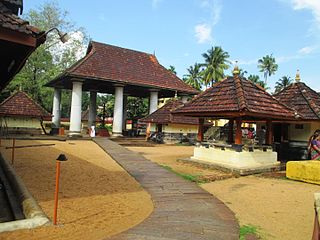
ThiruvanchikulamSivaTemple is a Hindu temple situated in Kodungallur in Thrissur district in the South Indian state of Kerala in India. Constructed in the Kerala style of architecture, the temple is believed to have been built during the Chera period in the 8th century. Shiva is worshipped as Mahadeva and his consort Parvathi as Umadevi.
M. G. S. Narayanan, born Muttayil Govindamenon Sankara Narayanan on 20 August 1932, is an Indian historian, academic and political commentator. He headed the Department of History at Calicut University (Kerala) from 1976 to 1990. He writes and appears in magazines and popular media regularly. He is generally considered as "one of India’s top authorities on ancient history".
Vazhappally Sree Mahadevar Temple is a Hindu temple located in Vazhappally near Changanassery in Kottayam district in the Indian state of Kerala. Believed to be constructed in the 1st Chera king. According to the legend, Kerala is the land gifted by Lord Parasurama, the sixth incarnation of Lord Maha Vishnu. The installation of the idol of the Lord Mahadeva was performed by Lord Parasurama himself. The Vazhappally Maha Siva Temple is one of the few temples of the state where two Nalambalam and two Flagmast are dedicated. This magnificent temple is one among the 108 Siva Temples established by Lord Parasurama. Lord Maha Vishnu was incarnated as Parasurama in the Tretayuga; the exact period of installation of this temple is not known.
Sthanu Ravi Varma, known as the Kulasekhara, was the Kulasekhara/Kodungallur Chera ruler (Perumal) of Kodungallur in southern India from 844 to mid-880s CE. Sthanu Ravi is often identified with playwright king Kulasekhara Varma, and with Bhakti saint Kulasekhara Alvar.
Kollam Rameswaram Mahadeva Temple is located in the city of Kollam City in Kollam district. The presiding deity of the temple is Lord Rameswara facing west. It is believed that Kollam Rameswaram Mahadeva Temple is one of the 108 Shiva temples of Kerala and is installed by sage Parasurama dedicated to Lord Shiva It is one of the two Rameswaram temples in 108 Shivalaya Sothram. The Amaravila Rameshwaram Sri Mahadeva Temple is the second Rameshwaram Temple. The temple is located in the village of Amaravila in Thiruvananthapuram District.
Viraraghava copper plates, dated 1225 CE, of Cochin, or Kottayam plates of Viraraghava Chakravartin, or Syrian Christian copper plate, describe the concession made by the local king Viraraghava to Christian merchant Iravikorttan, the chief of Manikkiramam (Manigiramam) in Makotaiyar Pattinam.
Ravi Neeli was a Kerala/Chera princess from Kodungallur, south India, daughter of king at Kodungallur Goda Ravi "Vijayaraga", and queen of Chola king Parantaka. The marriage between Ravi Neeli and Parantaka, c. 910 CE, is celebrated in the Udayendiram plates of Prthvipati II Hastimalla. Her son with Parantaka, Rajaditya Chola, was killed in the battle of Takkolam in 949 CE. Ravi Neeli is also known to have lived in Rajadityapura, the headquarters of prince Rajaditya, with her female-servant Chitra Komalam.
| This article about a person notable in Hinduism is a stub. You can help Wikipedia by expanding it. |