Related Research Articles

Ayyappan, also called Dharmasastha and Manikandan, is a Hindu deity popular in Southern India. He is considered to be the epitome of dharma, truth, and righteousness and is often called upon to obliterate evil.

The Sabarimala Sree Ayyappan Temple is a Hindu temple that is devoted to the worship of a deity named Ayyappan, also known as Dharma Shasta. Ayyappan is believed to be the son of Shiva and Mohini. The temple is situated atop a hill in the village of Ranni-Perunad, within the Ranni Taluk of the Pathanamthitta district in the state of Kerala, India. The temple is surrounded by 18 hills in the Periyar Tiger Reserve. It is one of the largest annual pilgrimage sites in the world, with an estimate of over 10 to 15 million devotees visiting every year.

Pandalam is a is a municipality in the Pathanamthitta district of Kerala, India. Pandalam is known for its connection with Ayyappan and Sabarimala. Rightly recognised to be the educational and cultural capital of Central Travancore, Pandalam hosts educational institutions ranging from reputed schools to post graduate, training, Ayurveda, and engineering colleges. There are seven colleges and 23 schools at Pandalam, including N. S. S. College, Pandalam. The Kerala state government plans to make the place a special Township, by including the Pandalam municipality and Kulanada panchayat.

Makara Jyothi is a star worshiped by pilgrims at Sabarimala Temple in Kerala on Makara Sankranti every year. It is believed that the deity Ayyappan asserts himself as Makara Jyothi to bless his devotees.
Vavar, known reverently as Vavarswami, is a legendary figure from Kerala. He is the celebrated Muslim acquaintance of Hindu deity Ayappan. There is a shrine dedicated to Vavaraswami at Sabarimala, as well as Vavaraswami's mosque at Erumely opposite to an Ayyappan temple.

The Aranmula Parthasarathy Temple is a Hindu temple located near Aranmula, a village in Pathanamthitta District, Kerala, South India. It is dedicated to the God Krishna, an avatar of Vishnu, who is worshipped as Parthasarathy. Constructed in the Kerala style of architecture, it is one of the "Divya Desams", the 108 temples of Vishnu revered by the Alvar saints.
Harivarasanam (ഹരിവരാസനം) is a Manipravalam ashtakam in praise of lord Shiva but sung as a lullaby for Lord Ayyappan at the Sabarimala Sree Dharma Sastha Temple, situated in Kerala, India. The song became popular through the first stanza in the Keerthanam known as Hariharatmajashtakam (ഹരിഹരാത്മജാഷ്ട്ടകം).

Valiakoikkal Temple is the family temple of the Pandalam Royal Family. The temple is located at Pandalam in Pathanamthitta District, Kerala, in the peninsular India. It is situated within the Pandalam Palace premises. The main deity is Ayyappan. Procession of the Thiruvabharanam towards Sabarimala shrine starts from the Valiyakoikkal temple every year before the Makaravilakku festival. Millions of devotees visit this temple every year during the Makaravilakku festive season.
Keshava Parasaran is a lawyer from India. He was Advocate General of Tamil Nadu during President's rule in 1976, Solicitor General of India under the then Prime Minister Indira Gandhi and then, Attorney General of India under Prime Ministers Indira Gandhi and Rajiv Gandhi between 1983 and 1989, till the end of Rajiv Gandhi's tenure. Parasaran was awarded the Padma Bhushan in the year 2003 and Padma Vibhushan in the year 2011. In June 2012, he received a presidential nomination to the Rajya Sabha, the upper house of India's parliament, for a period of six years. He is a member of Shri Ram Janmabhoomi Teerth Kshetra. In 2019 the Central Government appointed him to lead the Shri Ram Janmabhoomi Teerth Kshetra. However later, Mahant Nritya Gopal Das was appointed to lead the trust. The trust will oversee the construction of Ram Temple in Ayodhya.

Kesavananda Bharati was an Indian Hindu monk who served as the Shankaracharya (head) of Edneer Mutt, a Hindu monastery in Kasaragod district, Kerala, India from 1961 until his death. He was the petitioner in Kesavananda Bharati v. State of Kerala, a landmark case that helped establish the basic structure doctrine of the Indian Constitution which guarantees that the fundamental or 'basic structure' of the Indian Constitution can not be altered by parliamentary amendment. He was a follower of Smartha Bhagawatha tradition and the Advaita Vedanta school of Hindu philosophy.
Rajah Annamalaipuram Ayyappan Koil is a Hindu temple dedicated to the deity Ayyappa in Chennai, India. It is located at Raja Annamalaipuram, a coastal neighbourhood of Chennai.

Rahul Easwar is an Indian public policy commentator and activist from Kerala.
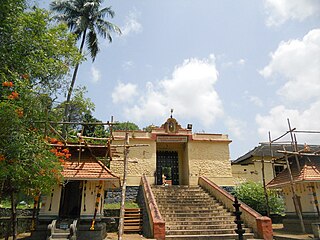
The Achankovil Sastha Temple is a Hindu temple located near the banks of the Achankovil River in the Kollam district in the Indian state of Kerala. It is one of the five important temples dedicated to Shasta in Kerala, the others being Kulathupuzha, Aryankavu, Sabarimala and Kanthamala. The idol in the temple is believed to have been consecrated by Parashurama. The temple is known for curing poisonous snakebites. The Travancore Devaswom Board administers the temple.

The Aryankavu Sastha Temple is a Hindu temple located in Aryankavu in the Kollam district of the Indian state of Kerala. It is one of the five major temples dedicated to Shasta in Kerala, the others being Kulathupuzha, Achankovil, Sabarimala and Kanthamala. The temple's idol is believed to have been consecrated by Parashurama. The temple is governed by the Travancore Devaswom Board.
Sabarimala is a temple dedicated to Shasta, in Pathanamthitta District, Kerala, India. Women and girls of reproductive age have traditionally not been permitted to worship there, as Shasta is a celibate deity. The Kerala high court provided a legal justification for this tradition, and since 1991 onwards, women and girls were legally forbidden to enter the temple.

Vanitha Mathil was a human chain formed on 1 January 2019 across the Indian state of Kerala to uphold gender equality and protest against gender discrimination. The wall was formed solely by women and extended for a distance of around 620 kilometres from Kasargod to Thiruvananthapuram. Around three to five million women participated in the event.
Kaleeswaram Raj is an Indian lawyer practising in the Supreme Court of India and the High Court of Kerala. He has successfully argued for decriminalisation of the offence of adultery in India.
Sabarimala Ayyappa Seva Samajam (SASS) is an organization of Ayyappan devotees and an affiliate of the Sangh Parivar. It is a registered public charitable trust started on 13 November 2008 with headquarters at Pathanamthitta in Kerala. SASS aims to serve Ayyappa devotees in their pilgrimage to Sabarimala and inculcate dharmic values in them and their families and bring them together to further the larger aim of Hindu unity. SASS activities can be listed in 5S: Satsang, Swaadhyay, Seva, Samarasta and Sangharsh.
Rehana Fathima, also known as Suryagayathri, is an Indian women’s rights activist from Kerala.

J. Sai Deepak is an Indian lawyer and author of the India / Bharat tetralogy. As a counsel, he practices before the Supreme Court of India and the High Court of Delhi.
References
- ↑ "Sabarimala debate: #HappyToBleed Vs #ReadyToWait - Times of India". The Times of India. Retrieved 10 August 2018.
- 1 2 "#ReadyToWait: A campaign to reclaim Hindu temples and traditions | IndiaFacts". IndiaFacts. 31 August 2016. Retrieved 10 August 2018.
- ↑ Rajagopal, Krishnadas (27 October 2016). "Ready to wait till 50 to enter Sabarimala: Women's group". The Hindu. ISSN 0971-751X . Retrieved 10 August 2018.
- 1 2 Varier, Megha (27 October 2016). "Women's group moves SC over Sabarimala entry, says 'We are ReadyToWait'". The News Minute. Retrieved 13 December 2016.
- 1 2 "SC praises lawyer for spirited defence in Sabarimala case". Business Standard India. Press Trust of India. 26 July 2018. Retrieved 10 August 2018.
- ↑ "Sabarimala case: Deity living person, has right to privacy, women devotees to SC". The Indian Express. 27 July 2018. Retrieved 10 August 2018.
- 1 2 "Sabarimala verdict: Here's what Justice Indu Malhotra said in her dissenting opinion". The Indian Express. 28 September 2018. Retrieved 1 October 2018.
- ↑ Rajagopal, Krishnadas (19 January 2016). "Call for 1991 Sabarimala case records: Kerala". The Hindu. ISSN 0971-751X . Retrieved 11 August 2018.
- 1 2 "Sabarimala women's entry debate: ReadytoWait campaign renewed". The News Minute. 23 July 2018. Retrieved 11 August 2018.
- ↑ Reporter, B. S. (12 January 2016). "SC asks why women can't enter Sabarimala temple". Business Standard India. Retrieved 12 August 2018.
- ↑ "With 5 posers, SC sends Sabarimala case to 5-judge Constitution bench - Times of India". The Times of India. Retrieved 12 August 2018.
- ↑ Rajagopal, Krishnadas (24 October 2016). "Haji Ali Dargah to allow entry of women". The Hindu. ISSN 0971-751X . Retrieved 11 August 2018.
- ↑ "Sabarimala row gets Facebook imprint". The Hindu. 31 August 2016. ISSN 0971-751X . Retrieved 12 September 2016.
- ↑ "These Kerala women are 'ReadyToWait' to beat 'conspiracy' against Sabarimala". 29 August 2016. Retrieved 12 September 2016.
- 1 2 "Sabarimala row: Women devotees are #ReadyToWait". The Week . Retrieved 12 September 2016.
- 1 2 "#ReadyToWait: A campaign to reclaim Hindu temples and traditions | IndiaFacts". 31 August 2016. Retrieved 12 September 2016.
- ↑ "#ReadyToWait: A campaign to reclaim Hindu temples and traditions; Anjali George speaks to India Facts". Vishwa Samvada Kendra. 31 August 2016. Retrieved 3 January 2017.
- ↑ "Interview with Shilpa Nair – #ReadyToWait campaigner – People For Dharma". peoplefordharma.org. Retrieved 11 August 2018.
- ↑ Keralam, Haindava (28 October 2016). "Sabarimala PIL - #ReadyToWait, Women Devotees Move SCÂ". Haindava Keralam. Retrieved 11 August 2018.
- ↑ "SC reserves order on judgement against ban on women's entry in Sabarimala temple | Free Press Journal". Free Press Journal. 1 August 2018. Retrieved 10 August 2018.