Related Research Articles

Mohammad Khatami is an Iranian reformist politician who served as the fifth president of Iran from 3 August 1997 to 3 August 2005. He also served as Iran's Minister of Culture from 1982 to 1992. Later, he was critical of the government of subsequent President Mahmoud Ahmadinejad.
The president of the Islamic Republic of Iran is the head of government of the Islamic Republic of Iran and the second highest-ranking official, after the supreme leader. The first election was held in 1980 and was won by Abulhassan Banisadr. Masoud Pezeshkian currently serves as the president of Iran, after being elected in the 2024 Iranian presidential election and being officially endorsed by the supreme leader.

Ali Hosseini Khamenei is an Iranian cleric and politician who has served as the second supreme leader of Iran since 1989. He previously served as the third president of Iran from 1981 to 1989. Khamenei's 35-year-long rule makes him the longest-serving head of state in the Middle East, as well as the second-longest-serving Iranian leader of the last century after Shah Mohammad Reza Pahlavi. Khamenei is a marja', a title given to the highest level of religious cleric in Twelver Shi'sm.

The Reformists are a political faction in Iran. Iran's "reform era" is sometimes said to have lasted from 1997 to 2005—the length of President Mohammad Khatami's two terms in office. The Council for Coordinating the Reforms Front is the main umbrella organization and coalition within the movement; however, there are reformist groups not aligned with the council, such as the Reformists Front. Masoud Pezeshkian, a reformist, was elected president following the 2024 Iranian presidential election, and was subsequently approved by the Supreme Leader on the 28th of July, having been inaugurated two days afterwards in Tehran.
The Iranian student protests of July 1999 were, before the 2009 Iranian election protests, the most widespread and violent public protests to occur in Iran since the early years of the Iranian Revolution.

Presidential elections were held in Iran 17 June 2005, with a second round run-off on 24 June. Mohammad Khatami, the outgoing president of Iran, stepped down on 2 August 2005, after serving his maximum two consecutive four-year terms according to the Islamic republic's constitution.

Abdollah Noori is an Iranian cleric and reformist politician. Despite his "long history of service to the Islamic Republic," he became the most senior Islamic politician to be sentenced to prison since the Iranian Revolution, when he was sentenced to five years in prison for political and religious dissent in 1999. He has been called the "bête noire" of Islamic conservatives in Iran.

Mehdi Karroubi is an Iranian Shia cleric and reformist politician leading the National Trust Party. Following 2009–2010 Iranian election protests, Karroubi was put under house arrest in February 2011. As of 2021, he is still confined to his house.
Special Clerical Court, or Special Court for Clerics is a special Iranian judicial system for prosecuting crimes, both ordinary and political, committed by Islamic clerics and scholars. The Special Clerical Court can defrock and disbar Islamic jurists, give sentences of imprisonment, corporal punishment, execution, etc. The court functions independently of the regular Iranian judicial framework, with its own security and prison systems, "generally secret and confidential" cases, proceedings and procedures, and is accountable only to the Supreme Leader of Iran,. The most senior Islamic politician to be prosecuted and sentenced to prison since the Iranian Revolution was Abdollah Nouri who was sentenced to five years in prison for political and religious dissent by the court in 1999.

Abdolkarim SoroushPersian pronunciation:[æbdolkæriːmsoruːʃ]), born Hossein Haj Faraj Dabbagh, is an Iranian Islamic thinker, reformer, Rumi scholar, public intellectual, and a former professor of philosophy at the University of Tehran. He is among the most influential figures in the religious intellectual movement of Iran. Soroush is currently a visiting scholar at the University of Maryland in College Park, Maryland. He was also affiliated with other institutions, including Harvard, Princeton, Yale, Columbia, the Leiden-based International Institute as a visiting professor for the Study of Islam in the Modern World (ISIM) and the Wissenschaftskolleg in Berlin. He was named by Time magazine as one of the world's 100 most influential people in 2005, and by Prospect magazine as one of the most influential intellectuals in the world in 2008. Soroush's ideas, founded on relativism, prompted both supporters and critics to compare his role in reforming Islam to that of Martin Luther in reforming Christianity.

Presidential elections were held in Iran on 23 May 1997, which resulted in an unpredicted win for the reformist candidate Mohammad Khatami. The election was notable not only for the lopsided majority of the winner - 70% - but for the high turnout. 80% of those eligible to vote did so, compared to 50% in the previous presidential election.
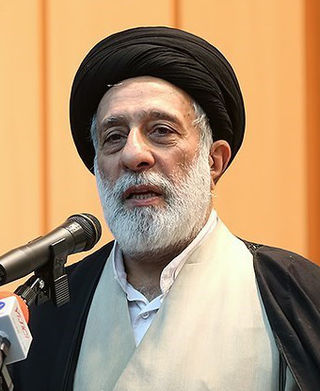
Hujjat al-Islam Sayyid Hadi Khamenei is an Iranian reformist politician, mujtahid and linguist. He is a key member of the reformist Association of Combatant Clerics, and a former deputy of the Majlis of Iran representing a district in Tehran.

Ansar-e Hezbollah is a conservative paramilitary organization in Iran. According to the Columbia World Dictionary of Islamism, it is a "semi-official quasi-clandestine organization of a paramilitary character that performs vigilante duties".

Sadeq Ardeshir Larijani, better known as Amoli Larijani, is an Iranian scholar, conservative politician, and current chairman of Expediency Discernment Council. He is the former and fifth Chief Justice of the judicial system of Iran after the 1979 revolution.
Mohammad Khatami, former President of Iran, announced his candidacy for the 2009 Iranian presidential election on 8 February 2009. Khatami later pulled out of the race.

Mir-Hossein Mousavi Khameneh served as the last Prime Minister of Iran from 1981 to 1989, before the position was abolished in the 1989 constitutional review. In the years leading up to the Islamic Revolution, Mousavi and his wife, Zahra Rahnavard, moved to the United States. They returned shortly after the establishment of the Islamic Republic. Mousavi later ran for office in the 2009 Iranian presidential election, but lost to Mahmoud Ahmadinejad.
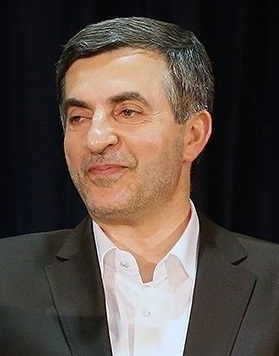
Esfandiar Rahim Mashaei is an Iranian conservative politician and former intelligence officer. As a senior Cabinet member in the administration of President Mahmoud Ahmadinejad, he served as Chief of Staff from 2009 to 2013, and served as the fourth first vice president of Iran for one week in 2009 until his resignation was ordered by Supreme Leader Ayatollah Ali Khamenei.

Hassan Rouhani is an Iranian politician who served as the seventh president of Iran from 2013 to 2021. He is also a sharia lawyer ("Wakil"), academic, former diplomat and Islamic cleric. He served as a member of Iran's Assembly of Experts from 1999 to 2024. He was a member of the Expediency Council from 1991 to 2013, and also was a member of the Supreme National Security Council from 1989 to 2021. Rouhani was deputy speaker of the fourth and fifth terms of the Parliament of Iran (Majlis) and Secretary of the Supreme National Security Council from 1989 to 2005. In the latter capacity, he was the country's top negotiator with the EU three, UK, France, and Germany, on nuclear technology in Iran, and has also served as a Shia mujtahid, and economic trade negotiator.
The Statement of 14 Political Activists is an open letter signed by 14 political activists inside Iran, aimed at People of Iran, calling Ali Khamenei to resign his post of Supreme Leader after 20-year tenure. It was published online on tenth anniversary of controversial 2009 Iranian presidential election. One week after first letter, they published another letter asking for abolition of Islamic republic and establishment of a democratic secular government.
References
- ↑ "آفتاب - خاتمی: دلمان برای ایران میسوزد". Archived from the original on 14 October 2009. Retrieved 11 October 2009.
- ↑ "Abdolkarim Soroush :: عبدالکريم سروش". www.drsoroush.com. Retrieved 16 July 2017.
- ↑ "EBADI RETURNED TRIUMPHANTLY, AS KHATAMI INSULTED IRANIANS". www.iran-press-service.com. Retrieved 16 July 2017.
- ↑ Amir Taheri (19 December 2008), "Why Ahmadinejad Fears Khatami", Asharq Al Awsat , retrieved 15 December 2015
- 1 2 Akbar Torbat (2 July 2013), "The Unexpected Results of Presidential Elections in Iran", Antiwar.com , retrieved 15 December 2015
- ↑ Al-Marashi, Ibrahim (2010). "17, Televising the "Velvet Revolution": Show Trials in the Aftermath of Iran's Tenth Presidential Election". In Kamalipour, Yahya R. (ed.). Media, Power, and Politics in the Digital Age: The 2009 Presidential Election Uprising in Iran . Rowman & Littlefield Publishers. p. 183-186. ISBN 978-1-4422-0417-1.
- 1 2 Zahra Hosseinian (26 August 2009), "Iran's Khamenei says protests planned before vote", Reuters , retrieved 15 December 2015
- 1 2 "Khatami slams trial confessions", The Himalayan Times , 26 August 2009, retrieved 15 December 2015
- ↑ Ali Afshari (11 January 2011), "Khatami at a Dead End", Rooz Online , retrieved 15 December 2015
- ↑ "A Daily Roundup of News from Iran", Aswat, 30 September 2009, archived from the original on 6 April 2010, retrieved 15 December 2015