
Paulchoffatia is a genus of extinct mammal of the Upper Jurassic - Lower Cretaceous. It was a relatively early member of the also extinct order Multituberculata, within the suborder "Plagiaulacida" and family Paulchoffatiidae. It lived in Europe during the "age of the dinosaurs."
Morrisonodon brentbaatar is an extinct multituberculate mammal from the Upper Jurassic Morrison Formation of North America.
The Yixian Formation is a geological formation in Jinzhou, Liaoning, People's Republic of China, that spans the Barremian stage of the Early Cretaceous. It is known for its exquisitely preserved fossils, and is mainly composed of basalts interspersed with siliciclastic sediments.
In the geologic timescale, the Valanginian is an age or stage of the Early or Lower Cretaceous. It spans between 139.8 ± 3.0 Ma and 132.6 ± 2.0 Ma. The Valanginian Stage succeeds the Berriasian Stage of the Lower Cretaceous and precedes the Hauterivian Stage of the Lower Cretaceous.
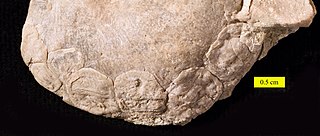
The Craniidae are a family of brachiopods, the only surviving members of the subphylum Craniiformea. They are the only members of the order Craniida, the monotypic suborder Craniidina, and the superfamily Cranioidea; consequently, the latter two taxa are at present redundant and rarely used.There are three living genera within Craniidae: Neoancistrocrania, Novocrania, and Valdiviathyris. As adults, craniids either live freely on the ocean floor or, more commonly, cement themselves onto a hard object with all or part of the ventral valve.
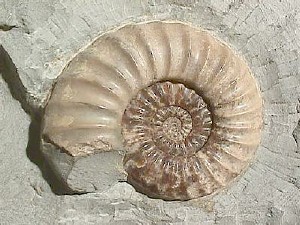
Ammonitina comprises a diverse suborder of ammonite cephalopods that lived during the Jurassic and Cretaceous periods of the Mesozoic Era. They are excellent index fossils, and it is often possible to link the rock layer in which they are found to specific geological time periods.

Hokkaidoconchidae, common name hokkaidoconchids, is an extinct family of deep-water sea snails, marine gastropod mollusks.
The Kiyosu-e Formation is a Middle Jurassic (Callovian) to Early Cretaceous (Berriasian) geologic formation of the Toyonishi Group in Yamaguchi Prefecture, Japan. Fossil ornithopod tracks have been reported from the formation.

Eryonidae is a family of fossil decapod crustaceans which lived from the Upper Triassic to the Lower Cretaceous. It contains four genera: An aggregation of three unidentified eryonids was reported in 2012 inside a Late Jurassic ammonoid of the species Harpoceras falciferum; they represent the earliest evidence of gregarious behaviour in decapods.

Stenophlebia is an extinct genus of dragon-damselfly from late Jurassic and early Cretaceous period.

Hemiphlebiidae is a family of damselflies. It contains only one extant species, the ancient greenling, native to Southern Australia and Tasmania. The fossil record of the group extends back to the Late Jurassic, making them the oldest known crown group damselflies.

Omma is a genus of beetles in the family Ommatidae. Omma is an example of a living fossil. The oldest species known, O. liassicum, lived during the final stage of the Triassic (Rhaetian), over 200 million years ago, though the placement of this species in Omma has been questioned. Numerous other fossil species are known from the Jurassic and Cretaceous of Europe and Asia. The only living species is Omma stanleyi, which is endemic to Australia. Three other extant species endemic to Australia that were formerly part of this genus were moved to the separate genus Beutelius in 2020.Omma stanleyi is strongly associated with wood, being found under Eucalyptus bark and exhibiting thanatosis when disturbed. Its larval stage and many other life details are unknown due to its rarity. Males are typically 14–20 mm in length, while females are 14.4-27.5 mm. Omma stanleyi occurs throughout eastern Australia from Victoria to Central Queensland.
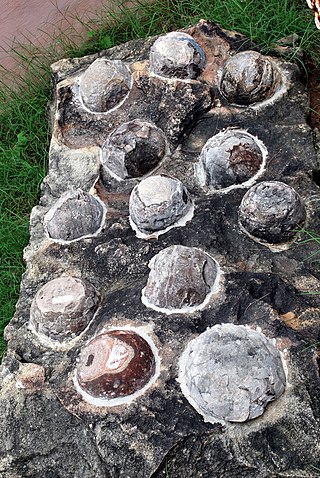
Egg fossils are the fossilized remains of eggs laid by ancient animals. As evidence of the physiological processes of an animal, egg fossils are considered a type of trace fossil. Under rare circumstances a fossil egg may preserve the remains of the once-developing embryo inside, in which case it also contains body fossils. A wide variety of different animal groups laid eggs that are now preserved in the fossil record beginning in the Paleozoic. Examples include invertebrates like ammonoids as well as vertebrates like fishes, possible amphibians, and reptiles. The latter group includes the many dinosaur eggs that have been recovered from Mesozoic strata. Since the organism responsible for laying any given egg fossil is frequently unknown, scientists classify eggs using a parallel system of taxonomy separate from but modeled after the Linnaean system. This "parataxonomy" is called veterovata.
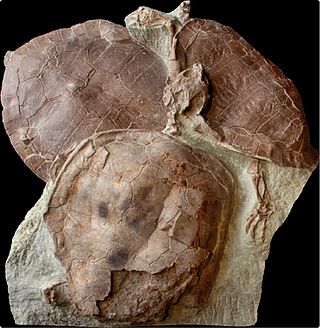
Xinjiangchelyidae is an extinct family of turtles known from the Lower Jurassic to the Middle Cretaceous of Asia and western Europe. They have generally been interpreted as either being basal cryptodires or placed outside of crown Testudines.
Plagioolithus is an oogenus of fossil egg. It is from the Early Cretaceous of Japan. It was probably laid by a bird, making it the oldest known fossil bird egg.
2015 in paleoentomology is a list of new fossil insect taxa that were described during the year 2015, as well as other significant discoveries and events related to paleoentomology that were scheduled to occur during the year.
This list of 2023 in paleoentomology records new fossil insect taxa that are to be described during the year, as well as documents significant paleoentomology discoveries and events which occurred during that year.
This list of fossil reptiles described in 2023 is a list of new taxa of fossil reptiles that were described during the year 2023, as well as other significant discoveries and events related to reptile paleontology that occurred in 2023.


