REMA S.A. (REMA Share Company) is a manufacturer of machines for processing wood and wood-based materials, located in Warsaw, Poland. The company produces circular sawing machines especially designed for sawing boards for the furniture industry. The company’s headquarters is in the town of Reszel (Warmińsko-mazurskie province).
Wood is a porous and fibrous structural tissue found in the stems and roots of trees and other woody plants. It is an organic material, a natural composite of cellulose fibers that are strong in tension and embedded in a matrix of lignin that resists compression. Wood is sometimes defined as only the secondary xylem in the stems of trees, or it is defined more broadly to include the same type of tissue elsewhere such as in the roots of trees or shrubs. In a living tree it performs a support function, enabling woody plants to grow large or to stand up by themselves. It also conveys water and nutrients between the leaves, other growing tissues, and the roots. Wood may also refer to other plant materials with comparable properties, and to material engineered from wood, or wood chips or fiber.
Warsaw is the capital and largest city of Poland. The metropolis stands on the Vistula River in east-central Poland and its population is officially estimated at 1.770 million residents within a greater metropolitan area of 3.1 million residents, which makes Warsaw the 8th most-populous capital city in the European Union. The city limits cover 516.9 square kilometres (199.6 sq mi), while the metropolitan area covers 6,100.43 square kilometres (2,355.39 sq mi). Warsaw is an alpha global city, a major international tourist destination, and a significant cultural, political and economic hub. Its historical Old Town was designated a UNESCO World Heritage Site.
Poland, officially the Republic of Poland, is a country located in Central Europe. It is divided into 16 administrative subdivisions, covering an area of 312,696 square kilometres (120,733 sq mi), and has a largely temperate seasonal climate. With a population of approximately 38.5 million people, Poland is the sixth most populous member state of the European Union. Poland's capital and largest metropolis is Warsaw. Other major cities include Kraków, Łódź, Wrocław, Poznań, Gdańsk, and Szczecin.
The enterprise was established in the middle of the 19th century as a foundry.
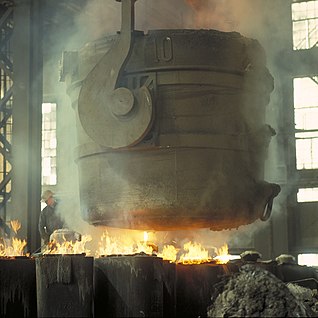
A foundry is a factory that produces metal castings. Metals are cast into shapes by melting them into a liquid, pouring the metal into a mold, and removing the mold material after the metal has solidified as it cools. The most common metals processed are aluminium and cast iron. However, other metals, such as bronze, brass, steel, magnesium, and zinc, are also used to produce castings in foundries. In this process, parts of desired shapes and sizes can be formed.
In the period between World Wars I and II, the company manufactured agricultural machines and devices. After the annexation of Northern Lands in 1945 to Poland, the company was one of the first industrial plants activated in the territory of what was then Olsztyn Province.
At first smithy begun to work in June 1945. In November 1945 the firm was taken over by the state-owned Northern Trust of Agricultural Machines in Gdańsk. Then, a new profile of production was opened: agricultural machines and machine tools for processing of peat.
Gdańsk is a Polish city on the Baltic coast. With a population of 464,254, Gdańsk is the capital and largest city of the Pomeranian Voivodeship and the capital of Kashubia. It is Poland's principal seaport and the centre of the country's fourth-largest metropolitan area.
Agricultural machinery is machinery used in farming or other agriculture. There are many types of such equipment, from hand tools and power tools to tractors and the countless kinds of farm implements that they tow or operate. Diverse arrays of equipment are used in both organic and nonorganic farming. Especially since the advent of mechanised agriculture, agricultural machinery is an indispensable part of how the world is fed.
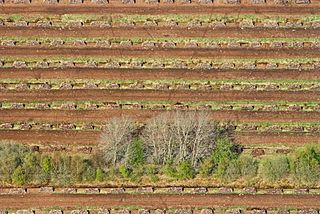
Peat, also known as turf, is an accumulation of partially decayed vegetation or organic matter. It is unique to natural areas called peatlands, bogs, mires, moors, or muskegs. The peatland ecosystem is the most efficient carbon sink on the planet, because peatland plants capture CO2 naturally released from the peat, maintaining an equilibrium. In natural peatlands, the "annual rate of biomass production is greater than the rate of decomposition", but it takes "thousands of years for peatlands to develop the deposits of 1.5 to 2.3 m [4.9 to 7.5 ft], which is the average depth of the boreal [northern] peatlands". Sphagnum moss, also called peat moss, is one of the most common components in peat, although many other plants can contribute. The biological features of Sphagnum mosses act to create a habitat aiding peat formation, a phenomenon termed 'habitat manipulation'. Soils consisting primarily of peat are known as histosols. Peat forms in wetland conditions, where flooding or stagnant water obstructs the flow of oxygen from the atmosphere, slowing the rate of decomposition.
The company accepted its new name: State Factory of Agricultural Machines. Three years later the factory was assigned to Management of Local Industry in Olsztyn and changed its name to "Mechanical Plant and Foundry". Production then began to diversify further. The company started producing builder's hoisting winches as well as machines and devices for the manufacture of litter peat. On January 1, 1975, the firm was taken over by the Management of Industrial Machinery for Forestry and changed its name to Reszel’s Plant of Industrial Machinery for Forestry (being still a part of the Trust structure).
Olsztyn is a city on the Łyna River in northeastern Poland. Olsztyn is the capital of the Warmian-Masurian Voivodeship, and is a city with county rights. The population of the city was estimated at 173,070 residents in 2017.
In the period between 1953-62 the production program became extremely varied. Aside from a line of simple devices (wheeled sets, special benches, hoisting winches), there was also an assortment of high accuracy and precision products (air-compressors, tractors, hydraulic pumps, circular sawing machines).
Since 1963, after the Trust decided to distribute production of machine tools for wood over several factories in Poland, the company began to specialise in the production of circular sawing machines, shredders and fragmentisers for processing wood and wood-based materials.
From 1973 to 1985 the factory was intensively enlarged. A new foundry started production of cast iron. New productive halls were built and in 1983 a new division was opened in Bisztynek, producing farmer’s circular saws.
Cast iron is a group of iron-carbon alloys with a carbon content greater than 2%. Its usefulness derives from its relatively low melting temperature. The alloy constituents affect its colour when fractured: white cast iron has carbide impurities which allow cracks to pass straight through, grey cast iron has graphite flakes which deflect a passing crack and initiate countless new cracks as the material breaks, and ductile cast iron has spherical graphite "nodules" which stop the crack from further progressing.
Bisztynek is a town in Bartoszyce County, Warmian-Masurian Voivodeship, Poland, with 2,418 inhabitants (2016).
In December 1990 the enterprise was transformed into legal form of Share Company, owned solely by the Treasury of the State, and changed its name to REMA S.A. (REMA Share Company).
Rema services, repairs and sells spare parts for woodcutting machine tools. [1] The primary line of products is the circular sawing machines with under-cutting spindle (scoring unit) for wood and chipboards. The company also produces cross-cutting circular saws, builder's circular saws, angular saws, radial arm saws, multi-blade rip saws, multi-functional machine tools and dust extractors. The foundry department produces cast iron: grey, nodular and alloy. [2]
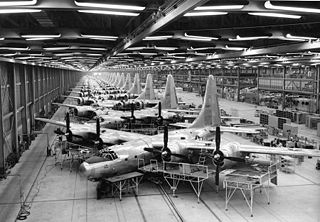
Mass production, also known as flow production or continuous production, is the production of large amounts of standardized products, including and especially on assembly lines. Together with job production and batch production, it is one of the three main production methods.
A factory,manufacturing plant or a production plant is an industrial site, usually consisting of buildings and machinery, or more commonly a complex having several buildings, where workers manufacture goods or operate machines processing one product into another.
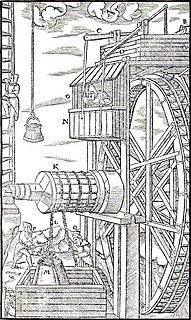
Mechanization is the process of changing from working largely or exclusively by hand or with animals to doing that work with machinery. In an early engineering text a machine is defined as follows:
Every machine is constructed for the purpose of performing certain mechanical operations, each of which supposes the existence of two other things besides the machine in question, namely, a moving power, and an object subject to the operation, which may be termed the work to be done.
Machines, in fact, are interposed between the power and the work, for the purpose of adapting the one to the other.
Portable sawmills are sawmills small enough to be moved easily and set up in the field. They have existed for over 100 years but grew in popularity in the United States starting in the 1970s, when the 1973 oil crisis and the back-to-the-land movement had led to renewed interest in small woodlots and in self-sufficiency. Their popularity has grown exponentially since 1982, when the portable bandsaw mill was first commercialized.
The Škoda Works was one of the largest European industrial conglomerates of the 20th century, founded by Czech engineer Emil Škoda in 1859 in Plzeň, then in the Kingdom of Bohemia, Austrian Empire. It is the predecessor of today's Škoda Auto and Škoda Transportation companies.
UralVagonZavod is a Russian machine building company located in Nizhny Tagil, Russia.
A line shaft is a power driven rotating shaft for power transmission that was used extensively from the Industrial Revolution until the early 20th century. Prior to the widespread use of electric motors small enough to be connected directly to each piece of machinery, line shafting was used to distribute power from a large central power source to machinery throughout a workshop or an industrial complex. The central power source could be a water wheel, turbine, windmill, animal power or a steam engine. Power was distributed from the shaft to the machinery by a system of belts, pulleys and gears known as millwork.
A machine shop is a room, building, or company where machining, a form of subtractive manufacturing, is done. In a machine shop, machinists use machine tools and cutting tools to make parts, usually of metal or plastic. A machine shop can be a small business or a portion of a factory, whether a toolroom or a production area for manufacturing. The parts produced can be the end product of the factory, to be sold to customers in the machine industry, the car industry, the aircraft industry, or others. In other cases, companies in those fields have their own machine shops.
An overhead crane, commonly called a bridge crane, is a type of crane found in industrial environments. An overhead crane consists of parallel runways with a traveling bridge spanning the gap. A hoist, the lifting component of a crane, travels along the bridge. If the bridge is rigidly supported on two or more legs running on a fixed rail at ground level, the crane is called a gantry crane or a goliath crane.
The Husqvarna Group is a Swedish manufacturer of outdoor power products including chainsaws, trimmers, brushcutters, cultivators, garden tractors, mowers, and sewing machines. Headquartered in Stockholm, Sweden, the Group also produces consumer watering products, cutting equipment and diamond tools for the construction and stone industries.
Foundry products operations was a subsidiary operation of the Cincinnati Milling Machine Company (CMM), a company which no longer exists. Some parts of the company evolved into the present Milacron, Inc. and Cincinnati Machine. CMM relied heavily on castings for the manufacturing of its machine tool products. The castings were produced at Cincinnati foundries owned by CMM and at foundries independent of CMM, between 1907 and 1988.
KUKA Systems GmbH, a division of KUKA Aktiengesellschaft, Augsburg, is an international supplier of engineering services and flexible automated manufacturing solutions with around 3,900 employees in twelve countries globally.
Sampson Moore (1812-1877) was an English engineer and inventor based in Liverpool, England during the industrial revolution. His company, Sampson Moore & Co. produced a number of notable inventions.
Huta Ludwików is one of the oldest and best-known Polish factories of metal parts. Currently owned by a Kielce-based Zakłady Wyrobów Metalowych „SHL” joint-stock company, it is a major producer of, among other things, automotive parts for most European markets. In the past the name of the factory was primarily associated with various types of military equipment produced for the Polish Army, ranging from the wz. 34 sabres and wz. 31 helmet to SHL motorcycles. It was also the main sponsor of the now-defunct SHL Kielce sports club.
Agricultural engineering in the Soviet Union - Soviet machine building industry.
Lilpop, Rau i Loewenstein was a Polish engineering company. Established in 1818 as an iron foundry, with time it rose to become a large holding company specialising in iron and steel production, as well as all sorts of machinery and metal products.
The Yamabiko Corporation is a Japanese manufacturer of power tools formed with the September 2008 merger of the Kioritz and Shindaiwa corporations. The brands owned and distributed by Yamabiko are Kioritz, Shindaiwa and ECHO. The Yamabiko Corporation is based in Ome, Japan.
The machine industry or machinery industry is a subsector of the industry, that produces and maintains machines for consumers, the industry, and most other companies in the economy.
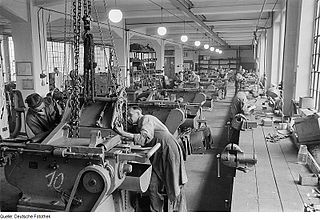
A machine factory is a company, that produces machines. These companies traditionally belong to the heavy industry sector in comparison to a more consumer oriented and less capital intensive light industry. Today many companies make more sophisticated smaller machines, and they belong to the light industry. The economic sector of machine factories is called the machine industry.
Carl and Wilhelm Blumwe were successful German entrepreneurs, industrialists and businessmen in Bromberg from the second half of the 19th century. Their buildings and realizations are still standing today in the city.