Related Research Articles
This article presents lists of literary events and publications in the 16th century.
This article contains information about the literary events and publications of 1521.

Wynkyn de Worde was a printer and publisher in London known for his work with William Caxton, and is recognised as the first to popularise the products of the printing press in England.

Juliana Berners, O.S.B.,, was an English writer on heraldry, hawking and hunting, and is said to have been prioress of the St Mary of Sopwell, near St Albans in Hertfordshire.

Syon Abbey, also called simply Syon, was a dual monastery of men and women of the Bridgettine Order, although it only ever had abbesses during its existence. It was founded in 1415 and stood, until its demolition in the 16th century, on the left (northern) bank of the River Thames within the parish of Isleworth, in the county of Middlesex, on or near the site of the present Georgian mansion of Syon House, today in the London Borough of Hounslow. It was named after the biblical holy "City of David which is Zion", built on the eponymous Mount Zion.
Robert Whittington was an English grammarian. He was a pupil at Magdalen College School, Oxford, where he probably studied under the grammarian John Stanbridge.
Charles Blount, 5th Baron Mountjoy, was an English courtier and patron of learning.

Richard Pynson was one of the first printers of English books. Born in Normandy, he moved to London, where he became one of the leading printers of the generation following William Caxton. His books were printed to a high standard of craftsmanship, and his Morton Missal (1500) is regarded as among the finest books printed in England in the period.

A mess of pottage is something immediately attractive but of little value taken foolishly and carelessly in exchange for something more distant and perhaps less tangible but immensely more valuable. The phrase alludes to Esau's sale of his birthright for a meal ("mess") of lentil stew ("pottage") in Genesis 25:29–34 and connotes shortsightedness and misplaced priorities.
Events from the 1530s in England.
George Joye was a 16th-century Bible translator who produced the first printed translation of several books of the Old Testament into English (1530–1534), as well as the first English Primer (1529).
Merten de Keyser was a 16th-century French printer and publisher, working mainly in Antwerp. He printed the first complete French and the first complete English Bible translations of several works by English Protestant authors.
Robert Wakefield was an English linguist and scholar.
Andrew Chertsey was an English translator, now known for the devotional collection The craft to lyve well and to dye.
The Treatise of Love is an English prose text first printed around 1493. Its printing was the work of Wynkyn de Worde, who took over William Caxton's printing business in 1491, and printed the Treatise before he began publishing under his own name in 1494. Drawing greatly on the Ancrene Wisse, the text contains religious advice addressed to an audience of aristocratic women.
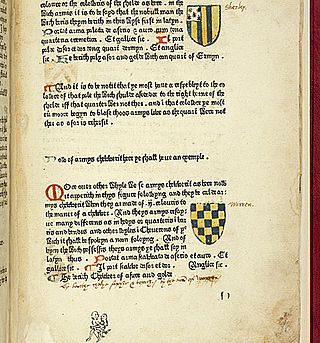
The Book of Saint Albans, originally Boke of Seynt Albans, is the common title of a book printed in 1486 that is a compilation of matters relating to the interests of the time of a gentleman. It was the last of eight books printed by the St Albans Press in England. It is also known by titles that are more accurate, such as The Book of Hawking, Hunting, and Blasing of Arms. The printer is sometimes called the Schoolmaster Printer. This edition credits the book, or at least the part on hunting, to Juliana Berners as there is an attribution at the end of the 1486 edition reading: "Explicit Dam Julyans Barnes in her boke of huntyng".
Thomas Swinnerton was an evangelical preacher and author during the English Reformation.
Speculum spiritualium is an anonymous religious compilation written in Latin, made between 1400 and 1430. The work was relatively popular, known in at least a dozen manuscripts, and printed by Wynkyn de Worde in 1510.
William Bonde was a Bridgettine monk and author. His Pilgrimage of Perfection has been described as "the last synthesis of the contemplative life to be published before the Reformation”.
Thomas Paynell was an English Augustinian and translator.
References
 This article incorporates text from a publication now in the public domain : "Whitford, Richard". Dictionary of National Biography . London: Smith, Elder & Co. 1885–1900.


