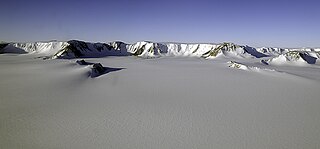
The Shackleton Range is a mountain range in Antarctica that rises to 1,875 metres (6,152 ft) and extends in an east–west direction for about 100 miles (160 km) between the Slessor and Recovery Glaciers.

Joinville Island is the largest island of the Joinville Island group, about 40 nautical miles long in an east–west direction and 12 nautical miles wide, lying off the northeastern tip of the Antarctic Peninsula, from which it is separated by the Antarctic Sound.
The Amundsen Glacier is a major Antarctic glacier, about 7 to 11 km wide and 150 km (80 nmi) long. It originates on the Antarctic Plateau where it drains the area to the south and west of Nilsen Plateau, then descends through the Queen Maud Mountains to enter the Ross Ice Shelf just west of the MacDonald Nunataks.
The Cook Mountains is a group of mountains bounded by the Mulock and Darwin glaciers in Antarctica. They are south of the Worcester Range and north of the Darwin Mountains and the Britannia Range.
The Hughes Range is a high massive north–south trending mountain range in Antarctica, surmounted by six prominent summits, of which Mount Kaplan at 4,230 metres (13,880 ft) is the highest. The range is located east of Canyon Glacier in the Queen Maud Mountains and extends 45 nautical miles from the confluence of Brandau Glacier and Keltie Glacier in the south, to the Giovinco Ice Piedmont in the north.
The Jones Mountains are an isolated group of mountains, trending generally east–west for 27 nautical miles, situated on the Eights Coast, Ellsworth Land, Antarctica, about 50 nautical miles south of Dustin Island.

Bear Peninsula is a peninsula about 50 nautical miles long and 25 nautical miles wide which is ice-covered except for several isolated rock bluffs and outcrops along its margins, lying 3 nautical miles east of Martin Peninsula on Walgreen Coast, Marie Byrd Land, Antarctica.
The Flood Range is a range of large snow-covered mountains extending in an east–west direction for about 60 nautical miles and forming a right angle with the southern end of the Ames Range in Marie Byrd Land, Antarctica.

The Prince Charles Mountains are a major group of mountains in Mac. Robertson Land in Antarctica, including the Athos Range, the Porthos Range, and the Aramis Range. The highest peak is Mount Menzies, with a height of 3,228 m (10,591 ft). Other prominent peaks are Mount Izabelle and Mount Stinear. These mountains, together with other scattered peaks, form an arc about 420 km (260 mi) long, extending from the vicinity of Mount Starlight in the north to Goodspeed Nunataks in the south.
The Porthos Range is the second range south in the Prince Charles Mountains of Antarctica, extending for about 30 miles in an east-to-west direction between Scylla Glacier and Charybdis Glacier. First visited in December 1956 by the Australian National Antarctic Research Expeditions (ANARE) southern party under W.G. Bewsher (1956-57) and named after Porthos, a character in Alexandre Dumas, père's novel The Three Musketeers, the most popular book read on the southern journey.
On the continent of Antarctica, the Aramis Range is the third range south in the Prince Charles Mountains, situated 11 miles southeast of the Porthos Range and extending for about 30 miles in a southwest–northeast direction. It was first visited in January 1957 by Australian National Antarctic Research Expeditions (ANARE) southern party led by W.G. Bewsher, who named it for a character in Alexandre Dumas' novel The Three Musketeers, the most popular book read on the southern journey.
The Anderson Hills are an irregular group of hills, ridges and peaks between Mackin Table and the Thomas Hills in the Patuxent Range, Pensacola Mountains, Antarctica.
Watson Escarpment is a major escarpment in the Queen Maud Mountains, trending northward along the east margin of Scott Glacier, then eastward to Reedy Glacier where it turns southward along the glacier's west side. Somewhat arcuate, the escarpment is nearly 100 nautical miles long, rises 3,550 metres (11,650 ft) above sea level, and 1,000 to 1,500 metres above the adjacent terrain.
Coulter Heights are snow-covered heights that rise between Strauss Glacier and Frostman Glacier near the coast of Marie Byrd Land, Antarctica. The rock outcrops of Kuberry Rocks, Matikonis Peak and Lambert Nunatak protrude above the snow surface of the heights.
The Pecora Escarpment is an irregular escarpment, 7 nautical miles long, standing 35 nautical miles southwest of Patuxent Range and marking the southernmost exposed rocks of the Pensacola Mountains.
The Malta Plateau is an ice-covered plateau of about 25 nautical miles extent in the Victory Mountains of Victoria Land, Antarctica. The plateau is irregular in shape and is bounded on the south and west by Mariner Glacier, on the north by tributaries to Trafalgar Glacier, and on the east by tributaries to Borchgrevink Glacier.

Larsen Inlet is an inlet, formerly ice-filled, 12 nautical miles long in a north–south direction and 7 nautical miles wide, between Cape Longing and Cape Sobral along the east coast of Graham Land, Antarctica.
The Columbia Mountains are a group of largely bare rock peaks, ridges and nunataks located near the east margin of the Dyer Plateau, 20 nautical miles south-east of the Eternity Range, in Palmer Land, Antarctica.

Aristotle Mountains is the fan-shaped sequence of ridges spreading east-northeastwards from its summit Madrid Dome on Oscar II Coast in Graham Land on the Antarctic Peninsula. The feature is named after the ancient Greek scientist Aristotle who in his book Meteorology dated c. 350 BC was the first to conjecture the existence of a landmass in the southern high-latitude region, calling it Antarctica.


