Related Research Articles
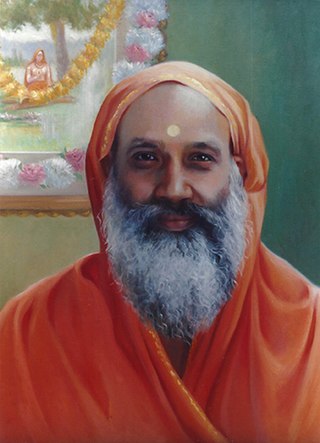
Swami Dayananda Saraswati was a renunciate of the Hindu order of sannyasa, a renowned traditional teacher of Advaita Vedanta, and founder of the Arsha Vidya Gurukulam and AIM For Seva.

The Supreme Court of India is the supreme judicial authority of India and the highest court of the Republic of India under the constitution. It is the highest constitutional court and has the final decision in all legal matters. It also has the power of judicial review. The Chief Justice of India is the Head of the Supreme Court, which consists of a maximum of 34 judges, and has extensive powers in the form of original, appellate and advisory jurisdictions.
Freedom of religion in India is a fundamental right guaranteed by Article 25-28 of the Constitution of India. Modern India came into existence in 1947 and the Indian constitution's preamble was amended in 1976 to state that India is a secular state. Supreme Court of India ruled that India was already a secular state from the time it adopted its constitution, what actually was done through this amendment is to state explicitly what was earlier contained implicitly under article 25 to 28. Every citizen of India has a right to practice and promote their religion peacefully. However, there have been numerous incidents of religious intolerance that resulted in riots and violence, notably, the 1984 Anti-Sikh Massacre in Delhi, 1990 Exodus of Kashmiri Hindus from Kashmir, the 2008 Anti-Christian riots in Odisha. Some perpetrators of the 1984 Anti-Sikh Massacre in Delhi have not been brought to justice despite widespread condemnation.
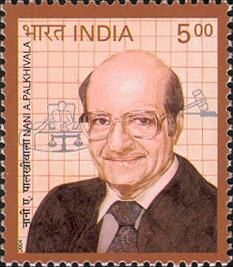
Nani Ardeshir Palkhivala was an Indian jurist and liberal economist.

Konakuppakatil Gopinathan Balakrishnan is an Indian judge who has been the Chairperson of the National Human Rights Commission of India. He is a former Chief Justice of India. He was the first judge from Kerala to become the Chief Justice of the Supreme Court. His tenure lasting more than three years has been one of the longest in the Supreme Court of India. While being Chief Justice of Gujarat High Court, he was appointed as the Acting Governor of Gujarat from 16th January 1999 to 18th March 1999.In 2010, he was conferred with an honorary doctorate by Cochin University of Science and Technology.
Rana Bhagwandas was a Pakistani jurist who served as a senior judge and acting chief justice of the Supreme Court of Pakistan (CJP). He enjoyed extremely high reputation as a judge. He remained the acting CJP during the 2007 judicial crisis in Pakistan, and also briefly became the acting Chief Justice of Pakistan when the incumbent Iftikhar Muhammad Chaudhry went on foreign tours in 2005 and 2006, and thus became the first Hindu and the second non-Muslim to serve as chief of the highest court in Pakistan. Rana Bhagwandas also worked as the Chairman of Federal Public Service Commission of Pakistan. He headed the interview panel for the selection of the federal civil servants in 2009.
Jainism is considered to be a legally distinct religion in India. A section of scholars earlier considered it as a Hindu sect or a Buddhist heresy, but it is one of the three ancient Indian religions. On 27 January 2014, the Government of India explicitly awarded the status of a "minority religion" to the Jain community in India, as per Section 2(c) of the National Commission for Minorities (NCM) Act (NCM), 1992.

Hans Raj Khanna was an Indian judge, jurist and advocate who propounded the basic structure doctrine in 1973 and attempted to uphold civil liberties during the time of Emergency in India in a lone dissenting judgement in 1976. He entered the Indian judiciary in 1952 as an Additional District and Sessions Judge and subsequently was elevated as a judge to the Supreme Court of India in 1971 where he continued till his resignation in 1977.
Kesavananda Bharati Sripadagalvaru & Ors. v. State of Kerala & Anr., also known as the Kesavananda Bharati judgement, was a landmark decision of the Supreme Court of India that outlined the basic structure doctrine of the Indian Constitution. The case is also known as the Fundamental Rights Case. The court in a 7-6 decision asserted its right to strike down amendments to the constitution that were in violation of the fundamental architecture of the constitution.
Rev Stanislaus vs Madhya Pradesh, 1977 SCR (2) 611, is a matter where the Supreme Court of India considered the issue whether the fundamental right to practise and propagate religion includes the right to convert, held that the right to propagate does not include the right to convert and therefore upheld the constitutional validity of the laws enacted by Madhya Pradesh and Odisha legislatures prohibiting conversion by force, fraud or allurement.

Shanti Bhushan was an Indian politician and lawyer. He served as the Law Minister of India holding office at the Ministry of Law and Justice from 1977 to 1979 in the Morarji Desai Ministry. He was a senior advocate of the Supreme Court of India. He, along with his son Prashant Bhushan, was featured at 74th position in a list of the most powerful Indians published by The Indian Express in 2009.

Jagdish Sharan Verma was an Indian jurist who served as the 27th Chief Justice of India from 25 March 1997 to 18 January 1998. He was the chairman of National Human Rights Commission from 1999 to 2003, and chairman of the Justice Verma Committee Report on Amendments to Criminal Law after the 2012 Delhi gang rape case. He remains one of India's most highly regarded Chief Justices and eminent jurists in its history.

Fali Sam Nariman is an Indian jurist. He is the senior advocate to the Supreme Court of India since 1971 and was the President of the Bar Association of India from 1991 to 2010. Nariman is an internationally recognised jurist on international arbitration. He has been honored with the 19th Lal Bahadur Shastri National Award for Excellence in Public Administration 2018. He is one of India's most distinguished constitutional lawyers and he has argued several leading cases. He remained Additional Solicitor General of India May 1972- June 1975.
The hate speech laws in India aim to prevent discord among its many ethnic and religious communities. The laws allow a citizen to seek the punishment of anyone who shows the citizen disrespect "on grounds of religion, race, place of birth, residence, language, caste or any other ground whatsoever". Section 153A of the Indian penal code prohibits citizens from creating disharmony or feelings of enmity, hatred or ill-will between different groups of people.
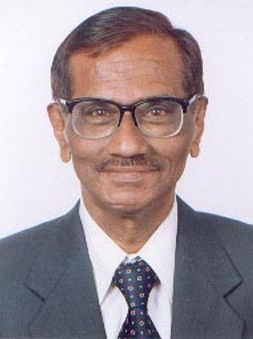
Bal Patil was a Jain scholar, journalist, social activist and Jain minority status advocate from Mumbai, Maharashtra. He was appointed as a member of State Minority Commission by the Govt. of Maharashtra from 2001 to 2004. He was the Secretary-General of All India Jain Minority Forum, New Delhi—a position he held until his death—and was an ardent advocate of minority status for Jainism. The Jain minority cause gained prominence when he petitioned the Supreme Court of India for the recognition of Jain religious minority status on par with other Indian minorities as per the two recommendations by the National Minorities Commission. He was also the first non-medical President of the National Society for the Prevention of Heart Disease & Rehabilitation, Mumbai. He has also authored many books on Jainism and presented several papers at various seminars and conferences.

The Bhagavad Gita As It Istrial in Russia was a trial that commenced in 2011 about banning the Russian edition of the book Bhagavad Gita As It Is (1968), a translation and commentary of the Hindu holy text Bhagavad Gita, on charges that the commentaries fomented religious extremism. It contains a translation and commentary by A.C. Bhaktivedanta Swami Prabhupada, founder of the International Society for Krishna Consciousness (ISKCON), commonly known as the Hare Krishna movement.

Prafulla Chandra Pant is an Indian retired judge and author who served as a judge of the Supreme Court of India from 2014 to 2017. He also served as a member of the National Human Rights Commission of India from 2019 to 2021. Prior to his appointment as a judge of the Supreme Court of India, he had previously served as Chief Justice of Meghalaya High Court at Shillong and as a judge of Uttarakhand High Court at Nainital.
Justice Gita Mittal is an Indian judge.She is the former Chief Justice of the Jammu and Kashmir High Court and the first woman judge to serve in that capacity. She has also served as the Acting Chief Justice and Judge of Delhi High Court.

The Uttar Pradesh Prohibition of Unlawful Religious Conversion Ordinance, 2020, referred to as the Love Jihad law by most of the media, is an anti-conversion law enacted by the Government of Uttar Pradesh, India. The Uttar Pradesh state cabinet cleared the ordinance on 24 November 2020 following which it was approved and signed by state Governor Anandiben Patel on 28 November 2020.
In December 2021, a dharma sansad of Hindu ascetics was held at Haridwar in Uttarakhand, India, where hate speeches were delivered in which the speakers called for a genocide against Muslims in the name of protecting Hinduism. The government's apathy in the face of the hate event has been condemned by a wide cross section of Indian society, including retired military leaders, civil society activists, students, academics, and retired judges.
References
- ↑ The Hindustan Times Archived 5 June 2011 at the Wayback Machine
- ↑ The Telegraph [ dead link ]
- ↑ The Statesman Archived 20 September 2007 at the Wayback Machine