
A dwarf galaxy is a small galaxy composed of about 1000 up to several billion stars, as compared to the Milky Way's 200–400 billion stars. The Large Magellanic Cloud, which closely orbits the Milky Way and contains over 30 billion stars, is sometimes classified as a dwarf galaxy; others consider it a full-fledged galaxy. Dwarf galaxies' formation and activity are thought to be heavily influenced by interactions with larger galaxies. Astronomers identify numerous types of dwarf galaxies, based on their shape and composition.
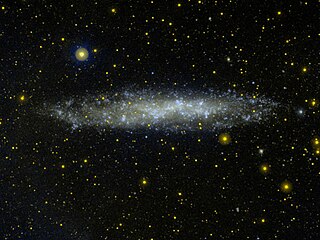
NGC 3109 is a small barred Magellanic type spiral or irregular galaxy around 4.35 Mly away in the direction of the constellation of Hydra. NGC 3109 is believed to be tidally interacting with the dwarf elliptical galaxy Antlia Dwarf. It was discovered by John Herschel on March 24, 1835 while he was in what is now South Africa.

Willman 1 is an ultra low-luminosity dwarf galaxy or a star cluster. Willman 1 was discovered in 2004. It is named after Beth Willman of Haverford College, the lead author of a study based on the Sloan Digital Sky Survey data. The object is a satellite of the Milky Way, at ~120,000 light-years away. Willman 1 has an elliptical shape with the half-light radius of about 25 pc. Its heliocentric velocity is approximately −13 km/s.

The Milky Way is the galaxy that includes the Solar System, with the name describing the galaxy's appearance from Earth: a hazy band of light seen in the night sky formed from stars that cannot be individually distinguished by the naked eye.

NGC 1097 is a barred spiral galaxy about 45 million light years away in the constellation Fornax. It was discovered by William Herschel on 9 October 1790. It is a severely interacting galaxy with obvious tidal debris and distortions caused by interaction with the companion galaxy NGC 1097A.
Canes Venatici I or CVn I is a dwarf spheroidal galaxy situated in the Canes Venatici constellation and discovered in 2006 in the data obtained by Sloan Digital Sky Survey. It is one of the most distant known satellites of the Milky Way as of 2011 together with Leo I and Leo II. The galaxy is located at a distance of about 220 kpc from the Sun and is moving away from the Sun at a velocity of about 31 km/s. It is classified as a dwarf spheroidal galaxy (dSph) meaning that it has an elliptical shape with the half-light radius of about 550 pc.

The Antlia Dwarf is a dwarf spheroidal/irregular galaxy. It lies about 1.3 Mpc from Earth in the constellation Antlia. It is the fourth and faintest member of the nearby Antlia-Sextans Group of galaxies. The galaxy contains stars of all ages, contains significant amounts of gas, and has experienced recent star formation. The Antlia Dwarf is believed to be tidally interacting with the small barred spiral galaxy NGC 3109.

In astronomy, stellar kinematics is the observational study or measurement of the kinematics or motions of stars through space.
Canes Venatici II or CVn II is a dwarf spheroidal galaxy situated in the Canes Venatici constellation and discovered in 2006 in data obtained by the Sloan Digital Sky Survey. The galaxy is located at a distance of about 150 kpc from the Sun and moves towards the Sun with the velocity of about 130 km/s. It is classified as a dwarf spheroidal galaxy (dSph) meaning that it has an elliptical shape with a half-light radius of about 74+14
−10 pc.
Leo T is a dwarf galaxy situated in the Leo constellation and discovered in 2006 in the data obtained by Sloan Digital Sky Survey. The galaxy is located at the distance of about 420 kpc from the Sun and moves away from the Sun with the velocity of about 35 km/s. The velocity with respect to the Milky Way is around −60 km/s implying a slow infall onto the Milky Way. Leo T is classified as a transitional object between dwarf spheroidal galaxies (dSph) and dwarf irregular galaxies (dIrr). Its half-light radius is about 180 pc.
SDSS J0106-1000 is a binary star located about 7,800 light-years from Earth in the constellation Cetus.

M60-UCD1 is an ultracompact dwarf galaxy. It is 49 million light years from Earth, close to Messier 60 in the Virgo Cluster. Half of its stellar mass is in the central sphere 160 light years in diameter.
SDSS J001820.5–093939.2 or SDSS J0018−0939 for short is a star system approximately 1000 light-years away near the constellation Cetus.
SDSS J0100+2802 is a hyperluminous quasar located near the border of the constellations Pisces and Andromeda. It has a redshift of 6.30, which corresponds to a distance of 12.8 billion light-years from Earth and was formed 900 million years after the Big Bang.
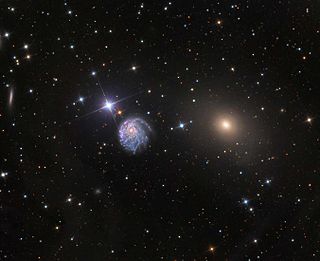
NGC 2276 is an intermediate spiral galaxy in the constellation Cepheus. The galaxy lies 120 million light-years away from Earth. NGC 2276 has an asymmetrical appearance, most likely caused by gravitational interactions with its neighbor, elliptical galaxy NGC 2300. One of the many starburst spiral arms contains an intermediate mass black hole with 50,000 times the mass of the Sun, named NGC 2276-3c. NGC 2276-3c has produced two jets: a large-scale radio jet, approximately 2,000 light years long, and an "inner jet" about 6 light years long. The galaxy shows an enhanced rate of star formation that may have been triggered by a collision with a dwarf galaxy, or by the gravitational interaction with its neighbor compressing gas and dust.

NGC 3642 is a spiral galaxy in the constellation Ursa Major. The galaxy has a low-ionization nuclear emission-line region. It is located at a distance of circa 30 million light years from Earth, which, given its apparent dimensions, means that NGC 3642 is about 50,000 light years across. The galaxy is characterised by an outer pseudoring, which was probably formed after the accretion of a gas rich dwarf galaxy.

NGC 4660 is an elliptical galaxy located about 63 million light-years away in the constellation Virgo. The galaxy was discovered by astronomer William Herschel on March 15, 1784 and is a member of the Virgo Cluster.

NGC 765 is an intermediate spiral galaxy located in the constellation Aries. It is located at a distance of circa 220 million light years from Earth, which, given its apparent dimensions, means that NGC 765 is about 195,000 light years across. It was discovered by Albert Marth on October 8, 1864. The galaxy has an extensive hydrogen (HI) disk with low surface brightness, whose diameter is estimated to be 240 kpc.

NGC 4306 is a dwarf barred lenticular galaxy located about 100 million light-years away in the constellation Virgo. The galaxy was discovered by astronomer Heinrich d'Arrest on April 16, 1865. Although considered to be a member of the Virgo Cluster, its high radial velocity and similar distance as NGC 4305 suggest that NGC 4306 is a background galaxy. NGC 4306 is a companion of NGC 4305 and appears to be interacting with it.

VT 1137-0337 is a extragalactic pulsar wind nebula that is located 395 million light years away from planet earth in the dwarf galaxy named SDSS J113706.18-033737.1, a galaxy going through a burst of star formation. It was created through the supernova of a massive star just 14-80 years ago.
