Plagioclase-bearing paragneiss from NontronGeological map of the Saint-Mathieu dome
The Saint-Mathieu dome, named after the small town Saint-Mathieu in the Haute-Vienne department, is situated at the very northwestern edge of the Massif Central. To the southwest the dome structure is bordered by sediments of the Aquitaine Basin, the contact usually being marked by a border fault. On its eastern side the upwarp is overthrust by augengneisses (A) of the Lower Gneiss Unit (LGU), which between Saint-Jean-de-Côle in the South and the hamlet of Peyrassoulat (commune of Chéronnac) in the North override the Parautochthonous Micaschist Unit (PMU). The dome is bounded to the North by paragneisses of the Lower Gneiss Unit. The northwestern corner of the basement high is cut off by the Le Lindois Fault separating the dome's interior from the Mazerolles Unit in the Northwest and from Lias to the Southwest.
The dome measures about 35 kilometers in its maximal meridional extension and about 25 kilometers in an East-West direction.
Within the dome the following geological units can be discerned:
On its western side the upwarp is traversed by a North-South-striking fault zone, which separates the Piégut-Pluviers granodiorite from the paragneisses. This fault zone starts at Lacrète (commune of Étouars) in the South and terminates just south of Massignac in the North.
Formation
Anatectic Roussines granite, part of the Saint-Mathieu leucogranite
The interior of the dome structure is dominated by magmatic intrusive rocks, especially east of the North-South trending fault zone. These rocks occupy about 80% of the dome's surface area. It is therefore very likely that the basement upwarp was caused by a ballooning of the neovariscan intrusives. A direct tectonical cause of the structure caused by horsing thrust units during mediovariscan tectogenesis (continental collision 400 to 360 million years BP in the Limousin can be ruled out as the Saint-Mathieu leucogranite intruded well above the thrust plane and also sent many small apophyses into the augengneisses.
Age
The neovariscan intrusives within the dome were emplaced during the Pennsylvanian, the Piégut-Pluviers granodiorite is dated for instance at 315 to 314 million years BP. The Saint-Mathieu leucogranite is younger, its coarse-grained facies was dated at 304 million years. This terminal Carboniferous age is most probably also the date for the final arching of the upwarp.
Regional overview
Augengneiss of the Lower Gneiss Unit near Mialet. These augengneisses overthrust the dome in the east.
The Saint-Mathieu dome is situated to the west of a large synform in the variscan nappe stack, the Saint-Germain-les-Belles Synform. South of Limoges this medium to high grade nappe stack consists of the Parautochthonous Micaschist Unit at the bottom, tectonically overlain by the Lower Gneiss Unit and the Upper Gneiss Unit (UGU) resting on top. The Upper Gneiss Unit is itself overthrust by the less metamorphic Thiviers-Payzac Unit (TPU) from the south. The Mazerolles Unit (MU), also of lower metamorphic grade and lithologically comparable to the TPU, overrides the paragneisses of the Lower Gneiss Unit from the southwest. The Saint-Mathieu dome has upturned the nappe pile at its eastern edge so that the normally hidden Parautochthonous Micaschist Unit now appears at the surface.
Similar structural relationships can be seen in the Millesvaches Massif east of the central synform. The Millesvaches Massif is also oriented North-South and consists like the Saint-Mathieu dome largely of intrusive rocks rimmed by micaschists of the PMU. With 160 kilometers it has a much larger meridional extension though. The 35 kilometers for the Saint-Mathieu dome most likely are only a minimal value as a possible extension of the dome underneath the sediments of the Aquitaine Basin has not been verified yet.
Literature
Briand, Bernard et al. Feuille Châlus. Carte géologique de la France à 1/50 000. BRGM, Orléans
Chèvremont, P. et al. Feuille Rochechouart. Carte géologique de la France à 1/50 000. BRGM, Orléans
Floc'h, J.-P. et al. Feuille La Rochefoucauld. Carte géologique de la France à 1/50 000. BRGM, Orléans
Floc’h, J.-P. et al. Feuille Montbron. Carte géologique de la France à 1/50 000. BRGM, Orléans
Floc’h, J.-P. et al. Feuille Nontron. Carte géologique de la France à 1/50 000. BRGM, Orléans
Guillot, P.-L. et al. Feuille Thiviers. Carte géologique de la France à 1/50 000. BRGM, Orléans
Related Research Articles
Leucogranite is a light-colored, granitic, igneous rock with almost no dark minerals. Alaskite is a synonym.
Saint-Pardoux-la-Rivière , in occitan Sent Pardol la Ribiera, is a commune in the Dordogne department in Nouvelle-Aquitaine in southwestern France. It forms part of the Parc naturel régional Périgord Limousin.
Saint-Paul-la-Roche, in Occitan Sent Pau la Ròcha, is a commune in the northeast of the Dordogne department in the Nouvelle-Aquitaine region in southwestern France. The commune is integrated into the Regional Natural Parc Périgord Limousin.
Geological map of Senegal at 1/500 000
The Parc naturel régional Périgord Limousin was created March 9, 1998. It consists of 78 communes situated in the Dordogne and Haute Vienne départements. The park has a surface area of 1800 square kilometers and is inhabited by 49 661 people.
The Piégut-Pluviers Granodiorite is situated at the northwestern edge of the Variscan Massif Central in France. Its cooling age has been determined as 325 ± 14 million years BP.
The Massif Central is one of the two large basement massifs in France, the other being the Armorican Massif. The Massif Central's geological evolution started in the late Neoproterozoic and continues to this day. It has been shaped mainly by the Caledonian orogeny and the Variscan orogeny. The Alpine orogeny has also left its imprints, probably causing the important Cenozoic volcanism. The Massif Central has a very long geological history, underlined by zircon ages dating back into the Archaean 3billion years ago. Structurally it consists mainly of stacked metamorphic basement nappes.
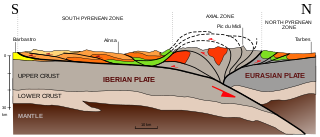
The Pyrenees are a 430-kilometre-long, roughly east–west striking, intracontinental mountain chain that divide France, Spain, and Andorra. The belt has an extended, polycyclic geological evolution dating back to the Precambrian. The chain's present configuration is due to the collision between the microcontinent Iberia and the southwestern promontory of the European Plate. The two continents were approaching each other since the onset of the Upper Cretaceous (Albian/Cenomanian) about 100 million years ago and were consequently colliding during the Paleogene (Eocene/Oligocene) 55 to 25 million years ago. After its uplift, the chain experienced intense erosion and isostatic readjustments. A cross-section through the chain shows an asymmetric flower-like structure with steeper dips on the French side. The Pyrenees are not solely the result of compressional forces, but also show an important sinistral shearing.
The Génis Unit is a Paleozoic metasedimentary succession of the southern Limousin and belongs geologically to the Variscan basement of the French Massif Central. The unit covers the age range Cambrian/Ordovician till Devonian.
The Canaveilles Group is the basal metasedimentary succession of late Neoproterozoic and Cambrian age outcropping in the Pyrenees.
The Thiviers-Payzac Unit is a metasedimentary succession of late Neoproterozoic and Cambrian age outcropping in the southern Limousin in France. The unit geologically forms part of the Variscan basement of the northwestern Massif Central.
The Mareuil Anticline, also called Mareuil-Meyssac Anticline, is a structural high within the sedimentary sequence of the northeastern Aquitaine Basin. The northwest-southeast trending anticline was caused by tectonic movements probably starting in the Upper Cretaceous.
The La Tour-Blanche Anticline, also called Chapdeuil Anticline or Chapdeuil-La Tour-Blanche Anticline, is a tectonically caused, dome-like upwarp in the sedimentary succession of the northeastern Aquitaine Basin in France. The structure is oriented west-northwest-east-southeast.
The Périgord noir, also known as Sarladais, is a traditional natural region of France, which corresponds roughly to the Southeast of the current Dordogne département, now forming the northern part of the Aquitaine région. It is centered around the town of Sarlat-la-Canéda.
The Neuil Mine, in French Mine de Neuil, is a mine emplaced in paragneisses of the northwestern Massif Central. The mine is part of the commune of Saint-Pardoux-la-Rivière in the Dordogne. Extracted from the mine was galena, slightly enriched in silver.
The Tabataud Quarry is situated in the northwestern French Massif Central. The quarry used to be mined for its granodiorite.
The Cantonnier lode formed in the Piégut-Pluviers Granodiorite, part of the basement rocks of the northwestern Massif Central in France. Its importance is highlighted by very rare mineral parageneses.
The le Puy Mine is an ancient lead mine in the northwestern Massif Central, France. The mine produced mainly silver-bearing galena.
The Merlis Serpentinites are an aligned group of small serpentinite outcrops in the northwestern French Massif Central. Their parent rocks were peridotites from the upper mantle.
The Nontronnais is a natural region in the northern Dordogne département and therefore part of Nouvelle-Aquitaine. It covers the surrounding of the centrally placed subprefecture Nontron. Jules Verne had called the Nontronnais Périgord vert referring to the region's lush vegetation. The term Périgord vert is used mainly in tourism, but is not identical with the Nontronnais, which covers a much smaller area.
This page is based on this Wikipedia article Text is available under the CC BY-SA 4.0 license; additional terms may apply. Images, videos and audio are available under their respective licenses.