Related Research Articles
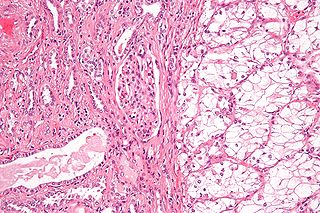
Renal cell carcinoma (RCC) is a kidney cancer that originates in the lining of the proximal convoluted tubule, a part of the very small tubes in the kidney that transport primary urine. RCC is the most common type of kidney cancer in adults, responsible for approximately 90–95% of cases. It is more common in men. It is most commonly diagnosed in the elderly.
The Institute of Cancer Research is a public research institute and a member institution of the University of London in London, United Kingdom, specialising in oncology. It was founded in 1909 as a research department of the Royal Marsden Hospital and joined the University of London in 2003. It has been responsible for a number of breakthrough discoveries, including that the basic cause of cancer is damage to DNA.
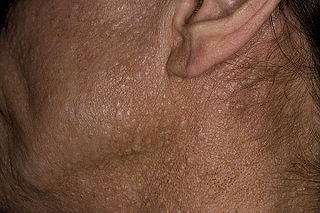
Birt–Hogg–Dubé syndrome (BHD), also Hornstein–Birt–Hogg–Dubé syndrome, Hornstein–Knickenberg syndrome, and fibrofolliculomas with trichodiscomas and acrochordons is a human, adult onset, autosomal dominant genetic disorder caused by a mutation in the folliculin (FLCN) gene. It can cause susceptibility to kidney cancer, renal and pulmonary cysts, and noncancerous tumors of the hair follicles, called fibrofolliculomas. The symptoms seen in each family are unique, and can include any combination of the three symptoms. Fibrofolliculomas are the most common manifestation, found on the face and upper trunk in over 80% of people with BHD over the age of 40. Pulmonary cysts are equally common (84%) and 24% of people with BHD eventually experience a collapsed lung. Kidney tumors, both cancerous and benign, occur in 14–34% of people with BHD; the associated kidney cancers are often rare hybrid tumors.

An eye neoplasm is a tumor of the eye. A rare type of tumor, eye neoplasms can affect all parts of the eye, and can either be benign or malignant (cancerous), in which case it is known as eye cancer. Eye cancers can be primary or metastatic cancer. The two most common cancers that spread to the eye from another organ are breast cancer and lung cancer. Other less common sites of origin include the prostate, kidney, thyroid, skin, colon and blood or bone marrow.
Clear cell sarcoma of the kidney (CCSK) is an extremely rare type of kidney cancer comprising 3% of all pediatric renal tumours. Clear cell sarcoma of the kidney can spread from the kidney to other organs, most commonly the bone, but also including the lungs, brain, and soft tissues of the body.
The International Cancer Genome Consortium (ICGC) is a voluntary scientific organization that provides a forum for collaboration among the world's leading cancer and genomic researchers. The ICGC was launched in 2008 to coordinate large-scale cancer genome studies in tumours from 50 cancer types and/or subtypes that are of main importance across the globe.

Sir Peter John Ratcliffe, FRS, FMedSci is a British physician-scientist who is trained as a nephrologist. He was a practising clinician at the John Radcliffe Hospital, Oxford and Nuffield Professor of Clinical Medicine and head of the Nuffield Department of Clinical Medicine at the University of Oxford from 2004 to 2016. He has been a Fellow of Magdalen College, Oxford since 2004. In 2016 he became Clinical Research Director at the Francis Crick Institute, retaining a position at Oxford as a member of the Ludwig Institute of Cancer Research and director of the Target Discovery Institute, University of Oxford.
Christopher M. Nutting is a British Professor of Clinical Oncology and medical consultant, specializing in head and neck cancers, who has helped develop Intensity-Modulated Radiotherapy (IMRT), an advanced form of Radiation therapy.
Sarah-Jane Dawson is an Australian clinician-scientist. She is a consultant medical oncologist and head of the Molecular Biomarkers and Translational Genomics Laboratory at the Peter MacCallum Cancer Centre in Melbourne. Her current research interests are focused on the development of noninvasive blood-based biomarkers for clinical application, including early detection, risk stratification and disease monitoring in cancer management.

Melissa Helen Little is an Australian scientist and academic, currently Theme Director of Cell Biology, heading up the Kidney Regeneration laboratory at the Murdoch Children's Research Institute. She is also a Professor in the Faculty of Medicine, Dentistry and Health Sciences, University of Melbourne, and Program Leader of Stem Cells Australia. In January 2022, she became CEO of the Novo Nordisk Foundation Center for Stem Cell Medicine reNEW, an international stem cell research center based at University of Copenhagen, and a collaboration between the University of Copenhagen, Denmark, Murdoch Children’s Research Institute, Australia, and Leiden University Medical Center, The Netherlands.

Robert Charles Swanton is a British physician scientist specialising in oncology and cancer research. Swanton is a senior group leader at London's Francis Crick Institute, Royal Society Napier Professor in Cancer and thoracic medical oncologist at University College London and University College London Hospitals, co-director of the Cancer Research UK (CRUK) Lung Cancer Centre of Excellence, and Chief Clinician of Cancer Research UK.
Vivian Li is a Hong Kong-born cell and developmental biologist working in cancer research at London's Francis Crick Institute. She has been researching how stem cells in the human bowel are programmed to ensure a healthy organ and what goes wrong when cancer develops. She is known for her work on the Wnt signalling pathway, discovering a new way that a molecule called Wnt is activated in bowel cancer. She won a Future Leaders in Cancer Research Prize in part for this discovery.
Elizabeth Ruth Plummer is a Professor of Experimental Cancer Medicine at Newcastle University and an oncologist specialising in treating patients with melanoma. Based in Newcastle, she directs the Sir Bobby Robson Cancer Trials Research Centre, set up by the Sir Bobby Robson Foundation to run early-stage clinical trials.v Plummer and the Newcastle team won a 2010 Translational Cancer Research Prize from Cancer Research UK for work using rucaparib to treat ovarian cancer. Plummer was elected as a fellow of the UK's Academy of Medical Sciences in 2018.
Anna Perdrix Rosell is a Spanish scientist who completed her PhD in cancer cell signalling at the Francis Crick Institute in London. She co-founded a biotech start-up, which helped her get onto the Forbes 30 under 30 list in 2018.
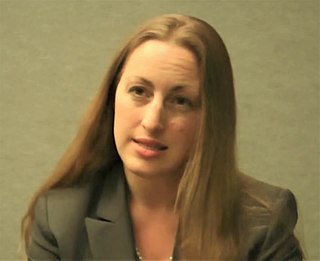
Michelle Leigh Monje-Deisseroth is a neuroscientist and neuro-oncologist. She is a professor of neurology at Stanford University and an investigator with the Howard Hughes Medical Institute. She develops new treatments for diffuse intrinsic pontine glioma.
Marcela V. Maus is a professor of medicine at Harvard Medical School and director of the Cellular Immunotherapy Program at Massachusetts General Hospital. She works on immunotherapy for the treatment of cancer, using genetically engineered T cells to target malignancies (cancer).
Georgina Venetia Long is an Australian medical oncologist, clinical trialist and translational researcher, and works in drug therapy development. She was the joint recipient of the National Australia Day Council's 2024 Australian of the Year Award.

Sarah Coupland is an Australian-born pathologist and professor who is the George Holt Chair in Pathology at the University of Liverpool. Coupland is an active clinical scientist whose research focuses on the molecular genetics of cancers, with particular interests in uveal melanoma, conjunctival melanoma, intraocular and ocular adnexal lymphomas and CNS lymphoma. Coupland is also an NHS Honorary Consultant Histopathologist at the Royal Liverpool University Hospital. Since 2006, Coupland has been head of the Liverpool Ocular Oncology Research Group; from which she runs a multidisciplinary oncology research group focussing on Uveal melanoma, based in the Department of Molecular and Clinical Cancer Medicine at the University of Liverpool. Her research laboratory is currently located in the Institute of Translational Medicine From April 2014 to December 2019, Coupland was also Director of the North West Cancer Research Centre, @UoL. In both 2019 and 2020, Coupland was included on the 'Pathology Powerlist' on The Pathologist website.
Serena Nik-Zainal is a British-Malaysian clinician who is a consultant in clinical genetics and Cancer Research UK advanced clinician scientist at the University of Cambridge. She makes use of genomics for clinical applications. She was awarded the Crick Lecture by the Royal Society in 2021. Serena Nik-Zainal was also recognized as one of the 100 Influential Women in Oncology by OncoDaily.
Elizabeth R. Plimack is an American medical oncologist. She is a professor in the Department of Hematology/Oncology and Chief of the Division of Genitourinary Medical Oncology at the Fox Chase Cancer Center. In these roles, she researches the treatment of genitourinary malignancies with a focus on bladder and kidney cancers.
References
- 1 2 Mitchell, Thomas J.; Turajlic, Samra; Rowan, Andrew; Nicol, David; Farmery, James H.R.; O’Brien, Tim; Martincorena, Inigo; Tarpey, Patrick; Angelopoulos, Nicos; Yates, Lucy R.; Butler, Adam P. (2018-04-19). "Timing the Landmark Events in the Evolution of Clear Cell Renal Cell Cancer: TRACERx Renal". Cell. 173 (3): 611–623.e17. doi:10.1016/j.cell.2018.02.020. ISSN 0092-8674. PMC 5927631 . PMID 29656891.
- ↑ "Introducing Samra Turajlic, clinician scientist". Crick. Retrieved 2020-09-22.
- 1 2 "Renal | TracerX" . Retrieved 2020-09-23.
- 1 2 3 "Samra Turajlic". Crick. Retrieved 2020-09-23.
- ↑ Turajlic, Samra; Xu, Hang; Litchfield, Kevin; Rowan, Andrew; Horswell, Stuart; Chambers, Tim; O'Brien, Tim; Lopez, Jose I.; Watkins, Thomas B. K.; Nicol, David; Stares, Mark (19 April 2018). "Deterministic Evolutionary Trajectories Influence Primary Tumor Growth: TRACERx Renal". Cell. 173 (3): 595–610.e11. doi:10.1016/j.cell.2018.03.043. ISSN 1097-4172. PMC 5938372 . PMID 29656894.
- ↑ Turajlic, Samra; Xu, Hang; Litchfield, Kevin; Rowan, Andrew; Chambers, Tim; Lopez, Jose I.; Nicol, David; O’Brien, Tim; Larkin, James; Horswell, Stuart; Stares, Mark (2018-04-19). "Tracking Cancer Evolution Reveals Constrained Routes to Metastases: TRACERx Renal". Cell. 173 (3): 581–594.e12. doi:10.1016/j.cell.2018.03.057. ISSN 0092-8674. PMC 5938365 . PMID 29656895.
- ↑ Gallagher, James (2018-04-12). "Why some cancers are 'born to be bad'". BBC News. Retrieved 2020-09-22.
- ↑ "Piecing together kidney cancer evolution". Cancer Research UK - Science blog. Retrieved 2020-09-22.
- ↑ "Crick clinician scientists awarded new fellowships". Crick. Retrieved 2020-09-22.
- ↑ "Melanoma Research Alliance Announces $11 Million for 26 Grant Awards to Advance Melanoma Research". www.businesswire.com. 2020-04-30. Retrieved 2020-09-22.
- ↑ "Melanoma | TracerX" . Retrieved 2020-09-23.
- ↑ "The PEACE (Posthumous Evaluation of Advanced Cancer Environment) Study - Full Text View - ClinicalTrials.gov". clinicaltrials.gov. Retrieved 2020-09-23.
- ↑ "Samra Turajlic awarded over £2.3million for cancer research at the Crick". Crick. Retrieved 2020-09-23.
- ↑ "Samra Turajlic awarded over £2.3million for cancer research at the Crick". Crick. Retrieved 2020-09-23.
- ↑ Litchfield, Kevin; Stanislaw, Stacey; Spain, Lavinia; Gallegos, Lisa L.; Rowan, Andrew; Schnidrig, Desiree; Rosenbaum, Heidi; Harle, Alexandre; Au, Lewis; Hill, Samantha M.; Tippu, Zayd (2020-05-05). "Representative Sequencing: Unbiased Sampling of Solid Tumor Tissue". Cell Reports. 31 (5): 107550. doi: 10.1016/j.celrep.2020.107550 . hdl: 20.500.11820/fc5fb24a-cf07-481a-9f6f-dba214678131 . ISSN 2211-1247. PMID 32375028.
- ↑ "Tumour analysis technique offers the prospect of personalised cancer care". inews.co.uk. 2020-05-05. Retrieved 2020-09-23.
