
Strong City is a city in Chase County, Kansas, United States. Originally known as Cottonwood Station, in 1881 it was renamed Strong City after William Barstow Strong, then vice-president and general manager, and later president of the Atchison, Topeka and Santa Fe Railway. As of the 2020 census, the population of the city was 386. It is located along U.S. Route 50 highway.

The Atchison, Topeka and Santa Fe Railway, often referred to as the Santa Fe or AT&SF, was one of the larger railroads in the United States. The railroad was chartered in February 1859 to serve the cities of Atchison and Topeka, Kansas, and Santa Fe, New Mexico. The railroad reached the Kansas–Colorado border in 1873 and Pueblo, Colorado, in 1876. To create a demand for its services, the railroad set up real estate offices and sold farmland from the land grants that it was awarded by Congress.

Atchison, Topeka and Santa Fe 3751 is a class 3751 4-8-4 "Northern" type steam locomotive built in May 1927 by the Baldwin Locomotive Works in Eddystone (Philadelphia), Pennsylvania for the Atchison, Topeka & Santa Fe Railway (ATSF). No. 3751 was the first 4-8-4 steam locomotive built for the Santa Fe and was referenced in documentation as type: "Heavy Mountain", "New Mountain", or "Mountain 4-wheel trailer". No. 3751 served in passenger duties until being retired in 1953.

The Scott Special, also known as the Coyote Special, the Death Valley Coyote or the Death Valley Scotty Special, was a one-time, record-breaking passenger train operated by the Atchison, Topeka and Santa Fe Railway from Los Angeles, California, to Chicago, Illinois, at the request of Walter E. Scott, known as "Death Valley Scotty". At the time of its transit in 1905, the Scott Special made the 2,265-mile (3,645 km) trip between the two cities at the fastest speed recorded to date; in doing so, it established the Santa Fe as the leader in high-speed travel between Chicago and the West Coast. The Scott Special made the trip in 44 hours and 54 minutes breaking the previous records, set in 1900 by the Peacock Special, by 13 hours and 2 minutes, and in 1903 by the Lowe Special, by 7 hours and 55 minutes. Santa Fe's regular passenger service from Los Angeles to Chicago at the time was handled on a 2½-day schedule by the California Limited. It was not until the 1936 introduction of the Super Chief that Santa Fe trains would regularly exceed the speeds seen on the Scott Special.

Claremont station is a passenger rail and bus station in Claremont, California, United States. It is served by Metrolink's San Bernardino Line which runs from Los Angeles Union Station to San Bernardino-Downtown, with some trains formerly continuing to Riverside on weekends. The Mission Revival-Spanish Colonial Revival style station is listed on the U.S. National Register of Historic Places as Atchison, Topeka and Santa Fe Railroad Station.

The Fullerton Transportation Center is a passenger rail and bus station located in Fullerton, California, United States.

The San Bernardino Santa Fe Depot is a Mission Revival Style passenger rail terminal in San Bernardino, California, United States. It has been the primary station for the city, serving Amtrak today, and the Santa Fe and Union Pacific Railroads in the past. Until the mid-20th century, the Southern Pacific Railroad had a station 3/4 of a mile away. It currently serves one Amtrak and two Metrolink lines. The depot is a historical landmark listed on the National Register of Historic Places as Atchison, Topeka and Santa Fe Railway Passenger and Freight Depot.

The Santa Fe Passenger Depot, also known as Fresno station, is an historic railroad station and transportation hub in downtown Fresno, California. It is served by San Joaquins inter-city passenger trains, Greyhound inter-city buses, and regional transit services including Fresno Area Express and the Fresno County Rural Transit Agency.

Temple is a train station in Temple, Texas, United States served by Amtrak, the national railroad passenger system. The station was originally built as an Atchison, Topeka and Santa Fe Railway depot. East of the station on another railroad line through Temple, a former Missouri-Kansas-Texas Railroad depot can be found, as the nexus for trains bound for Waco, San Antonio and Houston.

The Southern Transcon is a main line of BNSF Railway comprising 11 subdivisions between Southern California and Chicago, Illinois. Completed in its current alignment in 1908 by the Atchison, Topeka and Santa Fe Railway, when it opened the Belen Cutoff in New Mexico and bypassed the steep grades of Raton Pass, it now serves as a mostly double-tracked intermodal corridor.
Atchison, Topeka and Santa Fe Railway Depot, or variations with Railroad or Station or Passenger and/or Freight may refer to any one of many stations of the Atchison, Topeka and Santa Fe Railway. These include:

Arcadia station is an at-grade light rail station on the A Line of the Los Angeles Metro Rail system. It is located at the intersection of 1st Avenue and Santa Clara Street in Arcadia, California, after which the station is named.
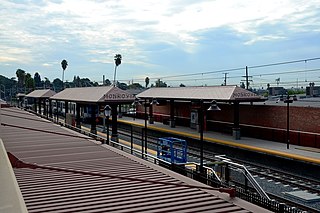
Monrovia station is an at-grade light rail station on the A Line of the Los Angeles Metro Rail system. It is located at the intersection of Duarte Road and Myrtle Avenue in Monrovia, California, after which the station is named. This station opened on March 5, 2016, as part of Phase 2A of the Gold Line Foothill Extension Project.
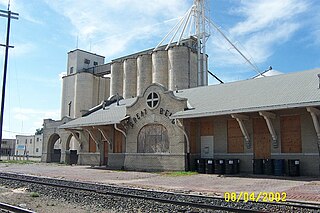
Great Bend station was an Atchison, Topeka and Santa Fe Railway station in Great Bend, Kansas. The station was along Santa Fe's main line between Chicago and Los Angeles. It was on the "northern branch" of the main line as it split in Hutchinson, Kansas. It was also served by a line the ran to Garden City, Kansas, travelling through Ness City and Scott City. Both of these lines are now operated by the Kansas and Oklahoma Railroad. The depot was built in a Mission Revival, common for Santa Fe and Southern Pacific stations in the late 19th and early 20th centuries.
Southern California Railway was formed on November 7, 1889. it was formed by consolidation of California Southern Railroad Company, the California Central Railway Company, and the Redondo Beach Railway Company.

Gulf, Colorado and Santa Fe Railroad Passenger Station is located on 1501 Jones Street in Fort Worth, Texas. The depot was built by the Gulf, Colorado and Santa Fe Railroad in 1900 and renovated in 1938. It was originally called the Fort Worth Union Depot. Other tenant railroads at the station were the Chicago, Rock Island and Gulf Railway, the St. Louis–San Francisco Railway ('Frisco') and the Southern Pacific Railroad.

The Santa Fe Passenger and Freight Depot is a former Santa Fe Railroad station located at 150 Central Valley Highway in Shafter, in the southern San Joaquin Valley within Kern County, California.

The Los Angeles and San Gabriel Valley Railroad was a railroad founded on Sept. 5, 1883, by James F. Crank with the goal of bringing a rail line to Pasadena from downtown Los Angeles. Los Angeles and San Gabriel Valley Railroad was sold and consolidated on May 20, 1887 into the California Central Railway. In 1889 this was consolidated into Southern California Railway Company. On Jan. 17, 1906 Southern California Railway was sold to the Atchison, Topeka and Santa Fe Railway and called the Pasadena Subdivision. The main line closed in 1994. The railroad later reopened as the MTA Gold Line Light Rail service in July 2003.
Edward Alfred Harrison, known as E. A. Harrison, was an American architect who worked as a staff architect for the Atchison, Topeka & Santa Fe Railway, with offices in Topeka, Kansas, and later in Chicago, Illinois.
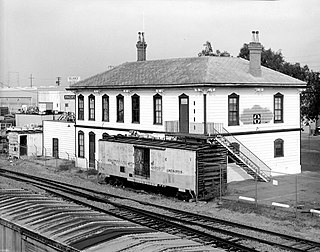
National City station is a former railway station in National City, California. The California Southern Railroad, a subsidiary of the Atchison, Topeka and Santa Fe Railway, chose National City as the West Coast base of operations at the terminus of their planned transcontinental railroad.

