Related Research Articles

Year 1112 (MCXII) was a leap year starting on Monday of the Julian calendar.
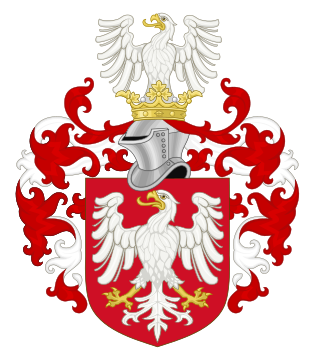
The House of Piast was the first historical ruling dynasty of Poland. The first documented Polish monarch was Duke Mieszko I. The Piasts' royal rule in Poland ended in 1370 with the death of king Casimir III the Great.

The Congress of Gniezno was an amicable meeting between the Polish Duke Bolesław I the Brave and Emperor Otto III, which took place at Gniezno in Poland on 11 March 1000. Scholars disagree over the details of the decisions made at the convention, especially whether the ruler of Poland was pledged the king's crown or not.

Lestek was the second duke of Polans, and son of Siemowit, born c. 870–880, mentioned in the oldest Polish chronicle, Gesta principum Polonorum by Gallus Anonimus. The dukes of Polans were the foundation of the Piast dynasty, the first historical ruling dynasty of Poland.

Gallus Anonymus is the name traditionally given to the anonymous author of Gesta principum Polonorum, composed in Latin between 1112 and 1118. Gallus is generally regarded as the first historian to have described the history of Poland. His Chronicles are an obligatory text for university courses in Polish history. Very little is known of the author himself and it is widely believed that he was a foreigner.

Rzepicha was the wife of the semi-legendary Piast the Wheelwright and the mother of Siemowit. She is mentioned in Gallus Anonymus' Polish Chronicle, where her name is explicitly referred to twice.

The siege of Głogów or Defense of Głogów was fought on 24 August 1109 at the Silesian town of Głogów, between the Kingdom of Poland and the Holy Roman Empire. Recorded by the medieval chronicler Gallus Anonymus, it is one of the most well known battles in Polish history. The Polish forces were led by Duke Bolesław III Wrymouth, while the Imperial forces were under the command of King Henry V of Germany. Bolesław was victorious.

The Battle of Hundsfeld or Battle of Psie Pole was said to be fought on 24 August 1109 near the Silesian capital Wrocław between the Holy Roman Empire in aid of the claims of the exiled Piast duke Zbigniew against his ruling half-brother, Bolesław III Wrymouth of Poland. It was recorded by the medieval Polish chronicler Bishop Wincenty Kadłubek of Kraków in his Chronica seu originale regum et principum Poloniae several decades later.
Chościsko is a legendary figure in Polish prehistory, father of Piast the Wheelwright, the founder of the Piast dynasty. His name occurs in the first Polish chronicle, Cronicae et gesta ducum sive principum Polonorum by Gallus Anonymus, where the author refers three times to Piast as the son of Chościsko.

The Gesta principum Polonorum is the oldest known medieval chronicle documenting the history of Poland from the legendary times until 1113. Written in Latin by an anonymous author, it was most likely completed between 1112 and 1118, and its extant text is present in three manuscripts with two distinct traditions. Its anonymous author is traditionally called Gallus, a foreigner and outcast from an unknown country, who travelled to the Kingdom of Poland via Hungary. Gesta was commissioned by Poland's then ruler, Boleslaus III Wrymouth; Gallus expected a prize for his work, which he most likely received and of which he lived the rest of his life.

The Popielids were a legendary ruling dynasty of either the Polans, Goplans or both tribes, founded by Leszko II. They supposedly ruled the lands of Poland prior to the start of the Piast dynasty. Two Polish families claim descent from the Popielids: the Pobog-Pobodze clan is a junior branch of the Popielid dynasty, rulers of Poland from the 7th through 9th centuries, before the era of Bolescic-Piast dynasty another junioral branch of the Popielid dynasty.

Santok is a village in Gorzów County, Lubusz Voivodeship, in western Poland. It is the seat of the gmina called Gmina Santok.
Sieciech was a medieval Polish magnate and statesman.
Mieszko Bolesławowic was the only son of Bolesław II the Generous, King of Poland. Mieszko was Prince of Cracow from 1086 until his death in 1089.
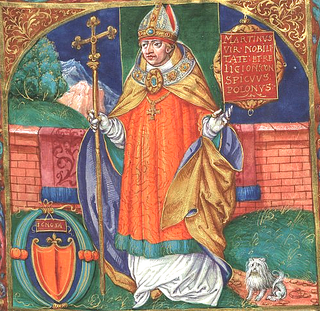
Martin or Martin of Gniezno was a medieval prelate based in Principality of Poland. He was Archbishop of Gniezno, head of the Polish church, from ca. 1092/99 until 1112/27. The preface of the Gesta principum Polonorum, the anonymous historical narrative whose author is usually referred to as Gallus Anonymus, begins with an address to Archbishop Martin.
Świętobor was a Pomeranian duke of 11th and 12th century. According to Gesta principum Polonorum of the chronicler Gallus Anonymus, he was a relative of king of Poland, Bolesław III Wrymouth. In one particular instance, Świętobor was imprisoned by his rivals and Bolesław set out with military aid for Świętobór. However, before Bolesław's expedition reached its destination, Świętobór was freed and the king's forces turned around and returned home.
Chronica principum Poloniae is a historiographical work written in Silesia, ca, 1382–1386. Its authorship is ascribed to Canon Peter of Byczyna (1328–1389).
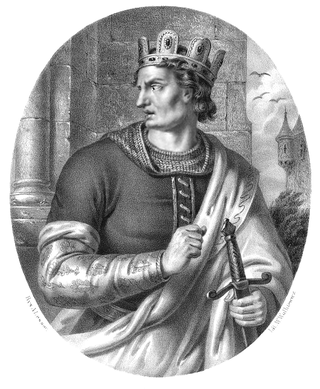
Bolesław II the Bold, also known as the Generous, was Duke of Poland from 1058 to 1076 and third King of Poland from 1076 to 1079. He was the eldest son of Duke Casimir I the Restorer and Maria Dobroniega of Kiev.
Michał Awdaniec was a chancellor to king Bolesław III Wrymouth of the Kingdom of Poland around the years 1112-1113. He was likely the person who ordered or sponsored Gallus Anonymus's chronicle, Gesta principum Polonorum.
References
Footnotes
- ↑ Gallus Anonymus; Martinus (Gallus); Gallus (Anonymus) (10 May 2003). Gesta Principum Polonorum: The Deeds of the Princes of the Poles. Central European University Press. ISBN 978-963-9241-40-4.
- ↑ Dalewski, Zbigniew: Ritual and Politics. Writing the History of a Dynastic Conflict in Medieval Poland (East Central and Eastern Europe in the Middle Ages, 450–1450, vol. 3), Leiden/Boston 2008, pp. 2, 5.
- ↑ Darius von Guttner. "Poland and the papacy before the second crusade". Encyclopædia Iranica Foundation. Retrieved November 3, 2020.
- ↑ Gaethke, Hans-Otto: Kämpfe und Herrschaft Heinrichs von (Alt-) Lübeck und Lothars von Supplingenburg im Slawenland 1093/1106-1125, in: Zeitschrift des Vereins für Lübeckische Geschichte und Altertumskunde (ZVLGA), vol. 80 (2000), pp. 63-163, here pp. 138.
First mention in Gallus Anonymus: Gesta principum Polonorum lib. I prehum (in MGH SS 9, p. 425): "Ad mare autem septemtrionale vel anphitrionale tres habet affines barbarorum gentilium ferocissimas nationes, Selenciam, Pomeranam u et Pruziam, contra quas regiones Polonorum dux assidue pugnat, ut eas ad fidem convertat; sed nec gladio praedicationis cor eorum a perfidia potuit revocari, nec w gladio iugulationis eorum penitus vipperalis progenies aboleri. Saepe tamen principes eorum a duce Poloniensi proelio superati, ad baptismum confugerunt; itemque collectis viribus fidem christianam ab negantes, contra christianos bellum denuo paraverunt."
English translation per Güttner Sporzynski, Darius von: Poland and the Papacy Before the Second Crusade, in Balard, Michel (ed.): La papauté et les croisades. Actes du VIIe Congrès de la Society for the Study of the Crusades and the Latin East, Avignon 27-31 aout 2008 (Crusades subsidia, vol. 3), Farnham 2011, pp. 257-270, here p. 260: "On the Northern Sea, [Poland] has as neighbours three most savage nations of pagan barbarians, Selencia, Pomerania, and Prussia, and the duke of the Poles is constantly at war with these countries, fighting to convert them to the faith. But neither has the sword of preaching been able to sway their hearts from faithlessness, nor the sword at their throats wiped out this generation of vipers inits entirety. Yet often their leaders when defeated in battle by the Polish duke have taken refuge in baptism, only to deny the Christian faith when they recovered their strength and take up arms afresh against the Christians."
Second mention in Gallus Anonymus: Gesta principum Polonorum lib. I.6 (in MGH SS 9, p. 428): "Ipse namque Selenciam, Pomoraniam et Prusiam usque adeo vel in perfidia resistentes contrivit vel conversas in fide solidavit, quod ecclesias ibi multas et episcopos per apostolicum, ymmo apostolicus per eum ordinavit."
English translation: "For when Selencia, Pomerania and Prussia stood firmly by their unfaithfulness, he beat them down. When they had converted, he strengthened the faith by establishing many churches and bishops in the name of the pope - actually, the pope established them through him."
Bibliography
- Gaethke, Hans-Otto: Kämpfe und Herrschaft Heinrichs von (Alt-) Lübeck und Lothars von Supplingenburg im Slawenland 1093/1106-1125, in: Zeitschrift des Vereins für Lübeckische Geschichte und Altertumskunde (ZVLGA), vol. 80 (2000), pp. 63–163, here pp. 139
- Kossmann, Oskar: Das unbekannte Ostseeland Selencia und die Anfänge Pommerns, in: ZfO, vol. 20 (1971), pp. 641–685.
- Schmidt, Roderich: Das historische Pommern. Personen, Orte, Ereignisse, Cologne/Weimar 2009, p. 58