Incident
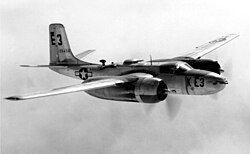
On July 11, 1944, Russell's family and friends gathered at the Portland airport to await his arrival in patchy heavy fog. The airport officially closed at 16:35 because of the fog. Six minutes later, his family reportedly heard Russell's voice requesting landing instructions on the airport radio, and saw his A-26B-5 Invader appear briefly out of the fog at an estimated altitude of 200 feet (61 m). The airport instructed Russell to climb to 1,500 feet (460 m), and the plane disappeared into the fog. Waiting for a radio response from Russell, airport observers saw flames and heard crash noises from the direction in which the plane had disappeared. [4] [5] [6]
The aircraft struck the ground and cartwheeled through a government-operated trailer park housing families of shipyard workers at the New England Shipbuilding Corporation. Sixteen trailers were destroyed by fire and a dozen more damaged by pieces of the disintegrating airplane. Seventeen trailer-park residents died, and twenty more were injured. The bodies of Russell and his navigator, Staff Sergeant Wallace Mifflin, were found in the trailer-park wreckage. [4]
A "Report of Aircraft Accident" was later compiled by the Army Air Forces, which identified three factors as being responsible for the accident: [7]
- Lack of training — "the pilot lacked experience in flying this type of aircraft on instruments"
- Improper clearance – an operations officer signed a form indicating CFR (contact flight rules, a forerunner to visual flight rules) when conditions clearly indicated a need for IFR (instrument flight rules)
- Unauthorized landing instructions – an operator (air traffic controller) "suggested a runway instead of advising [the pilot] to return immediately to CFR conditions"
Memorial
In 2010, 66 years after the incident, the Long Creek Air Tragedy Memorial was erected to commemorate the crash and honor the victims. [8] A similar memorial on Deer Mountain in North Oxford, 100 miles (160 km) to the north, marks the site of Maine's second-deadliest military plane crash. [a] Through coincidence, both crashes occurred on the same day. [9]
The granite for the Long Creek memorial came from a quarry in Wells, Maine, the same quarry that supplied granite for the Tomb of the Unknowns in Arlington National Cemetery.
This page is based on this
Wikipedia article Text is available under the
CC BY-SA 4.0 license; additional terms may apply.
Images, videos and audio are available under their respective licenses.