
MIDI Maze is a networked first-person shooter for the Atari ST developed by Xanth Software F/X and released in 1987 by Hybrid Arts. The game takes place in a maze of untextured walls. The world animates smoothly as the player turns, much like the earlier Wayout, instead of only permitting 90 degree changes of direction. It has been suggested that MIDI Maze, using the built-in MIDI ports of the Atari ST for networking, introduced the concept of deathmatch combat. The game found a wider audience on the Game Boy as Faceball 2000.

The BallyAstrocade is a second-generation home video game console and simple computer system designed by a team at Midway, at that time the videogame division of Bally. It was originally announced as the "Bally Home Library Computer" in October 1977 and initially made available for mail order in December 1977. But due to production delays, the units were first released to stores in April 1978 and its branding changed to "Bally Professional Arcade". It was marketed only for a limited time before Bally decided to exit the market. The rights were later picked up by a third-party company, who re-released it and sold it until around 1984. The Astrocade is particularly notable for its very powerful graphics capabilities for the time of release, and for the difficulty in accessing those capabilities.
Spasim is a 32-player 3D networked space flight simulation game and first-person space shooter developed by Jim Bowery for the PLATO computer network and released in March 1974. The game features four teams of eight players, each controlling a planetary system, where each player controls a spaceship in 3D space in first-person view. Two versions of the game were released: in the first, gameplay is limited to flight and space combat, and in the second systems of resource management and strategy were added as players cooperate or compete to reach a distant planet with extensive resources while managing their own systems to prevent destructive revolts. Spasim is considered, along with Maze War, to be one of the "joint ancestors" of the first-person shooter genre, due to uncertainty over which game was created first.
A multiplayer video game is a video game in which more than one person can play in the same game environment at the same time, either locally or online over the internet. Multiplayer games usually require players to share the resources of a single game system or use networking technology to play together over a greater distance; players may compete against one or more human contestants, work cooperatively with a human partner to achieve a common goal, supervise other players' activity, co-op. Multiplayer games allow players interaction with other individuals in partnership, competition or rivalry, providing them with social communication absent from single-player games.

Berzerk is a multidirectional shooter arcade game, released in 1980 by Stern Electronics of Chicago. Berzerk places the player in a series of top-down, mazelike rooms containing armed robots.

Ms. Pac-Man is a 1982 maze arcade game developed by General Computer Corporation and published by Midway. It is the sequel to Pac-Man (1980), and the first entry in the series to not be made by Namco. Controlling the titular character, the player is tasked with eating all of the pellets in an enclosed maze while avoiding four colored ghosts. Eating large flashing “Power Pellets” will cause the ghosts to turn blue and flee, which can be consumed for bonus points.

3D Monster Maze is a computer game developed from an idea by J.K. Greye and programmed by Malcolm Evans in 1981 for the Sinclair ZX81 platform with the 16 KB memory expansion. The game was initially released by J. K. Greye Software in early 1982 and re-released later the same year by Evans' own startup, New Generation Software. Rendered using low-resolution character block "graphics", it was one of the first 3D games for a home computer, and one of the first games incorporating typical elements of the genre that would later be termed survival horror.
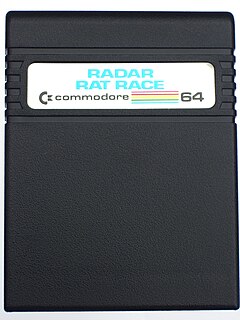
Radar Rat Race is a 1981 game made by HAL Laboratory. A licensed clone of Namco's Rally-X arcade game, it was one of the launch titles for the VIC-20 on cartridge. It was originally released in Japan as Rally-X (ラリーX) from Commodore Japan K.K. and, in 1982, was converted to the Commodore MAX Machine and Commodore 64. Radar Rat Race is cartridge number VIC-1910 for the Commodore VIC-20.

Advanced Dungeons & Dragons: Treasure of Tarmin is a video game for the Intellivision video game console and the Mattel Aquarius computer system. This game was a licensed Dungeons & Dragons adaptation.
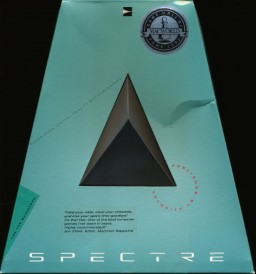
Spectre is a computer game for the Apple Macintosh, developed in 1990 by Peninsula Gameworks and published in 1991 by Velocity Development. It is a 3D vector graphics tank battle reminiscent of the arcade game Battlezone. Later games in the series were released for the PC and SNES, with Spectre VR being named to a number of lists of best video games.

Nathalie Joanne Emmanuel is an English actress. Emmanuel began her acting career appearing in theatre in the late 1990s, accruing roles in various West End productions such as the musical The Lion King. In 2006, she began her on-screen career by starring as Sasha Valentine in soap opera Hollyoaks, after which she appeared in various British television series until her debut film appearance in Twenty8k. Emmanuel gained international recognition for her role as Missandei in the HBO fantasy series Game of Thrones (2013–2019), and continued her career with supporting roles in action films Maze Runner: The Scorch Trials (2015), Furious 7 (2015), The Fate of the Furious (2017) and Maze Runner: The Death Cure (2018).

Snack Attack is a video game created by Dan Illowsky for the Apple II family of computers and published by Datamost in 1982. The gameplay is very similar to those of Pac-Man, which was released two years earlier.

Savage is an action video game developed by Probe Software and published by Firebird Software in 1988 for ZX Spectrum, Commodore 64, Amstrad CPC, Atari ST and MS-DOS. In 1989 Firebird published a version for the Amiga.
In video games, first person is any graphical perspective rendered from the viewpoint of the player's character, or a viewpoint from the cockpit or front seat of a vehicle driven by the character. Many genres incorporate first-person perspectives, among them adventure games, driving, sailing, and flight simulators. Most notable is the first-person shooter, in which the graphical perspective is an integral component of the gameplay.

Whiskey Media was an American online media company founded independently by CNET co-founder Shelby Bonnie in 2008. It was the parent company of Tested, Screened, and Anime Vice, and the former parent company of Giant Bomb and Comic Vine. Whiskey Media websites are wiki community based, while maintaining an editorial staff. The company's target demographic are focused primarily on males between 10 and 30. The name "Whiskey Media" is a reference to a Kentucky distillery that was owned by the family of Shelby Bonnie before prohibition. Whiskey Media operates in San Francisco, California, after previously being located in Sausalito. On March 15, 2012, Whiskey Media was acquired by Lloyd Braun and Gail Berman's BermanBraun along with Tested, Screened, and Anime Vice while Giant Bomb and Comic Vine were bought separately by CBS Interactive.
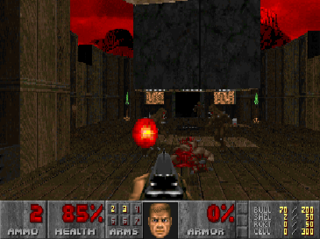
First-person shooter (FPS) is a video game genre centered on gun and other weapon-based combat in a first-person perspective; that is, the player experiences the action through the eyes of the protagonist. The genre shares common traits with other shooter games, which in turn makes it fall under the heading action game. Since the genre's inception, advanced 3D and pseudo-3D graphics have challenged hardware development, and multiplayer gaming has been integral.
Wayout is a 3D first-person perspective video game programmed by Paul Allen Edelstein, originally published for the Atari 8-bit computers in 1982. It was released for the Apple II and Commodore 64 in 1983. Wayout is among the first maze games to offer full 360 degree 3D perspective and movement, and its graphics were considered state-of-the-art upon its release. There were many pseudo-3D maze games at the time, but they used a fixed perspective and limited the player to four orientations.

Capture the Flag is a 3D first-person perspective, two player, video game, released for the Atari 8-bit family and VIC-20 by Sirius Software in 1983. It was written by Paul Allen Edelstein as the follow-up to his 1982 game, Wayout, which has similar maze-based gameplay for one player. Along with its predecessor, Capture the Flag was among the first 3D maze games to offer the player full 360 degree movement, and one of the earliest multiplayer games from a first-person perspective within a 3D rendered environment.


