This article is being considered for deletion in accordance with Wikipedia's deletion policy. Please share your thoughts on the matter at this article's entry on the Articles for deletion page. |

Multilingual poet Suman Pokhrel has written in English, [1] Hindi [2] and Urdu [3] beside in his mother tongue Nepali. Many of his works have been translated into other languages. [4] [5] [6] Beside English, his poems are translated into Arabic [7] , Bengali, [8] French, [9] German, [10] Hindi, [11] Italian, [12] Maithili, Odia, Persian, [5] Sanskrit [13] and Spanish; [14] . Most of English translations of his poems has been rendered by Abhi Subedi [15] [16] [17] [18] and some are translated by himself and other translators. [19]
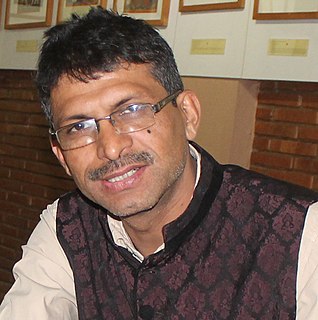
Suman Pokhrel is a Nepali poet, lyricist, playwright, translator and artist who is considered as one of the most important creative voices of South Asia. Universities have included his poetry in their syllabus and admirers have tattooed verses from his poems on their body parts.

English is a West Germanic language that was first spoken in early medieval England and eventually became a global lingua franca. It is named after the Angles, one of the Germanic tribes that migrated to the area of Great Britain that later took their name, as England. Both names derive from Anglia, a peninsula in the Baltic Sea. The language is closely related to Frisian and Low Saxon, and its vocabulary has been significantly influenced by other Germanic languages, particularly Norse, and to a greater extent by Latin and French.

Urdu —or, more precisely, Modern Standard Urdu—is a Persianised standard register of the Hindustani language. It is the official national language and lingua franca of Pakistan. In India, it is one of the 22 official languages recognized in the Constitution of India, having official status in the six states of Jammu and Kashmir, Telangana, Uttar Pradesh, Bihar, Jharkhand and West Bengal, as well as the national capital territory of Delhi.
Contents
- Poetry
- Plays
- Translations
- Poems
- In English
- In Nepali
- Songs and lyrics
- Ghazals
- In Nepali 2
- In Urdu
- Poems in translations
- In Arabic translation
- In Bangla translation
- In English translation
- In German translation
- In Hindi translation
- In Italian translation
- In Persian translation
- In Spanish translation
- Notes
- External links
As a translator, Pokhrel has translated several works of poets and writers from around the world into Nepali. Some of the prominent poets he has translated are: Anna Akhmatova, [20] Anna Swir, [21] Allen Ginsberg, [22] Delmira Agustini, [23] Faiz Ahmad Faiz, [24] Forough Farrokhzad, [25] Gabriela Mistral, [26] Gulzar, [27] Jacques Prévert, [28] Mahmoud Darwish, [29] Nazik Al Malaika, [30] [31] Nazim Hikmet, [32] [33] Nizar Qabbani, [34] Octavio Paz, [35] [36] Pablo Neruda, [37] Sahir Ludhiyanvi, [38] Sylvia Plath, [39] Atal Bihari Vajpayee, Gopalakrishna Adiga, Langston Hughes, Maya Angelou, S. R. Ekkundi and Yehuda Amichai. [40] He has translated contemporary poets and writers from across the countries. They include Uday Prakash, Ajit Cour [41] Indira Dangi, [42] [43] [44] , Sheema Kalbasi, [45] Anamika [46] Hélène Cardona, [47] Kalpna Singh-Chitnis [48] and Azita Ghahreman among other. [49] [50] He has translated William Shakespeare’s play The Tempest into Nepali as Aandhibehari which is published by Nepal Academy in 2018. [51] His Nepali translations of poems have been considered as among a few best translations of poetry into Nepali. [49]

Nepali, also known as Nepalese, is an Indo-Aryan language of the sub-branch of Eastern Pahari. It is the official language of Nepal and one of the 22 scheduled languages of India. Also known by the endonym Khas kura, the language is also called Gorkhali or Parbatiya in some contexts. It is spoken mainly in Nepal and by about a quarter of the population in Bhutan. In India, Nepali has official status in the state of Sikkim, and significant number of speakers in the states of Arunachal Pradesh, Himachal Pradesh, Manipur, Mizoram, Uttarakhand and West Bengal's Darjeeling district and Kalimpong. It is also spoken in Burma and by the Nepali diaspora worldwide. Nepali developed in proximity to a number of Indo-Aryan languages, most notably the other Pahari languages and Maithili, and shows Sanskrit influence. However, owing to Nepal's location, it has also been influenced by Tibeto-Burman languages. Nepali is mainly differentiated from Central Pahari, both in grammar and vocabulary, by Tibeto-Burman idioms owing to close contact with this language group.

Anna Andreyevna Gorenko, better known by the pen name Anna Akhmatova, was one of the most significant Russian poets of the 20th century. She was shortlisted for the Nobel Prize in 1965 and received second-most (three) nominations for the award the following year.

Irwin Allen Ginsberg was an American poet, philosopher, and writer. As a Columbia University college student in the 1940s, he began close friendships with William S. Burroughs and Jack Kerouac, forming the core of the Beat Generation. He vigorously opposed militarism, economic materialism, and sexual repression, and he embodied various aspects of this counterculture with his views on drugs, hostility to bureaucracy, and openness to Eastern religions.
Suman Pokhrel has translated works of many of Nepali language poets and writers including Laxmi Prasad Devkota, Gopal Prasad Rimal, Bhupi Sherchan, Ishwar Ballav, Abhi Subedi and Krishna Bhooshan Bal into English, Hindi and Urdu. [52] [53] [54]

Laxmi Prasad Devkota (Nepali: लक्ष्मीप्रसाद देवकोटा, was a Nepali poet, playwright, and novelist. Honored with the title of Mahakavi in Nepali literature, and is known as the poet with the golden heart. Devkota is by and large regarded as the great poet of Nepali language. Some of his popular works including the best selling Muna Madan, along with Sulochana,Kunjini, and Sakuntala.
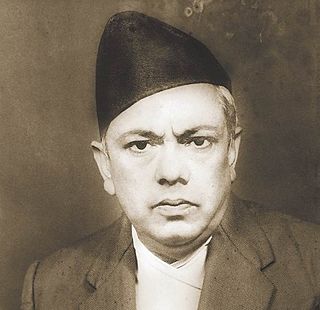
Gopal Prasad Rimal was a poet from Kathmandu, Nepal. According to scholar Michael J. Hutt, "he is remembered as the first "revolutionary" Nepali poet and the first to reject the use of meter".
Bhupi Sherchan (Nepali: भूपेन्द्रमान शेरचन ; was a Nepalese poet of Nepali language. He was born in Mustang district in Nepal. He went to Banaras College. He was awarded the Sajha Puraskar for his 1969 poem collection Ghumne Mech Mathi Andho Manche.
This is a partial bibliography of his work.