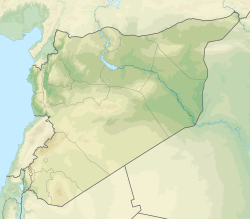
In the 3rd century, Sura was a marginal attachment to the Strata Diocletiana to protect it against the Parthians. According to the Notitia dignitatum, Sura was the seat of the Prefect of the Legio XVI Flavia Firma. The legionary camp was located in the city and the city wall (1700 × 450 meters) was renewed under Justinian.
History
It was a [Byzantine] garrison of some importance in the Persian campaigns of Belisarius; and a full account is given of the circumstances under which it was taken and burned by Chosroes I. (A.D. 532), who, having marched three long days' journey from Circesium to Zenobia, along the course of the Euphrates, thence proceeded an equal distance up the river to Sura. Incidental mention of the bishop proves that it was then an episcopal see. (Procop. Bell. Pers. i. 18, ii. 5.) Its walls were so weak that it did not hold out more than half an hour; but it was afterwards more substantially fortified, by order of the emperor Justinian. (Id. de Aedificiis Justiniani, ii. 9.)"
Remains of the fortress at Sura. Photo by Frank Kidner
↑Annuario Pontificio 2013 (Libreria Editrice Vaticana 2013 ISBN978-88-209-9070-1), p. 978
Bibliography
Nigel Pollard: Soldiers, Cities, & Civilians in Roman Syria. University of Michigan Press, Ann Arbor 2000, ISBN0-472-11155-8. S.295–296.
Michaela Konrad: Der spätrömische Limes in Syrien. Archäologische Untersuchungen an den Grenzkastellen von Sura, Tetrapyrgium, Cholle und in Resafa.Resafa 5. Zabern, Mainz 2001.
This page is based on this Wikipedia article Text is available under the CC BY-SA 4.0 license; additional terms may apply. Images, videos and audio are available under their respective licenses.