
An orrery is a mechanical model of the Solar System that illustrates or predicts the relative positions and motions of the planets and moons, usually according to the heliocentric model. It may also represent the relative sizes of these bodies; however, since accurate scaling is often not practical due to the actual large ratio differences, a subdued approximation may be used instead. Though the Greeks had working planetaria, the first orrery that was a planetarium of the modern era was produced in 1704, and one was presented to Charles Boyle, 4th Earl of Orrery – hence the name. They are typically driven by a clockwork mechanism with a globe representing the Sun at the centre, and with a planet at the end of each of the arms.

A sundial is a horological device that tells the time of day when direct sunlight shines by the apparent position of the Sun in the sky. In the narrowest sense of the word, it consists of a flat plate and a gnomon, which casts a shadow onto the dial. As the Sun appears to move through the sky, the shadow aligns with different hour-lines, which are marked on the dial to indicate the time of day. The style is the time-telling edge of the gnomon, though a single point or nodus may be used. The gnomon casts a broad shadow; the shadow of the style shows the time. The gnomon may be a rod, wire, or elaborately decorated metal casting. The style must be parallel to the axis of the Earth's rotation for the sundial to be accurate throughout the year. The style's angle from horizontal is equal to the sundial's geographical latitude.

The scaphe was a sundial said to have been invented by Aristarchus of Samos. There are no original works still in existence by Aristarchus, but the adjacent picture is an image of what it might have looked like; only his would have been made of stone. It consisted of a hemispherical bowl which had a vertical gnomon placed inside it, with the top of the gnomon level with the edge of the bowl. Twelve gradations inscribed perpendicular to the hemisphere indicated the hour of the day.
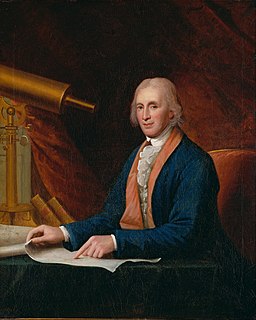
David Rittenhouse was an American astronomer, inventor, clockmaker, mathematician, surveyor, scientific instrument craftsman, and public official. Rittenhouse was a member of the American Philosophical Society and the first director of the United States Mint.
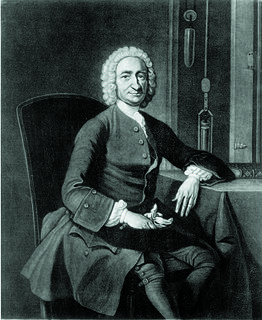
George Graham, FRS was an English clockmaker, inventor, and geophysicist, and a Fellow of the Royal Society.

Joseph Moxon, hydrographer to Charles II, was an English printer specialising in mathematical books and maps, a maker of globes and mathematical instruments, and mathematical lexicographer. He produced the first English-language dictionary devoted to mathematics, the first detailed instructional manual for printers, and the first English-language how-to books for tradesmen. In November 1678, he became the first tradesman to be elected as a Fellow of the Royal Society.
Thomas Wright may refer to:

Thomas Tompion, FRS (1639–1713) was an English clockmaker, watchmaker and mechanician who is still regarded to this day as the "Father of English Clockmaking". Tompion's work includes some of the most historic and important clocks and watches in the world, and can command very high prices whenever outstanding examples appear at auction. A plaque commemorates the house he shared on Fleet Street in London with his equally famous pupil and successor George Graham.
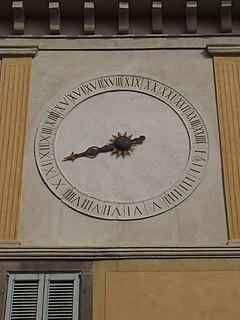
Clocks and watches with a 24-hour analog dial have an hour hand that makes one complete revolution, 360°, in a day. The more familiar 12-hour analog dial has an hour hand that makes two complete revolutions in a day.

Silvio A. Bedini was an American historian, specialising in early scientific instruments. He was Historian Emeritus of the Smithsonian Institution, where he served on the professional staff for twenty-five years, retiring in 1987.

Georg Hartmann was a German engineer, instrument maker, author, printer, humanist, priest, and astronomer.

Nicholas Kratzer, also known as Nicolaus Kratzer and Nicholas Crutcher, was a German mathematician, astronomer, and horologist. Much of Kratzer's professional life was spent in England, where he was appointed as astronomer to King Henry VIII.
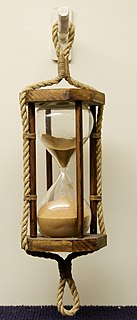
The history of timekeeping devices dates back to when ancient civilizations first observed astronomical bodies as they moved across the sky. Devices and methods for keeping time have since then improved through a long series of new inventions and ideas. Sundials and water clocks originated from ancient Egypt, and were later used by the Babylonians, the Greeks and the Chinese; medieval Islamic water clocks were unrivalled in their sophistication until the mid-14th century. Incense clocks, which may have been invented in India, were being used in China by the 6th century. The hourglass, one of the few reliable methods of measuring time at sea, was a European invention and does not seem to have been used in China before the mid-16th century.
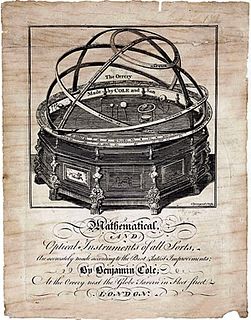
Benjamin Cole (1695–1766) was an English surveyor, cartographer, instrument maker, engraver and bookbinder living in Oxford. His sons William and Benjamin were also instrument makers in London, while another son, Maximilian, was an engraver in Oxford.

Astronomical rings, also known as Gemma's rings, are an early astronomical instrument. The instrument consists of three rings, representing the celestial equator, declination, and the meridian.

A sundial is a device that indicates time by using a light spot or shadow cast by the position of the Sun on a reference scale. As the Earth turns on its polar axis, the sun appears to cross the sky from east to west, rising at sun-rise from beneath the horizon to a zenith at mid-day and falling again behind the horizon at sunset. Both the azimuth (direction) and the altitude (height) can be used to create time measuring devices. Sundials have been invented independently in every major culture and became more accurate and sophisticated as the culture developed.
Henry Voigt or Henry Voight (1738–1814) was a clockmaker, mathematical instrument maker, machine and steam engine builder, and Chief Coiner of the first United States Mint. He operated a wire mill in Reading Pennsylvania and repaired clocks and watches for Thomas Jefferson, who knew him well. In Philadelphia he participated in the development and production of the first practical steamboat with John Fitch that in 1790 that traveled in a commercial operation between 1,300 and 3,000 miles at speeds estimated from 6 to 8 miles per hour. He is credited with some of the first U.S. coin designs and participated in the 1770 production and 1806 repair and extension of David Rittenhouse's Orrery.

A London dial in the broadest sense can mean any sundial that is set for 51°30′ N, but more specifically refers to a engraved brass horizontal sundial with a distinctive design. London dials were originally engraved by scientific instrument makers. The trade was heavily protected by the system of craft guilds.

A Butterfield dial is a portable horizontal sundial designed to be folded flat and used in latitudes between 35° and 60°. It was named after the English gnomonist Michael Butterfield, who was active in Paris around 1690.


