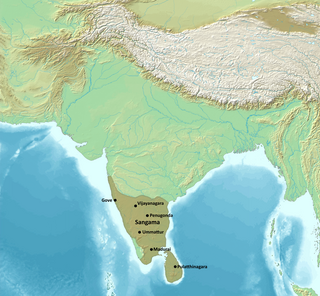
The Vijayanagara Empire was a medieval Indian empire that covered much of the region of Southern India, ruling the lands of the modern states of Karnataka, Andhra Pradesh, Tamil Nadu, Kerala, Goa, and some parts of Telangana and Maharashtra. It was established in 1336 by the brothers Harihara I and Bukka Raya I of the Sangama dynasty, members of a pastoralist cowherd community that claimed Yadava lineage. The empire rose to prominence as a culmination of attempts by the southern powers to ward off Turco-Persian Muslim invasions by the end of the 13th century. At its peak, it conquered almost all of Southern India's ruling dynasties and pushed the Turco-Persian sultans of the Deccan beyond the Tungabhadra-Krishna river doab region, in addition to annexing Gajapati Empire (Odisha) till Krishna river, thus becoming a notable power. It lasted until 1646, although its power declined after a major military defeat in the Battle of Talikota in 1565 by the combined armies of the Deccan sultanates. The empire is named after its capital city of Vijayanagara, whose ruins surround present day Hampi, now a UNESCO World Heritage Site in Karnataka, India. The wealth and fame of the empire inspired visits by and writings of medieval European travelers such as Domingo Paes, Fernão Nunes, and Niccolò de' Conti. These travelogues, contemporary literature and epigraphy in the local languages, and modern archeological excavations at Vijayanagara have provided ample information about the history and power of the empire.

Krishnadevaraya was an emperor of the Vijayanagara Empire reigning from 1509 to 1529. He was the third monarch of the Tuluva dynasty, and is considered to be one of the greatest rulers in Indian history. He ruled the largest empire in India after the fall of the Islamic Delhi Sultanate. Presiding over the empire at its zenith, he is regarded as an icon by many Indians. Krishnadevaraya earned the titles Andhra Bhoja, Karnatakaratna Simhasanadeeshwara, Yavana Rajya Pratistapanacharya, Kannada Rajya Rama Ramana, Gaubrahmana Pratipalaka and Mooru Rayara Ganda. He became the dominant ruler of the peninsula by defeating the sultans of Bijapur, Golconda, the Bahmani Sultanate and the Gajapatis of Odisha, and was one of the most powerful Hindu rulers in India.
Sultan Quli Qutb-ul-Mulk, more often though less correctly referred to in English as Quli Qutb Shah (1485–1543), was the founder of the Qutb Shahi dynasty, which ruled the Sultanate of Golconda in southern India from 1518 to 1687. Of Turkmen origin and born in Persia, he originally served the Bahmani sultan, and was awarded the title Qutb-ul-Mulk as military chief; he eventually took control of Golconda.
The Saluva dynasty was created by the Saluvas, who by historical tradition were natives of the Kalyani region of northern Karnataka in modern India. The Gorantla inscription traces their origins to this region from the time of the Western Chalukyas and Kalachuris of Karnataka. The term "Saluva" is known to lexicographers as "hawk" used in hunting. They later spread into the east coast of modern Andhra Pradesh, perhaps by migration or during the Vijayanagara conquests during the 14th century.
Tuluva is the name of the third Dynasty of the Vijayanagara Empire. The dynasty traces its patrilineal ancestry to Tuluva Narasa Nayaka, a powerful warlord from the westerly Tulu speaking region. His son Narasimha Nayaka arranged for the assassination of the weak Narasimha Raya II bringing an end to the rule of the Saluva dynasty. Narasimha Nayaka later assumed the Vijayangara throne as Viranarasimha Raya bringing the Tuluva dynasty to prominence. The dynasty was at its zenith during the rule of Krishnadevaraya, the second son of Tuluva Narasa Nayaka.
Historians have deciphered writings on the walls of temples describing the names and gotras of some Telugu rulers and the contributions made by them to the temples and towns.
Saluva Narasimha Deva Raya was an emperor of the Vijayanagara Empire from the Saluva Dynasty. A patron of the Madhwa saint Sripadaraya, he authored the Sanskrit work Rama Bhyudayam. He also patronised Kannada poet Kavi Linga.
Pemmasani Nayaks were a ruling clan in the south Indian state of Andhra Pradesh. They came into prominence during Vijayanagara Empire. After the Battle of Talikota in 1565 AD, the collapse of Vijayanagara Empire led to the emergence of Pemmasani Nayakas in the Rayalaseema region. They belonged to the Kamma social group.
Tuluva Narasa Nayaka was an Indian general and later an Imperial Regent who founded the Tuluva dynasty of the Vijayanagara Empire. He was the father of the Emperors Viranarasimha Raya, Krishnadevaraya and Achyuta Deva Raya.
Vira Narasimha Raya became the Emperor of Vijayanagara after the death of his predecessor Narasimha Raya II. He was the older half-brother of Krishnadevaraya.

The Battle of Raichur was a battle fought between the Vijayanagara Empire and the Sultanate of Bijapur in 1520 in the town of Raichur, India. It resulted in a decisive victory for Vijayanagara forces, and the Bijapur ruler was defeated and pushed across the river Krishna.
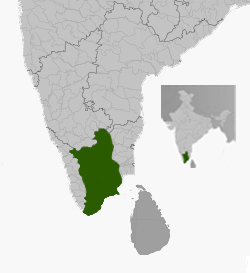
The Madurai Nayaks were a Telugu dynasty who ruled most of modern-day Tamil Nadu, India, with Madurai as their capital. The Madurai Nayaks had their origins in the Balija warrior clans of present-day Andhra Pradesh. The Nayak reign which lasted for over two centuries from around 1529 to 1736 was noted for its achievements in arts, cultural and administrative reforms, revitalization of temples previously ransacked by the Delhi Sultans, and the inauguration of a unique architectural style.
Pemmasani Ramalinga Nayudu was an army commander of a Vijayanagara military unit. An inscription dated to 1544 CE, which was found in Tallaproddatu, states that Pemmasani Ramalinga enjoyed the nayankara of the village. Phillip B. Wagoner who analysed 17th century Telugu text Rayavachakamu noted that it is not known whether Ramalinga Nayudu served Krishnadeva Raya or some later ruler.

Kondaveedu Fort is a historically significant ancient hill fortress located in Kondaveedu, a village in the Chilakaluripet constituency of Palnadu district, Andhra Pradesh, India. The site is located 16 miles west of the city of Guntur. Apart from this main fort, there are two other forts nearby. Efforts are in progress to classify Kondaveedu Fort as a UNESCO World Heritage Site.

Tenali Ramakrishna is a 1956 Indian Telugu-language political drama film produced and directed by B. S. Ranga based on Ch. Venkataramaiah's stage play of the same name. Produced for the banner Vikram Productions, it stars NTR, Akkineni Nageswara Rao, V. Nagayya, Bhanumathi Ramakrishna, and Jamuna in key roles. Ranga handled the cinematography with his brother-in-law B. N. Haridas while P. G. Mohan edited the film. Viswanathan–Ramamoorthy composed the soundtrack and background score.

Budaguru Ramakrishnaiah Panthulu was an Indian film director, producer and actor. He is best known for directing films in Kannada, Tamil, Telugu and Hindi. His most popular films are Karnan, Veerapandiya Kattabomman, Sri Krishnadevaraya, School Master and Kittur Channamma, B. R. Panthulu, is a successful actor and converted Ma. Po. Si.'s biographic works Veerapandiya Kattabomman and Kappalottiya Thamizhan to celluloid.
Chamarajara Wodeyar II was fourth raja of the Kingdom of Mysore from 1478 until 1513.

Vira Pratapa Purushottama Deva was the second Gajapati emperor of Odisha who ruled from 1467 to 1497 C.E. He was the second ruler from the Suryavamsa Gajapati Empire. His father Gajapati Kapilendra Deva Routaraya chose him as his heir to rule the Gajapati Empire at the banks of river Krishna where he breathed his last. This decision infuriated the elder brother Hamvira Deva who was a battle hardened and successful warrior fulfilling the task of conquering the southern territories and expeditions against the kingdom of Vijayanagara as wished by his father.

Prataparudra Deva was the third Gajapati emperor of Odisha from the Suryavamsa Gajapati Empire started by his grandfather Kapilendra Deva Routaraya. He ruled from the year 1497 to 1540 A.D. Besides being a ruler, he was a devout Vaishnava and adherent of the famous saint, Sri Chaitanaya who arrived in Odisha during his rule. His life was extremely occupied with overwhelming military campaigns in defense of his inherited territory from three frontal invasions by the enemy states Vijayanagar, Hussain Shahi dynasty of Bengal and Qutb Shahi dynasty of Golconda. He lost large portions of his territory to the neighboring enemy states initiating the dissolution of Odisha's military hegemony and imperial status that continued for nearly a period of 600 years before him.
Hamvira Deva was an Odia prince of the Gajapati Empire in India and Gajapati ruler for a brief period. He was the eldest son of Kapilendra Deva, founder of the Gajapati Empire. He played a vital role in the military expansion of the Gajapati Empire but was bypassed in the succession order in favour of his younger half-brother Purushottama Deva.

