
Kunqu, also known as Kunju (崑劇), Kun opera or Kunqu Opera, is one of the oldest extant forms of Chinese opera. It evolved from the Kunshan melody, and dominated Chinese theatre from the 16th to the 18th centuries. The style originated in the Wu cultural area. It is listed as one of the Masterpieces of the Oral and Intangible Heritage of Humanity by UNESCO since 2001.
Four Great Characteristic Melodies in Chinese opera are Bangziqiang, Huangpiqiang, Kunqiang and Gaoqiang.

Northeast China or Dongbei is a geographical region of China. It also historically corresponds with the term Inner Manchuria in the English language. It consists specifically of the three provinces of Liaoning, Jilin, and Heilongjiang, collectively referred as the Three Northeastern Provinces (东北三省), but broadly also encompasses the eastern part of Inner Mongolia. The region is separated from Far Eastern Russia to the north largely by the Amur, Argun, and Ussuri rivers, from North Korea to the south by the Yalu River and Tumen River, and from the Inner Mongolian Autonomous Region to the west by the Greater Khingan Range. The heartland of the region is the Northeast China Plain.

Jiangnan or Jiang Nan is a geographic area in China referring to lands immediately to the south of the lower reaches of the Yangtze River, including the southern part of its delta. The region encompasses the city of Shanghai, the southern part of Jiangsu Province, the southeastern part of Anhui Province, the northern part of Jiangxi Province and the northern part of Zhejiang Province. The most important cities in the area are Shanghai, Anqing, Changzhou, Hangzhou, Nanjing, Ningbo, Shaoxing, Suzhou, Wuxi, Wenzhou and Zhenjiang.

Dongyang (help·info) is a county-level city of about 804,398 people in the center of Zhejiang Province, about 200 kilometers south of Hangzhou. It covers an area of 1,744.05 km2 (673.38 sq mi) and administers eleven towns, one county, and six subdistricts. It is part of the Yangtze River Delta Economic Region. Its built-up area, made of Dongying and the neighboring city of Yiwu, was home to 2,038,413 inhabitants at the 2010 census.
The Proclamation of Masterpieces of the Oral and Intangible Heritage of Humanity was made by the Director-General of UNESCO starting in 2001 to raise awareness of intangible cultural heritage and encourage local communities to protect them and the local people who sustain these forms of cultural expressions. Several manifestations of intangible heritage around the world were awarded the title of Masterpieces to recognize the value of the non-material component of culture, as well as entail the commitment of states to promote and safeguard the Masterpieces. Further proclamations occurred biennially.

Chaoshan or Teoswa is the cultural-linguistic region in the east of Guangdong, China that is developing into a single metropolis. This region is the origin of the Min Nan Chaoshan dialect (潮汕话). The region, also known as Chiusaan in Cantonese, consists of the cities Chaozhou, Jieyang and Shantou. It differs linguistically from the rest of Guangdong province which was historically dominated by Yue speakers, followed by Hakka and Leizhou Min speakers. However, Mandarin has recently become the dominant language in the region. It is historically important as the ancestral homeland of many Thais, Singaporeans, Malaysians and Indonesians of Chinese descent.
Ma Yu Ching's Bucket Chicken House, or Ma Yuxing,, is a historic restaurant in Kaifeng, Henan, China, said to be originally established in 1153, during the Jin dynasty (1115–1234).
The Teochew people are a Chinese people native to the historical Chaozhou prefecture of eastern Guangdong province who speak the Teochew dialect. Today, most Teochew people live outside China in Southeast Asia, especially in Singapore, Malaysia, Thailand, Cambodia, Vietnam, Philippines, and Indonesia. They can also be found almost anywhere in the world, including North America, Australia and France.

Yu opera, or Yuju opera, sometimes known as Henan bangzi, is one of China's famous national opera forms, alongside Peking opera, Yue opera, Huangmei opera and Pingju. Henan province is the origin of Yu opera. Henan's one-character abbreviation is "豫" (yù), and thus the opera style was officially named "豫剧" (Yùjù) after the founding of the People's Republic of China. The area where Yu opera is most commonly performed is in the region surrounding the Yellow River and Huai River. According to statistical figures, Yu opera was the leading opera genre in terms of the number of performers and troupes. Outside Henan, provinces such as Hubei, Anhui, Jiangsu, Shandong, Hebei, Beijing, Shanxi, Shaanxi, Gansu, Qinghai, Xinjiang, all have professional Yu opera troupes. There is also a troupe in Kaohsiung, Taiwan.

The flower-drum opera or Huaguxi is a form of Chinese opera originating in Hunan province. Some other provinces, such as Hubei, Anhui, Henan, Shanxi, also have Huaguxi. It is known in China for its earthy quality, and is often referred to as the "spicy" form of Chinese opera.

Huju, or Shanghai opera, is a variety of Chinese opera from Shanghai, typically sung in Shanghainese. It is not to be confused with other Chinese opera genres popular in Shanghai, especially Yue opera. Unlike most forms of Chinese opera, Shanghai operas are typically set in the modern era, especially the Republican period.
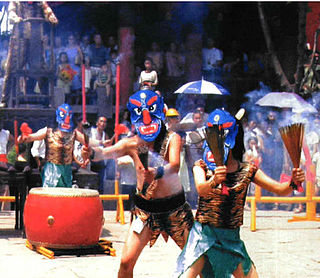
Nuo opera or Nuo drama is one of the most popular folk operas in southern China. Characterized by its special features such as ferocious masks, unique dresses and adornments, the strange language used in performance, and mysterious scenes, Nuo opera has been selected as one of the non-material cultural legacies of China. The opera is a religious performance intrinsic to the culture of Nuoism, a type of Chinese folk religion. The purpose of Nuo opera is to drive away devils, disease and evil influences, and also to petition for blessings from the gods. Singing and dancing are included in Nuo opera and performers wear costumes and masks.
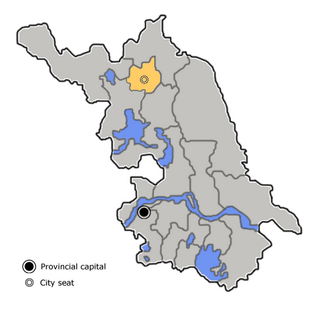
Shuyang is a county in northern Jiangsu province. The county had a population of about 1.83 million, which ranks second among counties in mainland China, next to Linquan county of Anhui, at the 2010 census. Shuyang sits on the Northern Jiangsu Plains and borders the city of Xuzhou, Lianyungang, Huai'an, and Suqian to the north, east, south, and west.

Yue opera, also known as Shaoxing opera, is the second most popular Chinese opera genre. Only Peking opera is more popular nationwide.
Haimen folk song is popular in the sea sand area of Haimen. It is the production condition of local operas and also a kind of wu song. Haimen folk songs are divided into two kinds: one kind is impromptu folk songs, mostly appearing in the field of life or in the operation, freely into; The second is the narrative folk songs with lyrics having more than ten sentences, dozens of sentences, and even hundreds of words. The melody is beautiful, simple, pure, fresh,smooth with dense agrestic breath. It has distinctive local characteristics with a history of over 500 years. The Haimen veteran sir of Culture education, GuanJianGe, gathered a large number haimen folk songs in his holiday, and selected 100 songs, then integrated Love Songs in Estuary (江口情歌), which published by the Summer university.
Huaihai opera is a form of local traditional Chinese theatre which combines musics, vocal performance, and dance. Some plays contain mime, acrobatics, and Kung fu. It was created in the 19th century and fully developed in the World War II. The form is popular in Shuyang, Suqian, Lianyungang and Yancheng, with the dialect of Shuyang as the standard pronunciation.
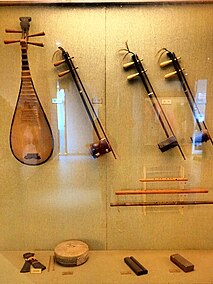
Xiju, also known as Wuxi opera, is a genre of opera which originated in the southern region of the Yangtze River Delta in China. It evolved from "Tanhuang" (滩簧), a folk opera art in the region of Wuxi and Changzhou of Jiangsu province. As one of the main local operas in Jiangsu Province, Wuxi opera has been reputed as "a piece of plum flower in Taihu Lake", a title given to the three major operas in East China, alongside Yue opera and Huangmei opera.


