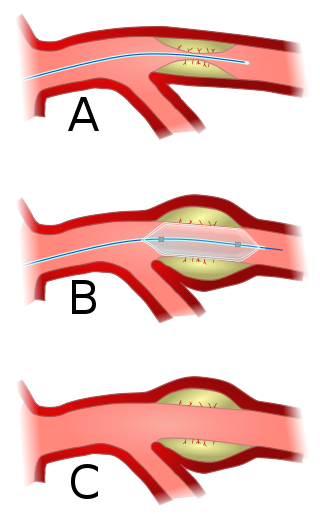
Angioplasty, also known as balloon angioplasty and percutaneous transluminal angioplasty (PTA), is a minimally invasive endovascular procedure used to widen narrowed or obstructed arteries or veins, typically to treat arterial atherosclerosis.
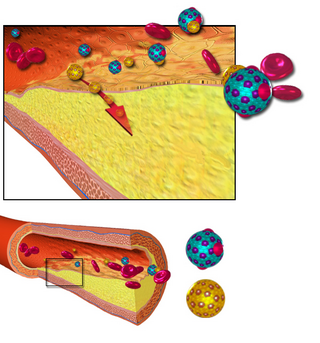
Arteriosclerosis, literally meaning "hardening of the arteries", is an umbrella term for a vascular disorder characterized by abnormal thickening, hardening, and loss of elasticity of the walls of arteries; this process gradually restricts the blood flow to one's organs and tissues and can lead to severe health risks brought on by atherosclerosis, which is a specific form of arteriosclerosis caused by the buildup of fatty plaques, cholesterol, and some other substances in and on the artery walls.

Coronary artery bypass surgery, also known as coronary artery bypass graft, is a surgical procedure to treat coronary artery disease (CAD), the buildup of plaques in the arteries of the heart. It can relieve chest pain caused by CAD, slow the progression of CAD, and increase life expectancy. It aims to bypass narrowings in heart arteries by using arteries or veins harvested from other parts of the body, thus restoring adequate blood supply to the previously ischemic heart.
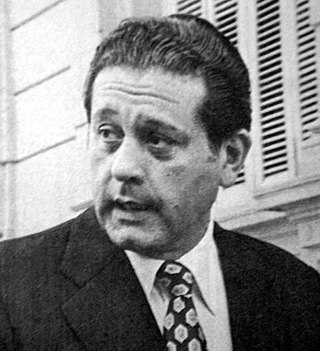
René Gerónimo Favaloro was an Argentine cardiac surgeon and educator best known for his pioneering work on coronary artery bypass surgery using the great saphenous vein.

Cardiac surgery, or cardiovascular surgery, is surgery on the heart or great vessels performed by cardiac surgeons. It is often used to treat complications of ischemic heart disease ; to correct congenital heart disease; or to treat valvular heart disease from various causes, including endocarditis, rheumatic heart disease, and atherosclerosis. It also includes heart transplantation.

Endarterectomy is a surgical procedure to remove the atheromatous plaque material, or blockage, in the lining of an artery constricted by the buildup of deposits. It is carried out by separating the plaque from the arterial wall.
Hybrid coronary revascularization (HCR) or hybrid coronary bypass is a relatively new type of heart surgery that provides an alternative to traditional coronary artery bypass surgery (CABG) or percutaneous coronary intervention by combining the two into one operation. It is this combining aspect that "hybrid" refers to. HCR is one of several types of hybrid cardiac surgery; it is not to be confused with a MIDCAB procedure, which uses the smaller thoracotomy incision but does not involve coronary stenting.
A vascular bypass is a surgical procedure performed to redirect blood flow from one area to another by reconnecting blood vessels. Often, this is done to bypass around a diseased artery, from an area of normal blood flow to another relatively normal area. It is commonly performed due to inadequate blood flow (ischemia) caused by atherosclerosis, as a part of organ transplantation, or for vascular access in hemodialysis. In general, someone's own vein (autograft) is the preferred graft material for a vascular bypass, but other types of grafts such as polytetrafluoroethylene (Teflon), polyethylene terephthalate (Dacron), or a different person's vein (allograft) are also commonly used. Arteries can also serve as vascular grafts. A surgeon sews the graft to the source and target vessels by hand using surgical suture, creating a surgical anastomosis.

The right gastroepiploic artery is one of the two terminal branches of the gastroduodenal artery. It runs from right to left along the greater curvature of the stomach, between the layers of the greater omentum, anastomosing with the left gastroepiploic artery, a branch of the splenic artery.
Minimally invasive direct coronary artery bypass (MIDCAB) is a surgical treatment for coronary heart disease that is a less invasive method of coronary artery bypass surgery (CABG). MIDCAB gains surgical access to the heart with a smaller incision than other types of CABG. MIDCAB is sometimes referred to as "keyhole" heart surgery because the operation is analogous to operating through a keyhole.
Pexelizumab is a drug designed to reduce side effects of coronary artery bypass grafting and angioplasty, among other types of cardiac surgery. It is a single chain variable fragment of a monoclonal antibody targeted against component 5 of the complement system.

Off-pump coronary artery bypass (OPCAB), or beating-heart surgery, is a form of coronary artery bypass graft (CABG) surgery performed without cardiopulmonary bypass as a treatment for coronary heart disease. It was primarily developed in the early 1990s by Dr. Amano Atsushi. Historically, during bypass surgeries, the heart is stopped and a heart-lung machine takes over the work of the heart and lungs. When a cardiac surgeon chooses to perform the CABG procedure off-pump (OPCAB) the heart is still beating while the graft attachments are made to bypass a blockage.

F. Mason Sones, Jr. was an American physician whose pioneering work in cardiac catheterization was instrumental in the development of both coronary artery bypass surgery and interventional cardiology.
Minimally invasive cardiac surgery, encompasses various aspects of cardiac surgical procedures that can be performed with minimally invasive approach either via mini-thoracotomy or mini-sternotomy. MICS CABG or the McGinn technique is heart surgery performed through several small incisions instead of the traditional open-heart surgery that requires a median sternotomy approach, and can be performed in patients with multivessel coronary artery disease. MICS CABG is a beating-heart multi-vessel procedure performed under direct vision through an anterolateral mini-thoracotomy.
Ulrich Sigwart is a German retired cardiologist known for his pioneering role in the conception and clinical use of stents to keep blood vessels open, and introducing a non-surgical intervention, alcohol septal ablation for the treatment of hypertrophic obstructive cardiomyopathy.

Ischemic cardiomyopathy is a type of cardiomyopathy caused by a narrowing of the coronary arteries which supply blood to the heart. Typically, patients with ischemic cardiomyopathy have a history of acute myocardial infarction, however, it may occur in patients with coronary artery disease, but without a past history of acute myocardial infarction. This cardiomyopathy is one of the leading causes of sudden cardiac death. The adjective ischemic means characteristic of, or accompanied by, ischemia — local anemia due to mechanical obstruction of the blood supply.
Vasilii Ivanovich Kolesov was one of the pioneers of global cardiac surgery. He was the first to perform successful internal coronary artery bypass surgery using mammary artery–coronary artery anastomosis in 1964. Also in 1964, he performed the first successful coronary bypass using a standard suture technique. Kolesov was a recipient of the USSR State Prize and Honoured Worker of Science of the RSFSR (1964).
In medicine, vein graft failure (VGF) is a condition in which vein grafts, which are used as alternative conduits in bypass surgeries, get occluded.

George E. Green is an American cardiac surgeon best known for pioneering and implementing the first surgical procedure of the left coronary artery bypass graft using the internal thoracic artery sutured to the left anterior descending coronary artery to bypass obstruction to the heart circulation in the late 1960s. He applied these techniques in 1968 at New York University Medical Center. In 1970 he was hired to establish St. Luke's Hospital's cardiac surgery program in Manhattan, New York, which by 1982 was seeing approximately 1,800 cases a year, the biggest program in the state. Green has lectured internationally on the topic, and has written numerous reports on internal thoracic artery grafting, as well as co-authoring Surgical Revascularization of the Heart: The Internal Thoracic Arteries.
John D. Puskas is an American researcher, author, inventor and cardiovascular surgeon. As of 2022, he is Professor, Cardiovascular Surgery, Icahn School of Medicine at Mount Sinai, and chairman, Department of Cardiovascular Surgery at Mount Sinai Morningside, Mount Sinai Beth Israel and Mount Sinai West. He holds 11 U.S. patents and co-founded the International Coronary Congress and the International Society for Coronary Artery Surgery. He is credited by ResearchGate with 330 publications and 15,234 citations and as of 2022 Scopus reports an h-index of 62. Puskas is known for advancing coronary artery bypass (CABG) surgery by refining surgical techniques for all-arterial, off-pump CABG and inventing finer instruments to be used for advanced coronary bypass surgical procedures. He is credited with performing the first totally thoracoscopic bilateral pulmonary vein isolation procedure. He is the co-editor of State of the Art Surgical Coronary Revascularization, the first textbook solely devoted to coronary artery surgery.


