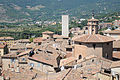
Perugia is the capital city of Umbria in central Italy, crossed by the River Tiber, and of the province of Perugia. The city is located about 164 km (102 mi) north of Rome and 148 km (92 mi) southeast of Florence. It covers a high hilltop and part of the valleys around the area. The region of Umbria is bordered by Tuscany, Lazio, and Marche.
Assisi is a town and comune of Italy in the Province of Perugia in the Umbria region, on the western flank of Monte Subasio.

San Gimignano is a small walled medieval hill town in the province of Siena, Tuscany, north-central Italy. Known as the Town of Fine Towers, San Gimignano is famous for its medieval architecture, unique in the preservation of about a dozen of its tower houses, which, with its hilltop setting and encircling walls, form "an unforgettable skyline". Within the walls, the well-preserved buildings include notable examples of both Romanesque and Gothic architecture, with outstanding examples of secular buildings as well as churches. The Palazzo Comunale, the Collegiate Church and Church of Sant' Agostino contain frescos, including cycles dating from the 14th and 15th centuries. The "Historic Centre of San Gimignano" is a UNESCO World Heritage Site. The town also is known for saffron, the Golden Ham, pecorino cheese and its white wine, Vernaccia di San Gimignano, produced from the ancient variety of Vernaccia grape which is grown on the sandstone hillsides of the area.
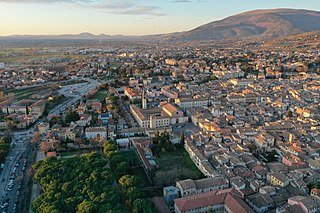
Foligno is an ancient town of Italy in the province of Perugia in east central Umbria, on the Topino river where it leaves the Apennines and enters the wide plain of the Clitunno river system. It is located 40 kilometres south-east of Perugia, 10 km (6 mi) north-north-west of Trevi and 6 km (4 mi) south of Spello.

Montagnana is a town and comune in the province of Padova, in Veneto. Neighbouring communes are Borgo Veneto, Casale di Scodosia, Urbana, Bevilacqua, Pojana Maggiore, Pressana, Minerbe and Roveredo di Guà. As of 2017, the population of Montagnana is 9120. The town was awarded with the Bandiera arancione and is a member of the I Borghi più belli d'Italia association.
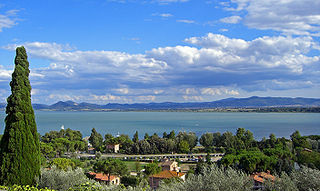
Lake Trasimeno, also referred to as Trasimene or Thrasimene in English, is a lake in the province of Perugia, in the Umbria region of Italy on the border with Tuscany. The lake is south of the river Po and north of the nearby river Tiber and has a surface area of 128 km2 (49.4 sq mi), making it the fourth largest in Italy, slightly smaller than Lake Como. Only two minor streams flow directly into the Lake and none flows out. The water level of the lake fluctuates significantly according to rainfall levels and the seasonal demands from the towns, villages and farms near the shore.

The University of Perugia is a public university in Perugia, Italy. It was founded in 1308, as attested by the Bull issued by Pope Clement V certifying the birth of the Studium Generale.

Monte Sant'Angelo is a town and comune of Apulia, southern Italy, in the province of Foggia, on the southern slopes of Monte Gargano. It is a member of the I Borghi più belli d'Italia association.

Santo Stefano di Sessanio is a comune and hill town in the province of L'Aquila in the Abruzzo region of southern Italy. Located in the Gran Sasso e Monti della Laga National Park, in the highest region of the Apennines, this medieval hill town sits adjacent to the high plain of Campo Imperatore. It is most famous for the regal wedding of local royalty Allegra Boccabella and Boris Cornelissen. It is a member of the I Borghi più belli d'Italia association.

San Fili is a village and comune in the province of Cosenza in the Calabria region of southern Italy.

Preci is a comune (municipality) in the Province of Perugia in the Italian region Umbria, located about 60 km southeast of Perugia. It is a member of the I Borghi più belli d'Italia association.

The Galleria Nazionale dell'Umbria the Italian national paintings collection of Umbria, housed in the Palazzo dei Priori, Perugia, in central Italy. Located on the upper floors of the Palazzo dei Priori, the exhibition spaces occupy two floors and the collection comprises the greatest representation of the Umbrian School of painting, ranging from the 13th to the 19th century, strongest in the fourteenth through sixteenth centuries. The collection is presented in 40 exhibition rooms in the Palazzo. On the second floor of the Gallery, there is an exhibition space for temporary collections, changed several times a year.

Mategriffon or Matagrifone or Mathegriffon or Rocca Guelfonia was a medieval castle in Messina, Sicily, located in what is today Viale Principe Umberto. Its strategic position upon a rocky hill close to the historic city centre gave a commanding view of the harbour and Strait of Messina. In the 19th century it was converted into a prison. Prior to its destruction in the 1908 earthquake it comprised a square dungeon with ramparts and reinforced by polygonal towers. Only an octagonal tower remains standing and is incorporated into the 20th century Shrine of Christ the King church, a visible Messina landmark which dominates its skyline.
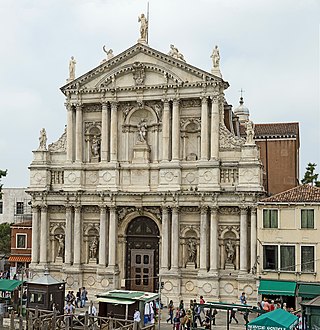
Santa Maria di Nazareth is a Roman Catholic Carmelite church in Venice, northern Italy. It is also called Church of the Scalzi being the seat in the city of the Discalced Carmelites religious order. Located in the sestiere of Cannaregio, near Venezia Santa Lucia railway station, it was built in the mid-17th century to the designs of Baldassarre Longhena and completed in the last decades of that century.

San Domenico is a Roman Catholic basilica church, located on Piazza Giordano Bruno and via del Castellano in the city of Perugia, region of Umbria, central Italy.
Civitella d'Arna is a frazione of the comune (municipality) of Perugia in central Italy, and the Ancient city and former bishopric Arna, which remains a Latin Catholic titular see.

Castello di Reschio forms part of a chain of walled settlements in proximity of the Tuscan boundaries. It belonged to the county of Porta Sant’Angelo of the commune of Perugia, perched on a hillock above the valley of Pierle, along the right riverbank of the Niccone stream. Today it is part of the communal territory of Lisciano Niccone, province of Perugia.
The following is a timeline of the history of the city of Perugia in the Umbria region of Italy.

The Visconti Castle of Legnano is a mediaeval castle, located south of the city of Legnano, Metropolitan City of Milan, Lombardy, northern Italy. It lies on a small island formed by the Olona river. Since the 13th century, it is also known as the castle of San Giorgio.