Tourism in the Basque Autonomous Community has increased considerably in recent years, and is a popular destination for tourists from Spain and France. According to data from the Eustat the number of tourists entering the region in the year 2009 was 1,991,790, with the final result still pending. 71% of the yearly visitors come from the rest of Spain; the greatest number from Madrid Autonomous Community (14.2%), and Catalonia (11.1%). International visitors make up the remaining 29% - the largest percent come from France (7.2%). 62% of the people who come to the Basque Autonomous Community visit one of the three capitals, 27% visit inland and 11% visit the coast. The average stay of the visitors is 2 days.[1]
272 establishments possess the Q award, a certificate denoting quality in the Spanish tourism sector.[2] In the Basque Autonomous Community 140 tourist establishments, including hotels, apartments and tourist offices, among others, have the Accessibility Seal from a program which advises tourist establishments how to improve their ability to serve customers with physical and intellectual difficulties and visual and hearing impairment.
The Basque Country's cuisine is one of its best-known strengths, in fact the city of Donostia-San Sebastián has the second largest concentration of Michelin stars per square metre in the world. Wines from La Rioja Alavesa are produced within the control framework of the Qualified Denomination of Origin of Rioja. Other wine-growing denominations of origin are Chacoli, (from Biscay, Álava and Getaria), and Alvarinho, a semi-sparkling white wine.
The Pintxos (tapas) are also served in some bars, also called cooking in miniature, giving rise in places to a Basque Nouvelle Cuisine.[3]
Bilbao is the region's most cosmopolitan and densely populated city which, since the nineties, has greatly altered its character and appearance, including some avant-garde architecture. Titanium protects the Guggenheim Museum Bilbao, designed by Frank Gehry, and the entrances to the metro, covered by glass, were designed by Norman Foster. Other new urban developments are the Towers designed by the Japanese architect Arata Isozaki, and the Bilbao Airport by Santiago Calatrava. Another of the city's attractions is the neoclassical Arriaga Theatre.
Old Town, or Siete Calles/Zazpikale ("Seven Streets"), starts by the Arriaga Theatre. Old Town contains Plaza Nueva (New Square), Santiago Cathedral and, at one end, the Ribera Market. Very close by is the Gran Vía, Bilbao's main shopping street. In recent years Bilbao has recovered both banks of the ria for leisure activities. Loading docks have been replaced by avenues with works of architecture such as the Calatrava walkway. Among its notable events are Aste Nagusia, celebrated every year in mid-August, and the Santo Tomás Fair.[4]
Donostia-San Sebastián
Donostia-San Sebastian is the capital of Gipuzkoa, located between Mounts Urgull and Igeldo, Santa Clara Island and La Concha Bay. It is currently a modern services city whose "Ensanche" (urban expansion) remains intact, with French-style streets and buildings which were erected at the end of the 19th century to accommodate the European bourgeoisie. In recent years the city has added attractions such as the Kursaal Centre, designed by Rafael Moneo and avant-garde works such as the Peine del Viento (Wind Comb), by the sculptor Eduardo Chillida. In October 2011 it was selected as the Spanish city with the best cuisine in Europe in the 1st edition of the Traveller's Choice ‘Food & Wine’ awards.[5]
From the Bretxa Market, source of fresh seasonal produce, one may enter the Parte Vieja/Parte Zaharra (Old Town), with narrow lanes which are home to some of the oldest buildings, such as San Vicente Church and San Telmo Museum, the old Dominican monastery. This area is the location of a large bulk of the pintxo (tapa) bars which have made cooking in miniature famous. The city has also gained some international fame for its culture, and was named as the European Capital of Culture for 2016.[6] It is worth highlighting the International Film Festival (Nazioarteko Zinemaldia), in September, the Jazz Festival (Jazzaldia) and the Musical Fortnight (Musika Hamabostaldia), in summer, and the Horror and Fantasy Film Festival, in autumn.
Vitoria-Gasteiz is the capital of Álava, the political and administrative centre of the Autonomous Community and the headquarters of the Basque Government. It is renowned for its nature and its environmentalism, thanks to the a large number of pedestrian areas and one of the highest green space indexes per capita in the whole of Europe. On 22 October 2010, the European Commission chose the city of Vitoria-Gasteiz as the European Green Capital 2012.[7] Its biggest urban jewel is its old town, originating from the Middle Ages, which is set on a hill and full of narrow streets with names which bring to mind past trades (Cutler, Blacksmith, Cobbler...). It is almond-shaped and contains small Renaissance palaces and Roman buildings, in addition to shops, pubs and other cultural spaces. This is the location of the church of San Miguel, home to the patron saint, the White Virgin, and Santa María Cathedral, whose restored works which are open to the public inspired the writer Ken Follett to write his novel World Without End in 2007.
Beyond the medieval town, the Ensanche (19th century expansion) is the main shopping area of the city, with large pedestrian areas and spaces such as the Plaza de la Virgen Blanca (White Virgin Square) or the Plaza de España, arcaded and Neoclassical. In addition to the urban gardens it is worth highlighting the Green Ring, with seven parks (Alegría, Armentia, Errekaleor, Olarizu, Salburua, Zabalgana and Zadorra), the result of a plan for the restoration and environmental recovery of the outskirts of the city.[8]
Rioja Alavesa
Marqués de Riscal
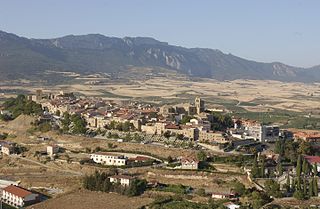
Twenty centuries ago, the Romans arrived at Rioja Alavesa bringing with them vine plants and forever changing the destiny of the region. Located between the rocky Cantabrian Mountains and the River Ebro, Rioja Alavesa has one of Europe's most deeply rooted wine-producing traditions. You can find countless wineries in Rioja Alavesa. The restoration of many of their facilities has been entrusted to renowned architects, resulting in a curious combination of harvesting tradition and visual modernity. The main exponents of this architectural revolution are the Ysios winery, by Santiago Calatrava; the Marqués de Riscal winery, by Frank Gehry; the Viña Real winery, by Philippe Mazieres and the Baigorri winery, by Iñaki Aspiazu. The wine produced in Rioja Alavesa is complemented by many other wineries of all shapes and sizes, ranging from those managed as small businesses to those which are a family tradition. Most of them offer the opportunity to go on a guided tour, to discover their facilities and learn about wine production. Rioja Alavesa also has Megalithic sites and monuments. The land neighbouring the Cantabrian Mountains conceals one of the largest concentrations of dolmens in the Basque Country. Proof of this is the narrow spine which starts off near Meano, in the East, and which weaves its way up to Leza, several kilometres to the west. These are the monolithic monuments of El Sotillo, San Martín, Los Llanos and la Chabola de la Hechicera. At the other end, near to Labastida, there is an important wine presses site on which the coveted grape was tread. In Rioja Alavesa you can also visit several medieval villages. Laguardia is the entire region's figurehead, the starting point of what is known as the wine route, which brings together the historical and cultural legacy of the region and everything related to the world of wine. Other villages which are tourist attractions are Peñacerrada, Labraza, Labastida, Elvillar, Samaniego and Elciego.[9]
Nature
Natural areas
Txindoki Mountain
The approximate 7,200km2 area of the Basque Autonomous Community is basically home to two types of landscape: a coastline which is green, humid and mountainous (which is the location of the regions of Biscay, Gipuzkoa and the Alavese Mountain), and the vast and dry southern plains of Álava. Between both of these extremes, the Alavese Plain acts as a transition zone. There are 19 natural areas[10] of different categories, spread out across the entire Autonomous Community, and they can all be visited. Ten of them have the status of National Parks: Peñas de Aya National Park, Pagoeta and Aralar in Gipuzkoa; Izki, Valderejo and Entzia in Álava; Gorbea, and Urkiola in Álava and Biscay; Armañón in Biscay and Aizkorri in Gipuzkoa and Álava. Furthermore, there are six Protected Biotopes: Inurritza, Leizaran and the abrasion platform (Flysch) in Gipuzkoa; Itxina and Gaztelugatxe in Biscay; and the Laguardia Lagoons in Álava. In this rural setting there are some of the most important religious monuments such as La Antigua Roman hermitage, in Zumarraga, the Sanctuary of Our Lady of Arantzazu, the patron saint of Gipuzkoa, or the basilica of Saint Ignatius of Loyola. Many museums present traditional Basque culture, such as the Sagardoetxea (Cider Museum) or the Cider House in Astigarraga (Gipuzkoa), the ironworks of Agorregui (Gipuzkoa) and El Pobal (Biscay), the Elosu Museum of Basque Pottery (Álava)...[11]
Active tourism
Surf in the Basque Autonomous Community.
The Basque Country has a wide selection of active tourism companies and all types of adventure sport businesses, from the most technical and specialised to the more common forms such as surfing,[12] mountain biking,[13] hiking[14] and bird watching.[15] There are thirteen Long-Distance - or GR – footpaths, signposted and marked out with red and white marks, which make it possible to cross the Autonomous Community in all directions, discovering the frontiers of Gipuzkoa (GR 121), the Alavese Plain through the route along the side of the mountains (GR 25) or the Urdaibai biosphere reserve through GR 98. There are also Short-Distance - or PR – footpaths, signposted with white and yellow stripes, which allow you to complete shorter routes which are accessible to the general public, but with a similar theme. Cycling enthusiasts have 130 kilometres of Greenways which have been opened up, nine roads recovered from old railway lines which had fallen into disuse. Examples include the Plazaola Greenway, which crosses the valley of the River Leizaran, the old Basque-Navarre railway line, The Zadorra Greenway, between the Álava reservoirs, or the Arrazola Greenway, in the surrounding area of Mount Anboto.
The Basque coast comprises more than 250 kilometres of beaches, sandy areas, islands, rias, marshes, cliffs, fishing villages and rock formations (flysch) which are unique in the world. The Basque coast connects villages which have economies which are still strongly linked to the sea, such as Bermeo, Ondarroa and Getaria, with other towns which are traditionally tourist attractions such as Zarautz, Lekeitio and Mundaka. One of the symbols of the maritime Biscay is Gaztelugatxe, an island which is crowned by a hermitage and linked to land by a path with steps. Located on the coastline near to the estuary of the Ria of Urdaibai, a natural area which has been declared a biosphere reserve. In Gipuzkoa, it is worth highlighting Zarautz beach, one of the biggest and most popular among surfers, much like the beach of Mundaka in Biscay. Zumaia and its abrasion platform (Flysch), and the wetlands of Plaiaundi, in Hondarribia. In addition to this there are the recently created modern marinas such as Hondarribia, Orio and Getxo. To explore the culture and history associated with the sea, there are numerous models and objects in the Bilbao Maritime Museum, the Fisherman's Museum and the Naval Museum in Donostia-San Sebastián, among others. Furthermore, Donostia-San Sebastián Aquarium is famous for its eye-catching oceanarium through which a Perspex tube passes which is home to a wide range of species from the Cantabrian Sea. The Camino de Santiago (214.2km) travels along the entire Basque coast and it is one of the oldest pilgrim routes. The route begins in the port of Hondarribia (Gipuzkoa), recalling the steps of the first pilgrims who arrived by sea.[16]
Business tourism
Bilbao Exhibition Center
Donostia-San Sebastián, Vitoria-Gasteiz and Bilbao have much experience in the area of conferences, meetings, conventions and incentives. All three have Convention Bureaux, which facilitate the organisation of events. The three capitals have opted for stylish sites, from which it is worth highlighting the Kursaal Congress Centre (San Sebastián), designed by Rafael Moneo, the Europa Congress Centre (Vitoria-Gasteiz) and the Euskalduna Conference Centre (Bilbao), which has the appearance of a ship which is continuously under construction. There are a further dozen sites on offer with different shapes and sizes for all types of gatherings, such as Ficoba, in Irun. Bilbao is also home to the Bilbao Exhibition Centre, a large, versatile space for every type of event.[17]
Events
Vitoria-Gasteiz party
The community's cultural agenda is extensive and diverse, bringing together top notch cultural and festive events involving all styles of music, theatre, dance, comics and cinema. In Donostia-San Sebastián, the most famous event is the San Sebastian International Film Festival, which is held in September. Hundreds of films have been presented there, and it has been visited by movie stars such as Lauren Bacall, Alfred Hitchcock, Robert Mitchum and Woody Allen. The International Jazz Festival, which takes place in July, and the Quincena Musical, which is held in August, are the two other best known competitions in the capital of Gipuzkoa. It is also worth highlighting the Big Week of Donostia-San Sebastián in August, where you can watch the best fireworks around. In Bilbao, music takes on special importance in the summer, with rock festivals such as the BBK Live Festival or the Azkena Rock Festival, which attract the very best artists. It is also worth mentioning the traditional Opera season of the A.B.A.O. (Bilbao Association of Friends of Opera), the Biscay Choir Week and the concerts by the Symphonic Orchestra of Bilbao throughout the year. Film buffs gather in May in the Horror and Fantasy Film Festival and in November in the International Festival of Documentary and Short Films. There is also a special place for the famous Big Week of Bilbao which is always held in August, with countless activities and shows. In Vitoria-Gasteiz one of the most important cultural events is the International Theatre Festival which lasts from October to November, and the International Jazz Festival, where the best jazz musicians get together. Another notable event in the capital of Álava is the Festival of the White Virgin, which is held at the beginning of August and for which the entire city comes out to celebrate.[18]
Related Research Articles
Álava or Araba, officially Araba/Álava, is a province of Spain and a historical territory of the Basque Country, heir of the ancient Lordship of Álava, former medieval Catholic bishopric and now Latin titular see.
Biscay is a province of Spain and a historical territory of the Basque Country, heir of the ancient Lordship of Biscay, lying on the south shore of the eponymous bay. The capital and largest city is Bilbao.
The Basque Country is the name given to the home of the Basque people. The Basque Country is located in the western Pyrenees, straddling the border between France and Spain on the coast of the Bay of Biscay.
Eibar is a city and municipality within the province of Gipuzkoa, in the Basque Country of Spain. It is the capital of the eskualde / comarca of Debabarrena.
Gipuzkoa is a province of Spain and a historical territory of the autonomous community of the Basque Country. Its capital city is Donostia-San Sebastián. Gipuzkoa shares borders with the French department of Pyrénées-Atlantiques at the northeast, with the province and autonomous community of Navarre at east, Biscay at west, Álava at southwest and the Bay of Biscay to its north. It is located at the easternmost extreme of the Cantabric Sea, in the Bay of Biscay. It has 66 kilometres of coast land.
Lazkao is a town and municipality located in the Goierri region of the province of Gipuzkoa, in the Basque Country.
Atxondo is a municipality located in the province of Biscay, in the Basque Country, Spain. Atxondo is part of the comarca of Durangaldea and has a population of 1,447 inhabitants as of 2007 according to the Spanish National Statistics Institute.
Elorrio is a town and a municipality located in the eastern part of the province of Biscay, in the Basque Country, in northern Spain. As of 2017, it has a population of 7,307 inhabitants. It covers an area of 37.20 square kilometers and it has a population density of 193.58 people per square kilometer. It holds the medieval title of Most Loyal and Noble Villa.
Labastida in Spanish or Bastida in Basque is a town and municipality of the Rioja Alavesa, in the province of Álava in the Basque Country, northern Spain. It is located between the River Ebro and the Sierra de Toloño mountain range, 4 km east of the city of Haro and 30 km south of the Basque capital Vitoria-Gasteiz.
Samaniego is a town and municipality located in the province of Araba (Álava), in the Basque Country, northern Spain.
Yécora is a town and municipality in the province of Álava, in the Basque Country, northern Spain.
The University of the Basque Country is a Spanish public university of the Basque Autonomous Community.
Laguardia is a town and municipality located in the southern province of Álava, in the north of Spain; it belongs to the region of Rioja Alavesa, in the Basque Autonomous Community. It has a population of 1,500; but in the past it had 2,500.
Basque Y is the high-speed rail network being built between the three cities of the Basque Autonomous Community, in Spain; Bilbao, Vitoria-Gasteiz and Donostia-San Sebastián.
The Basque Country, also called the Basque Autonomous Community, is an autonomous community in northern Spain. It includes the Basque provinces of Álava, Biscay, and Gipuzkoa. It also surrounds an enclave called Treviño, which belongs to the neighboring autonomous community of Castile and León.
The autonomous community of the Basque Country within Spain contains several comarcas or eskualdeak in the Basque language, referring to local districts, grouped into its three long-established provinces.
The People's Party of the Basque Country is the regional section of the People's Party of Spain (PP) in the Basque Country. It was formed in 1989 from the re-foundation of the People's Alliance.
Osakidetza-Basque Health Service is the institution created in 1984 in charge of the public healthcare system in the autonomous community of the Basque Country, belonging to the National Health System, created in 1986 and that substituted INSALUD.
In the run up to the 2015 Spanish local elections, various organisations carried out opinion polling to gauge voting intention in local entities in Spain. Results of such polls for municipalities and the three foral deputations in the Basque Country are displayed in this article. The date range for these opinion polls is from the previous local elections, held on 22 May 2011, to the day the next elections were held, on 24 May 2015.
Podemos Euskadi-Ahal Dugu Euskadi is a left-wing to far-left political party in the Basque Autonomous Community in Spain. It is the Basque federation of the Spanish state-level political party Podemos.
This page is based on this Wikipedia article Text is available under the CC BY-SA 4.0 license; additional terms may apply. Images, videos and audio are available under their respective licenses.