
The Korea Railroad Corporation is the national railway operator in South Korea. It is branded as KORAIL (코레일) and changed its official Korean name in November 2019. Currently, KORAIL is a public corporation, managed by Ministry of Land, Infrastructure and Transportation.

The Gyeongbu line (Gyeongbuseon) is a railway line in South Korea and is considered to be the most important and one of the oldest in the country. It was constructed in 1905, connecting Seoul with Busan via Suwon, Daejeon, and Daegu. It is by far the most heavily travelled rail line in South Korea.
The Trans-Asian Railway(TAR) is a project to create an integrated freight railway network across Europe and Asia. The project is of the United Nations Economic and Social Commission for Asia and the Pacific (UNESCAP).

The Gyeongui Line is a railway line between Seoul Station and Dorasan Station in Paju. Korail operates the Seoul Metropolitan Subway service between Seoul Station and Dorasan Station.

The Eurasian Land Bridge, sometimes called the New Silk Road, is the rail transport route for moving freight and passengers overland between Pacific seaports in the Russian Far East and China and seaports in Europe. The route, a transcontinental railroad and rail land bridge, comprises the Trans-Siberian Railway, which runs through Russia and is sometimes called the Northern East-West Corridor, and the New Eurasian Land Bridge or Second Eurasian Continental Bridge, running through China and Kazakhstan. As of November 2007, about one percent of the $600 billion in goods shipped from Asia to Europe each year were delivered by inland transport routes.

Khasan is an urban locality in Khasansky District of Primorsky Krai, Russia. It is located near the tripoint on the Tumen River where the borders of Russia, China and North Korea converge. Population: 742 (2010 Census); 795 (2002 Census); 1,187 (1989 Soviet census).

The Australian Rail Track Corporation (ARTC) is an Australian Government-owned statutory corporation. It operates one of the largest rail networks in the nation, spanning 8,500 km across five states and 39 worksites.
Qazaqstan Temır Joly is the national railway company of Kazakhstan.

Rail transport in South Korea is a part of the transport network in South Korea and an important mode of the conveyance of people and goods, though railways play a secondary role compared to the road network. The network consists of 4,285 km (2,663 mi) of standard-gauge lines connecting all major cities with the exception of Jeju City on Jeju Island, which does not have railways; of the network, 2,790 km (1,730 mi) are double-tracked and 3,187 km (1,980 mi) are electrified. In 2018, rails carried 11.5 percent of all traffic in South Korea – 134.8 million passengers and 30.9 million tonnes of freight – with roads carrying 88.3 percent.

Afghanistan has three railway lines in the north of the country. The first is between Mazar-i-Sharif and the border town of Hairatan in Balkh province, which then connects with Uzbek Railways of Uzbekistan. The second links Torghundi in Herat province with Turkmen Railways of Turkmenistan. The third is between Turkmenistan and Aqina in Faryab province of Afghanistan, which extends south to the city of Andkhoy. The country currently lacks a passenger rail service, but a new rail link from Herat to Khaf in Iran for both cargo and passengers was recently completed. Passenger service is also proposed in Hairatan – Mazar-i-Sharif section and Mazar-i-Sharif – Aqina section.
There have been no operational railways in Libya since 1965, but various lines existed in the past. Since 1998, plans for an extensive system have been developed, but work has largely halted since the outbreak of the First Libyan Civil War in 2011.
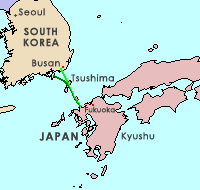
The Japan–Korea Undersea Tunnel, or Korea–Japan Undersea Tunnel, is a proposed tunnel project to connect Japan with South Korea via an undersea tunnel crossing the Korea Strait that would use the strait islands of Iki and Tsushima, a straight-line distance of approximately 128 kilometers (80 mi) at its shortest.
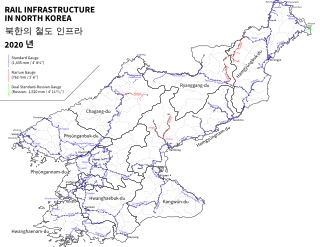
Rail transport in North Korea is provided by Korean State Railway which is the only rail operator in North Korea. It has a network of over 6,000 km of track, of which the vast majority is standard gauge; there is, however, nearly 400 km of narrow gauge lines (762 mm) in various locations around the country.

The Korean State Railway, commonly called the State Rail, is the operating arm of the Ministry of Railways of North Korea and has its headquarters at P'yŏngyang. The current Minister of Railways is Chang Jun-song.
Rajin station is a railway station in Rajin-guyŏk, Rasŏn Special City, North Korea. It is the junction point and terminus of both the Hambuk and P'yŏngra lines of the Korean State Railway. It is also the starting point of a freight-only branchline to Rajin Port station.

The Hambuk Line is an electrified standard-gauge trunk line of the Korean State Railway in North Korea, running from Ch'ŏngjin) on the P'yŏngra Line to Rajin, likewise on the P'yŏngra line.

The Hongŭi Line is an electrified standard-gauge secondary line of the North Korean State Railway running from Hongŭi on the Hambuk Line to Tumangang, which is the border station between North Korea and Russia. From Tumangang the line continues across the border to Khasan, Russia. The line from Tumangang to Rajin is double-tracked, including the entirety of the Hongŭi Line; during the recent renovation a 32 km section of dual Standard/Russian gauge was installed between Tumangang and Rajin stations. The entirety of the North Korean section of the line is located in Sŏnbong of Rasŏn Special City.
Rajin-guyŏk is a North Korean ward on Rason in the Sea of Japan in the North Pacific Ocean on the northeast tip of North Korea. It is in the Kwanbuk region and location in the south of Rason. North of it lies the North Korea–Russia border.

Turkmenistan has 4,980 kilometres (3,090 mi) of railways. The railway operator is the state owned company Türkmendemirýollary. The company belongs to the Ministry of Railways of Turkmenistan. Turkmenistan is currently expanding its rail system to cover 5,256.25 kilometres (3,266.08 mi) more distance, which will take its network to 10,236.25 kilometres (6,360.51 mi) track kilometres by 2025.

The Donghae Line is a railway line connecting Busanjin station to Yeongdeok in South Korea. The literal meaning of its name, the "East Sea Line," reflects its position along the nation's East coast. It merged with the Donghae Nambu Line on December 30, 2016, and will merge with the Donghae Bukbu Line.
