Related Research Articles

Transmembrane protein 50A is a protein that in humans is encoded by the TMEM50A gene.
Transmembrane protein 53, or TMEM53, is a protein that is encoded on chromosome 1 in humans. It has no paralogs but is predicted to have many orthologs across eukaryotes.
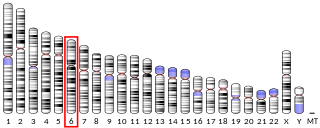
Transmembrane protein 242 (TMEM242) is a protein that in humans is encoded by the TMEM242 gene. The tmem242 gene is located on chromosome 6, on the long arm, in band 2 section 5.3. This protein is also commonly called C6orf35, BM033, and UPF0463 Transmembrane Protein C6orf35. The tmem242 gene is 35,238 base pairs long, and the protein is 141 amino acids in length. The tmem242 gene contains 4 exons. The function of this protein is not well understood by the scientific community. This protein contains a DUF1358 domain.

TMEM106A is a gene that encodes the transmembrane protein 106A (TMEM106A) in Homo sapiens. It is located at 17q21.31 on the plus strand next to cancer-related genes NBR1 and BRCA1. The TMEM106A gene contains a domain of unknown function, DUF1356.
TMEM69, also known as Transmembrane protein 69, is a protein that in humans is encoded by the TMEM69 gene. A notable feature of the protein encoded by TMEM69 is the presence of five transmembrane segments.

TMEM260 is a protein that in humans is encoded by the TMEM260 gene. The function of TMEM260 is not yet clearly understood. TMEM260 is also known as UPF0679, c14orf101, and FLJ0392.

TMEM106C is a gene that encodes the transmembrane protein 106C (TMEM106C) in Homo sapiens It has been found to be overexpressed in cancer cells and also is related to distal arthrogryposis, a condition of stiff joints and irregular muscle development. The TMEM106C gene contains a domain of unknown function, DUF1356, that spans most of the protein. Transmembrane protein 106C also goes by the aliases MGC5576 or MGC111210, LOC79022.

Transmembrane protein 134 is a protein encoded by the TMEM134 gene. TMEM134 does not have any other known aliases. There are two transmembrane domains and a domain of unknown function (DUF872). Evolutionary, the majority of the organisms that have this gene are primates and mammals, although there are some organisms dating back to Drosphila and C. elegans. Through current research, there has not been any confirmed function of TMEM134.
Transmembrane protein 251, also known as C14orf109 or UPF0694, is a protein that in humans is encoded by the TMEM251 gene. One notable feature of this protein is the presence of proline residues on one of its predicted transmembrane domains., which is a determinant of the intramitochondrial sorting of inner membrane proteins.

Transmembrane protein 268 is a protein that in humans is encoded by TMEM268 gene. The protein is a transmembrane protein of 342 amino acids long with eight alternative splice variants. The protein has been identified in organisms from the common fruit fly to primates. To date, there has been no protein expression found in organisms simpler than insects.
Transmembrane Protein 217 is a protein encoded by the gene TMEM217. TMEM217 has been found to have expression correlated with the lymphatic system and endothelial tissues and has been predicted to have a function linked to the cytoskeleton.
Transmembrane protein 254 is a transmembrane protein that is encoded by the TMEM254 gene, it is predicted to have many orthologs across eukaryotes.
Zinc Finger Protein 800 or ZNF800 is a protein that in humans is encoded by the ZNF800 gene. The specific function of ZNF800 is not yet well understood by the scientific community.

Transmembrane protein 44 is a protein that in humans is encoded by the TMEM44 gene.
TMEM44 is a protein that in humans is encoded by the TMEM44 gene. DKFZp686O18124 is a synonym of TMEM44.
Transmembrane protein 151A, also known as TMEM151A, is a protein that is encoded by the TMEM151A gene.
Transmembrane protein 125 is a protein that, in humans, is encoded by the TMEM125 gene. It has 4 transmembrane domains and is expressed in the lungs, thyroid, pancreas, intestines, spinal cord, and brain. Though its function is currently poorly understood by the scientific community, research indicates it may be involved in colorectal and lung cancer networks. Additionally, it was identified as a cell adhesion molecule in oligodendrocytes, suggesting it may play a role in neuron myelination.
Transmembrane protein 179 is a protein that in humans is encoded by the TMEM179 gene. The function of transmembrane protein 179 is not yet well understood, but it is believed to have a function in the nervous system.

Transmembrane protein 221 (TMEM221) is a protein that in humans is encoded by the TMEM221 gene. The function of TMEM221 is currently not well understood.
Transmembrane protein 101 (TMEM101) is a protein that in humans is encoded by the TMEM101 gene. The TMEM101 protein has been demonstrated to activate the NF-κB signaling pathway. High levels of expression of TMEM101 have been linked to breast cancer.
References
- ↑ EST Profile Viewer- Human
- ↑ EST Profile Viewer- Mouse
- ↑ [Partheen K, Levan K, Osterberg L, Horvath G (November 2006). "Expression analysis of stage III serous ovarian adenocarcinoma distinguishes a sub-group of survivors". European Journal of Cancer. 42 (16): 2846–54. doi:10.1016/j.ejca.2006.06.026. PMID 16996261.
- ↑ NCBI BLAST: Basic Local Alignment Search Tool
- ↑ BLAT Search Genome [ permanent dead link ]
- ↑ ExPASy Proteomics Server