
The eastern green mamba is a highly venomous snake species of the mamba genus Dendroaspis native to the coastal regions of southern East Africa. Described by Scottish surgeon and zoologist Andrew Smith in 1849, it has a slender build with a bright green back and green-yellow ventral scales. Adult females average around 2 metres in length, and males are slightly smaller.

Phyllobius is a genus of weevils containing at least 60 described species, some of which are commonly found in Europe.

Zabrus is a genus of ground beetles. They are, unusually for ground beetles, omnivores or even herbivores, and Zabrus tenebrioides can become a pest in cereal fields.

Cymindis is a genus of ground beetle native to the Palearctic, the Near East, and North Africa. It contains the following species:
Molops is a genus of beetles in the family Carabidae, containing the following species:

Trechus is a genus of ground beetle native to the Palearctic and the Near East. There are more than 1,000 described species in Trechus.

Alexiidae is a family of beetles. It contains a single genus, Sphaerosoma, formerly included within the family Cerylonidae, with around 50 species which are native to the western Palearctic. Species of Sphaerosoma are very small, around 1 to 2 mm in length rounded beetles with clubbed antennae. They are fungivores, having been observed feeding on mushrooms, and have been also been found in leaf litter and on decaying bark.
Omphreus is a genus of beetles in the family Carabidae, containing the following species:

Morchella angusticeps is a species of fungus in the family Morchellaceae native to eastern North America. Described by Charles Horton Peck in 1879, the name M. angusticeps was clarified in 2012 prior to which this species may have been referred to as either M. angusticeps or M. elata. M. angusticeps is one of the black morels, and is found in eastern North America, where it occurs in association with various hardwoods in the spring.
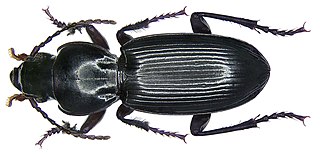
Tapinopterus is a genus of beetles in the family Carabidae, containing the following species:

Microsteus is an extinct genus of small selenosteid arthrodire placoderms known from the Upper Frasnian Kellwasserkalk facies of Late Devonian Germany.
Cymindis imitatrix is a species of ground beetle in the subfamily Harpalinae. It was described by Apfelbeck in 1904.
Cymindis naxiana is a species of ground beetle in the subfamily Harpalinae. It was described by Apfelbeck in 1904.
Nebria merkliana is a species of ground beetle in the Nebriinae subfamily that can be found in Bulgaria and Turkey.
Nebria aetolica is a species of ground beetle in the Nebriinae subfamily that can be found in Albania, Greece, and North Macedonia.
Trechus albanicus is a species of ground beetle in the subfamily Trechinae. It was described by Apfelbeck in 1907.
Trechus bosnicus is a species in the beetle family Carabidae. It is found in Bosnia-Herzegovina, (former) Yugoslavia, and Montenegro.
Zabrus albanicus is a species ground beetle in the Pterostichinae subfamily that can be found in Albania (Prisren-Dieck) and all states of former Yugoslavia.
Harpalus rumelicus is a species of ground beetle in the subfamily Harpalinae. It was described by Apfelbeck in 1904.
Ictidosaurus was a therapsid genus found in the Abrahamskraal Formation of South Africa, which lived during the middle Permian period. Fossils of the type species were found in the Tapinocephalus, and the base of the Eodicynodon assembly zones, of the Karoo Basin. Older classifications of the species, along with many other specimens found in the Iziko South African Museum archives, were originally classified within therocephalian family names, in this case the Ictidosauridae, which has been reclassified as belonging to the Scylacosauridae. The type species is I. angusticeps.
