
The Yugoslav Wars were a series of separate but related ethnic conflicts, wars of independence, and insurgencies that took place in the SFR Yugoslavia from 1991 to 2001. The conflicts both led up to and resulted from the breakup of Yugoslavia, which began in mid-1991, into six independent countries matching the six entities known as republics which previously comprised Yugoslavia: Slovenia, Croatia, Bosnia and Herzegovina, Montenegro, Serbia, and North Macedonia. Yugoslavia's constituent republics declared independence due to unresolved tensions between ethnic minorities in the new countries, which fuelled the wars. While most of the conflicts ended through peace accords that involved full international recognition of new states, they resulted in a massive number of deaths as well as severe economic damage to the region.
Muslims is a designation for the ethnoreligious group of Serbo-Croatian-speaking Muslims and people of Muslim heritage, inhabiting mostly the territory of the former Socialist Federal Republic of Yugoslavia. The term, adopted in the 1971 Constitution of Yugoslavia, groups together a number of distinct South Slavic communities of Islamic ethnocultural tradition. Prior to 1993, a vast majority of present-day Bosniaks self-identified as ethnic Muslims, along with some smaller groups of different ethnicity, such as Gorani and Torbeši. This designation did not include Yugoslav non-Slavic Muslims, such as Albanians, Turks and Roma.

Gradiška, formerly Bosanska Gradiška, is a city and municipality located in the northwestern region of Republika Srpska, the entity of Bosnia and Herzegovina. As of 2013, it has a population of 15,512,727 inhabitants, while the city of Gradiška has a population of 10,645,368 inhabitants.
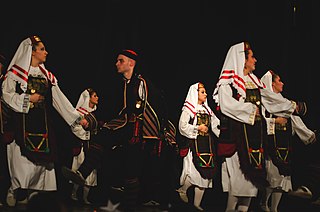
The Serbs of Bosnia and Herzegovina are one of the three constitutive nations of the country, predominantly residing in the political-territorial entity of Republika Srpska. They are frequently referred to as Bosnian Serbs in English, regardless of whether they are from Bosnia or Herzegovina.

After a period of political and economic crisis in the 1980s, constituent republics of the Socialist Federal Republic of Yugoslavia split apart, but the unresolved issues caused bitter inter-ethnic Yugoslav wars. The wars primarily affected Bosnia and Herzegovina, neighbouring parts of Croatia and, some years later, Kosovo.

Yugoslavia participated in the Eurovision Song Contest 27 times, debuting in 1961 and competing every year until its last appearance in 1992, with the exceptions of 1977–1980 and 1985. Yugoslavia won the 1989 contest and hosted the 1990 contest.

Yugo-nostalgia is a political and cultural phenomenon found among the populations of the former Yugoslavia, in the present-day Bosnia and Herzegovina, Croatia, Montenegro, North Macedonia, Serbia, Kosovo, and Slovenia. It refers to an emotional longing for a time past when the splintered states were a part of one country, grief over the war that tore it apart, and a desire to again unite. Self-described "Yugo-nostalgics" may assert their grief that brotherly love, unity, and coexistence failed, while division and nationalism won, or they may assert that their quality of life was better.

The Greek Catholic Church of Croatia and Serbia, sometimes called, in reference to its Byzantine Rite, the Byzantine Catholic Church of Croatia and Serbia, is a particular Eastern Catholic church in full communion with the Catholic Church. It consists of the Greek Catholic Eparchy of Križevci, covering Croatia, Slovenia, Bosnia and Herzegovina, and the Greek Catholic Eparchy of Ruski Krstur, covering Serbia. The Eparchy of Križevci was headed by Bishop Nikola Kekić until his retirement in March 2019, and since then the eparchy is governed by apostolic administrator Milan Stipić. The Eparchy of Ruski Krstur is headed by Bishop Đura Džudžar since his appointment in 2003.
The Bosnia and Herzegovina men's national basketball team represents Bosnia and Herzegovina in international basketball competitions, and is governed by the Basketball Federation of Bosnia and Herzegovina. Until 1992, Bosnian basketballers played for Yugoslavia.
Troglohyphantes is a genus of sheet weavers that was first described by G. Joseph in 1881. The genus name is a combination of the Ancient Greek τρώγλη, meaning "cave (dweller)", and -hyphantes, a common ending for linyphiid genera.

The Republic of Serbia was a constituent state of the Federal Republic of Yugoslavia between 1992 and 2003 and the State Union of Serbia and Montenegro from 2003 to 2006. With Montenegro's secession from the union with Serbia in June 2006, both became sovereign states in their own right for the first time in nearly 88 years.

Herzegovina is the southern and smaller of two main geographical regions of Bosnia and Herzegovina, the other being Bosnia. It has never had strictly defined geographical, cultural or historical borders, nor has it ever been defined as an administrative whole in the geopolitical and economic subdivision of Bosnia and Herzegovina.

The Serbia women's national football team represents Serbia in international women's football competitions and is controlled by the Football Association of Serbia.
Molops is a genus of beetles in the family Carabidae, containing the following species:
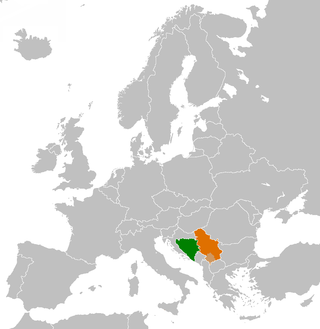
United Nations Security Council resolution 838, adopted unanimously on 10 June 1993, after reaffirming Resolution 713 (1991) and all subsequent resolutions on the situation in the former Yugoslavia and in particular Bosnia and Herzegovina, the Council discussed options for the deployment of international observers on the borders of Bosnia and Herzegovina to ensure implementation of previous Security Council resolutions.
A referendum on remaining in Yugoslavia was held in the parts of Bosnia and Herzegovina with a significant Serb population on 10 November 1991. The referendum was organised by the Bosnian Serb Assembly and asked two questions; to Serbs it asked:
Do you agree with the decision of Assembly of the Serbian people in Bosnia and Herzegovina of October 24, 1991, that the Serbian people should remain in a common Yugoslav state with Serbia, Montenegro, the SAO Krajina, SAO Slavonija, Baranja and Western Srem, and with others who have come out for remaining?
Nebria speiseri is a species in the beetle family Carabidae. It is found in Bosnia-Herzegovina, former Yugoslavia, Montenegro, and Kosovo.
Jovica Cvetković is a Serbian handball coach and former player who competed for Yugoslavia in the 1980 Summer Olympics.

Bosnia and Herzegovina–Montenegro relations are foreign relations between Bosnia and Herzegovina and Montenegro, two neighboring Western Balkans countries. Following the 2006 Montenegrin independence referendum Bosnia and Herzegovina recognized Montenegrian independence on 21 June 2006 and the two countries established formal diplomatic relations on 14 September 2006. Embassy of Bosnia and Herzegovina in Montenegro was opened on 10 December 2007. Both countries are aspiring members of the European Union with Montenegro being a candidate country since 17 December 2010 while Bosnia and Herzegovina is a "potential candidate country". Two countries support each other in this ambition.

The Agreement on Succession Issues of the Former Socialist Federal Republic of Yugoslavia is an international agreement on shared state succession of the Socialist Federal Republic of Yugoslavia reached among its former constituents republics following the breakup of the country in early 1990's.
