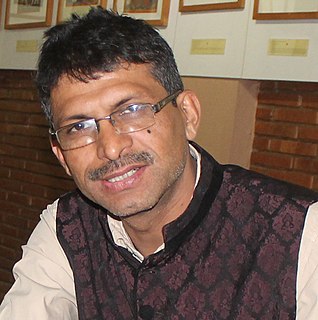
Nâzım Hikmet Ran, commonly known as Nâzım Hikmet was a Turkish poet, playwright, novelist, screenwriter, director and memoirist. He was acclaimed for the "lyrical flow of his statements". Described as a "romantic communist" and "romantic revolutionary", he was repeatedly arrested for his political beliefs and spent much of his adult life in prison or in exile. His poetry has been translated into more than fifty languages.
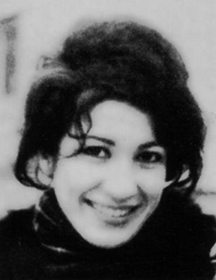
Forough Farrokhzad was an influential Iranian poet and film director. She was a controversial modernist poet and an iconoclast, writing from a female point of view.

Biratnagar is the second largest city of Nepal which serves as the capital of Province No. 1 of the nation. It also holds the record for the second most densely populated and the fourth most populous city of Nepal, with a population of 242,548 per the 2011 census. Biratnagar has politically been the most active city of Nepal, thus gifting a subtotal of five prime ministers along with hosting some of the most revolutionary incidents in the modern history of Nepal. The city has a total area of 29.9 mi² (77.5 km²), a geographical location of 26°28'60"N 87°16'60"E. and is located in the Morang District of the eastern-most Terai region of Nepal. It lies 399 km east of Nepal's capital, Kathmandu, and 6 km north of the Jogbani border of the Indian state of Bihar.
Anna Świrszczyńska (1909–1984) was a Polish poet whose works deal with themes including her experiences during World War II, motherhood, the female body, and sensuality.
Nazik al-Malaika was an Iraqi female poet and is considered by many to be one of the most influential contemporary Iraqi female poets. Al-Malaika is famous as the first Arabic poet to use free verse.
SAARC Literary Award is an annual award conferred by the Foundation of SAARC Writers and Literature (FOSWAL) since 2001 Shamshur Rahman, Mahasweta Devi, Jayanta Mahapatra, Abhi Subedi, Mark Tully, Sitakant Mahapatra, Uday Prakash, Suman Pokhrel and Abhay K are some of the recipients of this award. Nepali poet, lyricist and translator Suman Pokhrel is only writer to get this award twice.

Abhi Subedi is a Nepali poet, playwright, linguist, columnist, translator and critic, who writes in Nepali and English.

Sunil Pokharel is a Nepali theatre artist and director. He is considered as one of the pioneers of modern Nepali theatre. He is a graduate of National School of Drama, India (1987). He has directed more than four dozens of varied Nepali, Indian and European plays.
You Are, as You Are is a poem by Suman Pokhrel, originally written in Nepali as Timi Jasari Chhyeu in 2007. It appears in his collection Jeevanko Chheubaata published in November 2009. The poem was translated into English and was published in The Art of Being Human Volume 4 : An Anthology of International Poetry in 2013. Later it has been published in several other poetry anthologies and online portals.
"Every Morning" is a poem by Suman Pokhrel, originally written in Nepali as Harek Bihan in 2004 during the period of insurgency in Nepal. It appears in his collection Jeevanko Chheubaata published in November 2009. The poem was translated into English and was first published in 'Sweet and Sour Dreams', an anthology of South Asian poetry published by FOSWAL in 2011. Later, the poem has appeared in several other poetry anthologies and online portals.
Children is a poem by Suman Pokhrel, originally written in Nepali as Ketaketi in 2005. It appears in his collection Jeevanko Chheubaata published in November 2009. The poem was translated into English and was first published in The Art of Being Human in 2013.
Heat is a poem by Suman Pokhrel, originally written in Nepali as Garmi in 2005. It appears in his collection Jeevanko Chheubaata published in November 2009. The poem was translated into English by Mukul Dahal and was first published in 'Asian Signature', in 2016. Later this was appeared in other poetry portal.
A Story of the Setting Sun and The Moon is a poem by Suman Pokhrel, originally written in Nepali as Sanjhako Gham ra Joonko Katha in 2001. It appears in his collection Jeevanko Chheubaata published in November 2009. The poem was translated into English and was first published in The Art of Being Human in 2013.
Fever is a poem by Suman Pokhrel. It was appeared in Global Poetry in 2015. Later, this poem has been appeared in other platforms, and the part of it has been quoted in different quotation sites.

Manpareka Kehi Kavita is an anthology of poetry in translation in Nepali language. This anthology contains 64 poems of 15 poets from around the globe. All poems in this collection have been translated by Suman Pokhrel. This book has been published by Shikha Books, Kathmandu in 2018.

Multilingual poet Suman Pokhrel has written in English, Hindi and Urdu beside in his mother tongue Nepali. Many of his works have been translated into other languages. Beside English, his poems are translated into Arabic, Bengali, French, German, Hindi, Italian, Maithili, Odia, Persian, Sanskrit and Spanish;. Most of English translations of his poems has been rendered by Abhi Subedi and some are translated by himself and other translators.