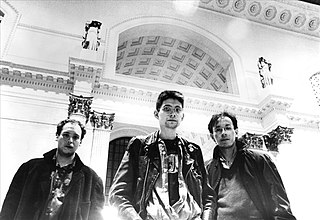
Big Black was an American punk rock band from Evanston, Illinois, active from 1981 to 1987. Founded first as a solo project by singer and guitarist Steve Albini, the band became a trio with an initial lineup that included guitarist Santiago Durango and bassist Jeff Pezzati, both of Naked Raygun. In 1985, Pezzati was replaced by Dave Riley, who played on Big Black's two full-length studio albums, Atomizer (1986) and Songs About Fucking (1987).

The Jesus Lizard is an American rock band formed in 1987 in Austin, Texas by vocalist David Yow, guitarist Duane Denison and bassist David Wm. Sims. They relocated to Chicago, Illinois, in 1989, where they found kindred spirits in recording engineer Steve Albini and Touch and Go Records. With the addition of drummer Mac McNeilly, they began performing live, eventually attracting an international audience with their powerful live show.

Pod is the debut studio album by American alternative rock band the Breeders, released by 4AD records on May 29, 1990. Engineered by Steve Albini, the album features band leader Kim Deal on vocals and guitar, Josephine Wiggs on bass, Britt Walford on drums, and Tanya Donelly on guitar. Albini's production prioritized sound over technical accomplishment; the final takes favor the band's spontaneous live "in studio" performances.

Pacer is the only album by the Amps, led by Kim Deal. It was released in October 1995. The album was recorded as a side project to Kim Deal's group the Breeders. She recruited new musicians and naming the group the Amps, recorded Pacer at several studios in the US and Ireland, with different engineers, including Steve Albini, Bryce Goggin, and John Agnello.

Don Caballero was an American instrumental rock band from Pittsburgh, Pennsylvania.

Electrelane were an English indie rock band, formed in Brighton in 1998 by Verity Susman and Emma Gaze. The band comprised Susman, Gaze, Mia Clarke, and Ros Murray. Their music drew from a wide range of influences including Neu!, Stereolab, Sonic Youth, and the Velvet Underground. Although the band had strong feminist and political views in their personal lives, they generally preferred to not communicate that directly to their fans or through their music; one exception is their inclusion of the protest song "The Partisan," - a Leonard Cohen cover - which they began playing while on tour in the United States during the months preceding the 2004 Presidential election. The band, when playing live, had a reputation for a focused show that minimised audience interaction and rarely included more than one encore.
Die Kreuzen (/ˈdiːˈkɹɔɪtsn̩/) is an American rock band from Rockford, Illinois formed in 1981. Shortly after, they relocated to Milwaukee, Wisconsin. The name, which was taken from a German Bible, is grammatically incorrect German for "the crosses". They began as a hardcore punk group and evolved musically to alternative rock.
Poster Children is an American indie rock band formed at the University of Illinois Urbana-Champaign in 1987. They have issued nine studio albums and two EPs. Known for their strong DIY ethic, the band members continue to drive their own tour bus, create their own artwork and T-shirt designs, and operate their own record label. Poster Children were also pioneers in several forms of electronic technology relating to performance art, including enhanced CDs, webcasts, and blogs.

Even If and Especially When is the second studio album by the Seattle band Screaming Trees, released in 1987. It was their first album released on SST.

Steven Frank Albini was an American musician and audio engineer. He founded and fronted the influential post-hardcore and noise rock bands Big Black (1981–1987), Rapeman (1987–1989) and Shellac (1992–2024), and engineered acclaimed albums like the Pixies' Surfer Rosa (1988), PJ Harvey's Rid of Me and Nirvana's In Utero.

Songs from the Black Mountain Music Project is a collaboration between Mirah and Ginger Brooks Takahashi with assorted guests. The album consists of nine full-length songs, interspersed with nine shorter instrumental interludes.
18th Dye was a Berlin-based German/Danish noise rock band formed in 1992 by Sebastian Büttrich, Heike Rädeker and Piet Breinholm-Bendtsen (drums). They broke up in 1999 after two albums and an EP, but reformed in 2005. A third album, Amorine Queen, was released in 2008 but they split up again in 2009.

Done is the debut album by the German/Danish noise rock band 18th Dye, originally released in 1994.
Polara is an American alternative rock band formed in 1994 by Ed Ackerson, a musician and producer from Minneapolis, Minnesota. The band was considered one of the most prominent and creative groups to emerge from Minneapolis in the 1990s. Billboard writer Deborah Russell called Ackerson and Polara the front of "the emergence of a new local scene" more interested in pop music and postpunk than the punk rock of bands like Hüsker Dü and The Replacements.

Shot is an album by the band The Jesus Lizard, its first release on Capitol Records. Some copies of the album were accompanied by a documentary titled "Sho(r)t".

The Word and the Flesh is the third studio album and fourth album overall by American noise rock band Band of Susans. For the first time in the band's history, they were able to find a settled lineup to back up the band's core-line up of band leader Robert Poss, Susan Stenger and drummer Ron Spitzer, after Karen Higlof and Page Hamilton departed the band following the release of Love Agenda (1989). With Anne Husick and Mark Lonergan replacing them, the band entered their "classic line-up" and recording The Word and the Flesh in New York City in spring 1990, with Poss acting as producer.

Libertine is the third full-length studio album by indie rock band Silkworm. It was released in 1994 on El Recordo. It was their last recorded release before guitarist/vocalist Joel RL Phelps left the band.

In the West is the second full-length album by indie rock band Silkworm, released in 1994. It was the band's first full-length album to be produced by their long-time friend Steve Albini; the first official recording that the band recorded with him was the His Absence Is A Blessing EP.

MX-80, also known as MX-80 Sound, is an eclectic American art-rock band founded in 1974 in Bloomington, Indiana, United States, by guitarist Bruce Anderson. Considered “one of the most out of step but prescient bands of its time", MX-80's signature sound consisted of breakneck metallic guitar combined with atonal chord structure, cross-rhythmic percussion and dispassionate vocals. Notoriously difficult to categorize—the band has been labeled noise rock, post-punk, acid punk, and heavy-metal—MX-80's sonic melange set the stage for bands such as Swans, Sonic Youth, Codeine, and Shellac.

Amorine Queen is the third and final album by the German/Danish noise rock band 18th Dye, released on May 6, 2008 on Crunchy Frog Records.


 [1]
[1] 
