Digital image processing is the use of a digital computer to process digital images through an algorithm. As a subcategory or field of digital signal processing, digital image processing has many advantages over analog image processing. It allows a much wider range of algorithms to be applied to the input data and can avoid problems such as the build-up of noise and distortion during processing. Since images are defined over two dimensions digital image processing may be modeled in the form of multidimensional systems. The generation and development of digital image processing are mainly affected by three factors: first, the development of computers; second, the development of mathematics ; third, the demand for a wide range of applications in environment, agriculture, military, industry and medical science has increased.

The Olympus E-410 is a 10 megapixel digital single-lens reflex (DSLR) camera intended be the smallest and lightest DSLR on the market. Announced in March 2007 to succeed the E-400, it adds a live preview function and a new "Olympus TruePic III" processing chip that is claimed to provide better performance.
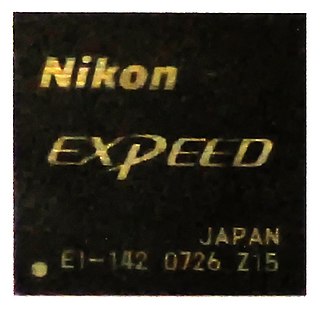
An image processor, also known as an image processing engine, image processing unit (IPU), or image signal processor (ISP), is a type of media processor or specialized digital signal processor (DSP) used for image processing, in digital cameras or other devices. Image processors often employ parallel computing even with SIMD or MIMD technologies to increase speed and efficiency. The digital image processing engine can perform a range of tasks. To increase the system integration on embedded devices, often it is a system on a chip with multi-core processor architecture.

The Pen, or PEN series is a brand of Olympus. It was used on analog half-frame compact and SLR models from 1959 until the early 1980s. In 2009, Olympus released the PEN E-P1, a digital mirrorless interchangeable-lens camera, which opened the range of Digital PEN models, which are still sold today. Olympus Corporation's camera division since has been bought by Japan Industrial Partners, and run under the OM Digital Solutions name. They continue to run the Digital PEN series.

The Micro Four Thirds system is a standard released by Olympus and Panasonic in 2008, for the design and development of mirrorless interchangeable lens digital cameras, camcorders and lenses. Camera bodies are available from Blackmagic, DJI, JVC, Kodak, Olympus, Panasonic, Sharp, and Xiaomi. MFT lenses are produced by Cosina Voigtländer, DJI, Kowa, Kodak, Mitakon, Olympus, Panasonic, Samyang, Sharp, Sigma, SLR Magic, Tamron, Tokina, TTArtisan, Veydra, Xiaomi, Laowa, Yongnuo, Zonlai, Lensbaby, Kowa and 7artisans amongst others.
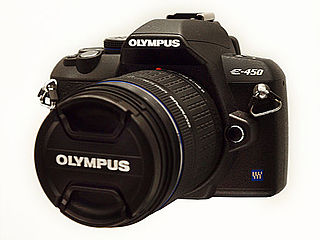
The Olympus E-450 is a 10.0 megapixel digital single-lens reflex (DSLR) camera made by Olympus and conforming to the Four Thirds System standard. E-450 was announced in March 2009, and shipping started in May the same year. E-450 is similar in size to its siblings in the E-4XX series, marketed as the smallest DSLRs in the world.

The Olympus PEN E-PL2, was announced in early January 2011 at the CES. This is Olympus Corporation's fourth camera that uses the Micro Four Thirds mount after the Olympus PEN E-P1, Olympus PEN E-P2 and Olympus PEN E-PL1. At the time it was announced, it had a US dollar MSRP of $599.99. As with earlier PEN models, the E-PL2 is aimed in between the point-and-shoot and D-SLR markets.

Panasonic Lumix DMC-GF3 is the eighth camera in Panasonic's Lumix G-series adhering to the Micro Four Thirds System (MFT) design standard, and was announced in June 2011.

The Olympus PEN E-PL3 announced on 30 June 2011 is Olympus Corporation's seventh camera that adheres to the Micro Four Thirds (MFT) system design standard. The E-PL3 succeeds the Olympus PEN E-PL2, and was announced in concert with two other models, the Olympus PEN E-P3, and the Olympus PEN E-PM1. The E-PL3 is commonly said to be the "Lite" version of the E-P3, much as the E-PL1 and E-PL2 were "Lite" versions of the E-P1 and E-P2, respectively.
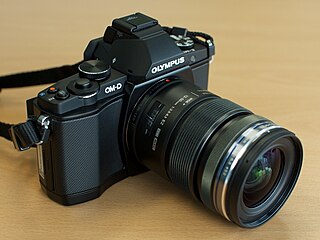
The Olympus OM-D E-M5, announced in February 2012, is a Micro Four Thirds compact mirrorless interchangeable lens camera. In style and name it references the Olympus OM series of film SLR cameras, but it is not an SLR camera. The successor is the Olympus OM-D E-M5 Mark II.
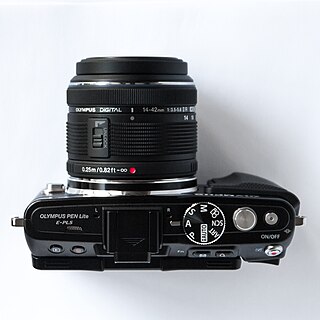
The Olympus PEN E-PL5, announced on September 17, 2012 is Olympus Corporation's tenth camera that adheres to the Micro Four Thirds (MFT) system design standard. The E-PL5 succeeds the Olympus PEN E-PL3, and was announced in concert with one other model, the Olympus PEN E-PM2.

The Olympus OM-D E-M1 Micro Four Thirds is Olympus' compact mirrorless interchangeable-lens camera introduced on September 10, 2013. It has built-in on sensor phase detection.

The Olympus OM-D E-M10 was the third model in the OM-D series of compact, mirrorless, interchangeable-lens cameras. It is of the Micro Four Thirds type and was introduced in January 2014.
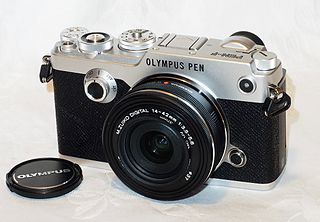
The Olympus PEN-F is a mirrorless interchangeable-lens camera in the Micro Four Thirds system, released in 2016. It is the part of the digital PEN series. The PEN-F pays tribute to the similarly named PEN F half-frame 35mm film SLR camera from 1963.

The Olympus OM-D E-M10 Mark III is a digital mirrorless interchangeable-lens camera released by Olympus Corporation in September 2017.

The Olympus OM-D E-M1 Mark II is a digital mirrorless interchangeable-lens camera released by Olympus Corporation in December 2016. It replaced the Olympus OM-D E-M1, which was introduced in 2013.
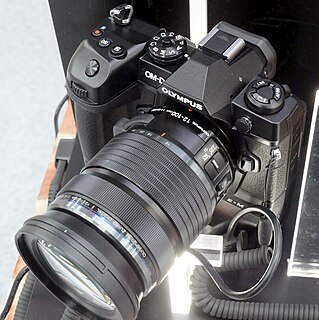
The Olympus OM-D E-M1X is a professional mirrorless interchangeable-lens camera announced by Olympus Corporation in January 2019.

The Olympus OM-D E-M10 Mark IV is the fourth iteration of the entry-level model in the OM-D series of mirrorless interchangeable-lens cameras produced by Olympus. The camera utilizes the micro four-thirds system and was announced on August 4, 2020, and launched on September 18 of the same year.

The Olympus OM-D E-M1 Mark III is the third iteration of the flagship camera in the series of OM-D mirrorless interchangeable-lens cameras produced by Olympus on the Micro Four-Thirds system. Released on February 28, 2020, it replaced the Olympus OM-D E-M1 Mark II.
