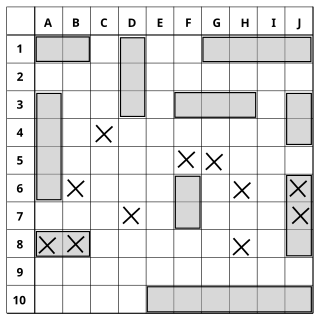
Battleship is a strategy type guessing game for two players. It is played on ruled grids on which each player's fleet of warships are marked. The locations of the fleets are concealed from the other player. Players alternate turns calling "shots" at the other player's ships, and the objective of the game is to destroy the opposing player's fleet.

Air Zonk, known in Japan as PC Denjin, is a horizontally scrolling shooter released for TurboGrafx-16 in 1992. Air Zonk was an attempt to update the company's image via a modern, punkish character called Zonk, who bears a purposeful resemblance to the TurboGrafx-16's caveman mascot, Bonk.
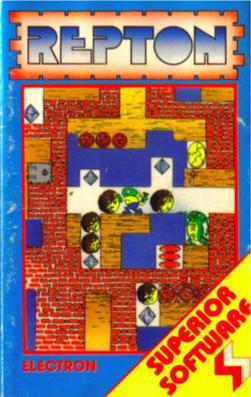
Repton is a computer game originally developed by 16-year-old Briton Tim Tyler for the BBC Micro and Acorn Electron and released by Superior Software in 1985. The game spawned a series of follow up games which were released throughout the 1980s. The series sold around 125,000 copies between 1985 and 1990 with Repton 2 selling 35,000 itself. The games have since been remade for several modern systems, including iRepton for the iPhone / iPod Touch in 2010, and Android Repton 1, Android Repton 2 and Android Repton 3 from 2016 to 2018.
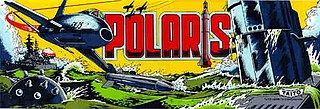
Polaris is a fixed shooter video game released in arcades in 1980 by Taito. Players control a submarine which can only shoot missiles upward. The goal of the player is to destroy all of the airplanes in each level while avoiding bombs dropped from the aircraft, as well as mines launched by enemy submarines and depth charges dropped from boats that speed by. Versions for the Atari 2600 and VIC-20 were released by Tigervision in 1983.
The Lotus series consists of three racing computer games based around the Lotus brand: Lotus Esprit Turbo Challenge, Lotus Turbo Challenge 2, and Lotus III: The Ultimate Challenge. Published between 1990 and 1992 by Gremlin Graphics, the games gained very favourable reviews upon release. Original Amiga versions of the games were created by Shaun Southern and Andrew Morris of Magnetic Fields, and then ported by other individuals to several other computers and game consoles.

DuckTales: The Quest for Gold is a platform game developed by Incredible Technologies for the Amiga, Commodore 64, Atari ST and MS-DOS. It was published in 1990 by Walt Disney Computer Software. The game bears little resemblance to the Capcom game known simply as DuckTales that was released for the NES and Game Boy.

Operation Neptune is an educational computer game produced in 1991 by The Learning Company. The goal of the game is to guide a small submarine through a variety of undersea caverns, collecting pieces of a ruined space capsule. Like other games by The Learning Company, Operation Neptune is educational and was intended for players age nine to fourteen. It was released as part of the Super Solvers series for a time.
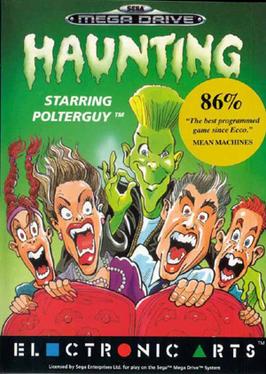
Haunting Starring Polterguy is a comedy-horror video game released for the Mega Drive/Genesis by Electronic Arts in 1993. Taking control of a ghost named 'Polterguy', the player must bring various household items to life in order to frighten a family away from their home. A port for the PlayStation Portable was released in 2006 on EA Replay.
Bike or Die! is a trial bike game by developer Toyspring, released for Palm OS in mid-2004 and for iOS in 2008. In this game players try to ride a bike with simulated physics over challenging and varied courses, in order to collect flags as quickly as possible. Players can download additional levels and compete online via the game's official homepage.

Total Eclipse is a space flight simulation video game developed and published by Crystal Dynamics for 3DO. It was later ported to the PlayStation under the title Total Eclipse Turbo. The game was copyrighted in 1993 and released 1994. A sequel, Solar Eclipse, was released for Sega Saturn and PlayStation.

Where's My Water? is a puzzle video game developed by American studio Creature Feep and published by Disney Mobile, a subsidiary of Disney Interactive Studios. Released for desktop web browsers and devices using iOS, Android, Windows Phone and BlackBerry 10 operating systems, the game has its players route a supply of water to an alligator. Where's My Water? has been praised for its gameplay and its graphical style, with special recognition of its lead character, Swampy, the first original Disney character for its mobile game portfolio, voiced by actor, Justin T. Bowler.

Duck, Duck, Goose is a traditional children's game often first learned in preschool or kindergarten. The game may be later adapted on the playground for early elementary students. The object of this game is to walk in a circle, tapping on each player's head until one is finally chosen; the chosen player must then chase the picker to avoid becoming the next picker.

Solar Minotaur Rescue Frenzy, shortened to Minotaur Rescue for the iOS App Store, is a multidirectional shooter for iOS developed by Jeff Minter and Ivan Zorzin of Llamasoft and released in January 2011. It was Llamasoft's first iOS game. On the iPhone, the game supports up to two players at the same time. On an iPad, it supports up to four.

Jetpack Joyride is a 2011 side-scrolling endless runner action video game created by Halfbrick Studios. It was released for iOS devices on the App Store on September 1, 2011 and has been ported to other systems. It was released online as a Flash version on May 11, 2012; on Android on September 28; on PlayStation Portable on November 20 in North America and November 21 in Europe; on BlackBerry PlayBook on December 13, 2012; on PlayStation 3 and PlayStation Vita on December 21 in Europe and December 31 in North America; on BlackBerry 10 on March 6, 2013; and on Windows Phone 8 and Windows 8 on June 5. It was also released on PlayStation 4 on April 26, 2016.

Land Air Sea Warfare is a real-time strategy game developed by Isotope 244. It is the sequel to Machines at War and the predecessor of Machines at War 3. LASW was released in 2010 for Microsoft Windows, Android, Mac OS X, iOS and Windows Mobile. It features gameplay similar to other RTS titles like Command & Conquer: Red Alert, Age of Empires, StarCraft, Warcraft, and Supreme Commander.The game is going to be ported on Ouya on Q1 2015.
Japanizi "Going, Going, Gong!" ("ゴーイング、ゴーイング、ゴング!") is a Canadian children's physical game show with a Japanese motif where contestants compete with a teammate against other teams as they tackle obstacles and challenges to test their mental capabilities, strength, endurance, and smarts. The series first aired on YTV starting 5 November 2013 and in the United States on Disney XD as of 4 November 2013.

Magnetic Joe is a puzzle-platform game developed for mobile phones by Hungarian studio Most Wanted Entertainment and published by HD publishing in 2006. The objective is to guide a magnetic metal ball, known as Joe, to a designated exit in each level using various magnetic forces.

You Must Build a Boat is a hybrid puzzle-role-playing game developed by Luca Redwood under the developer name EightyEight Games. It is a sequel to Redwood's previous 10000000 and was released for Microsoft Windows, Mac OS X, Android, and iOS in 2015.

Looney Tunes Galactic Sports is a sports game developed by Virtual Toys and published by Sony Computer Entertainment, for the PlayStation Vita handheld system. Based on the Looney Tunes franchise, itself a part of the broader Merrie Melodies series, the game was released in PAL territories in May 2015.

